


-
By:
Mirjeta Sadiku

- February 2, 2023 00:50 AM
- Share to:
"Absolution - Dialogue in the Dark" by Driton Hajredini is the winning work of the 14th edition of the "Muslim Mulliqi 2023" prize exhibition. It is a trilogy of videos, which has its origin in 2004, when the artist confesses to the priest, about his dilemmas if it is a sin "to be born in Kosovo". It captures the issue of isolation in universal language
"Absolution - Dialogue in the Dark" by Driton Hajredini is the winning work of the fourteenth edition of the international exhibition, the "Muslim Mulliqi 2023" award. The work, which elaborates on the questions of Kosovo's isolation and with it also the speculations of an isolated individual or artist, was declared the winner among the twenty-seven competing works.
Everything starts with the footage, from the frequent movements that resemble amateur recordings, of a man entering the church. Although the protagonist of the video, whose face is never shown but who is assumed to be the author himself, belongs to the Muslim faith, he goes to church in Germany to confess. "Am I sinning that I was born in Kosovo?", is the question in German addressed to the priest, whose explanation is that one does not choose where one is born and it is not better to live in Germany or America. The event develops further through the dialogue, priest-confessor. In fact, the genesis of the work is the year 2004, its open approach also speaks to the present. Now join "Sin 1" and "Sin 2", which came 18 years later to continue with "Absolution", which also gives the title to this Hajredini triptych. Thus, today he manages to unravel the issue of isolated Kosovo.
Most of the time the video shows scenes almost completely in the dark, with few lights entering from the interior mesh of the narrator's cabin, thus associating with the darkness that visa liberalization has left.
- Dialogue in the dark' reflects more concisely the relationship between national and international political contexts, as well as the necessity of freedom of movement in these contexts. It takes the form of a narrative giving voice to a specific personal experience of being trapped within national borders, while at the same time expressing a universal desire to despair, to be saved, to be blamed. It is also a work that inspires a deep reflection on global politics and the way power flows limit people's lives and souls", was the description given to this work by the jury composed of artist Ardian Isufi from the University of Arts of Albania , Irena Vaseva, curator from North Macedonia and Raino Isto, curator from the United States of America. "Gesture of respect: re-tro-spective, re-view, re-return, re-spect, re-speculation, re-spectacular", comes as the introduction of the curatorial text that breaks down the topic, also recalls the maxim "ars longa - vita brevis". There are traditions in art - reviews and retrospectives. Respect for the traditional has been clothed in art as a kind of polite gesture", the curators wrote, among other things.
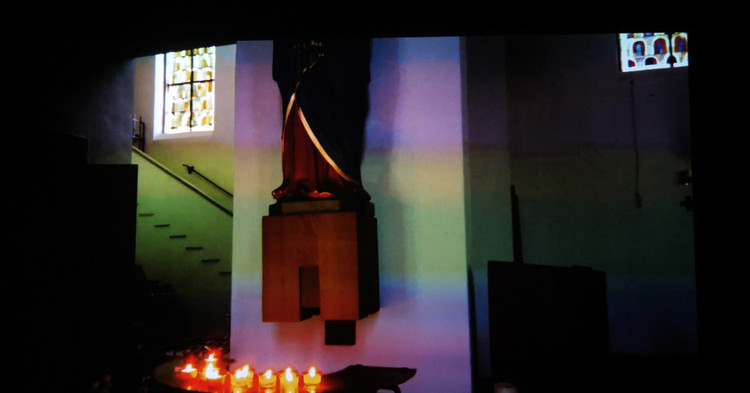
The author of the winning work, Driton Hajredini, was very excited as he announced that this was the tenth time he was participating in this exhibition.
also "Dialogue in the Dark" brings refugee art to Germany
"I can't hide it, it's a very good feeling. It's the first time I'm winning it and I didn't expect it. I non-stop participated in the exhibition for the 'Muslim Mulliqi' award, while I made this work extra for this exhibition", said Hajredini.
When he started the analysis of the topic with "Sins" here 19 years ago, Hajredini remembered that after ten years the visa situation in Kosovo would change.
"It is the video 'Absolution' that lasts 7 minutes, which was made in Germany and is a continuation, so to speak, of a closing trilogy of two previous videos, the first of which was made in 2004, the second in 2022 and the the third in 2023. It's about our condition as a people, because we're very isolated, so I go and confess in a booth to the priest and I ask the priest some pretty weird questions and I get some pretty weird answers ", said Hajredini.
In addition to the elaboration of the concrete topic, Hajredini's work actually has an inseparable connection between the author's own past and present.
"Since 1992 I have been an asylum seeker in Germany. I tried to study at the Düsseldorf Academy, but without success. Then I came back here, I finished the Academy of Arts, then I went back to Germany and when I came back, these challenges of ours have always followed us as a tribute and an awareness with the countries of Europe for us as a people, but also others who they don't have visa liberalization or freedom of movement", he said.
"Absolution" also takes the context of the constant state and is a kind of response given by the artist.
"When I realized this topic in 2004, I thought that at least in 2008, our work will be completed, visas will be liberalized, we will move forward as a people, as a country, but in that respect we have the situation of same, so it didn't become monotonous to do it once again with the same questions, but different answers. I participated with such a work, because I generally realized it as a video. That atmosphere, that dialogue in the dark with the priest, cannot be painted", he said, as he added that it is "being an artist" that has pushed him to participate more than ten times in this exhibition.
In addition to Hajredini, 26 other artists from different countries such as: France, Germany, Italy, Luxembourg and Moldova participated in the exhibition. Eleven of them were Albanians. The entire exhibition, which includes various art forms such as installation, video, painting and sculpture, was curated by Christian Mosar from Luxembourg and Raimund Stecker from Dusseldorf. The twenty-five participating works are distributed on both floors of the National Gallery of Kosovo.
As he expressed his regret that he could not speak Albanian, in what he called a "wonderful language", the German curator, Raimund Stecker, said that, disregarding the borders of the states, art is doing what politics does not even know how to think .
"The idea of the exhibition, the idea of bringing artists from abroad to Pristina was for the artists to come together. One thing politics really fails to understand is that individuals manage to work together very well, regardless of boundaries. I hope that the National Gallery here will grow, maybe like the National Gallery in London", he said at the opening of the exhibition.
also "Dialogue in the Dark" provokes the existence of art and human destiny
The deputy director of the GKK, Alisa Gojani-Berisha, spoke about all the work that the Gallery has done to return the "Muslim Mulliqi" award to the art-loving public once again, which has been absent from Kosovo for four years.
"It has been a challenge in itself, because exhibitions have a certain dynamic until it comes to the end of the process. However, 'Muslim Mulliqi' was a special emotion because it has not been held for four years due to the pandemic and this is the main biennial organized by the National Gallery of Kosovo", she said.
However, the entire burden for the selection of this award had fallen to the jury. One of the members of this jury, Ardian Isufi, said that differentiating one work as better than the others was a very difficult thing, and this is also due to the high artistic level of the participating works in general.
"For the sake of truth, it was very difficult, because the proposals of the artists had good alternatives, they were challenging, all of them, beyond our discussion between the jury members Mosar and Stecker, which was a detailed discussion for each artist, for the works of them, for their texts", said Isufi.
In the role of a member of the jury, but also of the artist, Isufi also spoke about the characteristics of the winning work and the elements that make it stand out from the other participating works.
"Without a doubt, the work of Driton Hajrenidi brings very strongly through the visual language acute issues related to the transition, as is the whole Balkans, but also the whole world, and above all, related to political views, social situations, which for we are very important, that artists must definitely confess them through art and to bring them as issues that open a public discussion. This was probably the most important point that we chose him", said Isufi.
As a painter and connoisseur of art, Kamuran Goranci has appreciated the work of Hajredinaj as he has analyzed something from its interior and symbolism.
"As long as I had the opportunity to see the work, even though I know Driton even earlier, and, as he himself said who has participated ten times, it is not easy to win. It is a concept, it has a basis, it has a message that our creators are facing and with some barriers or injustice in terms of maybe not only national, but religious, it comes and goes when the lack of visas and other vicissitudes are included. It means compressing a situation, a momentum for the Kosovar artist and what he faces if he is successful here and manages to be approved as an artist in the international arena. It is a very serious topic, but elaborated in an artistic way and with some contemporary messages that I liked", he appreciated.
Starting from the works of this exhibition as a whole, Goranci also spoke about the high level of art.
also Art passport with isolation stamp
"All the works here are good. It does not mean that there is no place to evaluate other works, but of course not everyone can win. This biennial has a tradition where the artists of the future are seen here in some form, that everything starts with the new. Even Kosovo and our young artists have reached a level, we can say not of the middle level, but close perhaps to creative artists of other countries", he said.
The "Muslim Mulliqi" award exhibition is held every two years. The 14th edition was planned to be held in 2020, but was canceled due to the pandemic. In 2018, the winners were Valdrin Thaçi and Artan Hajrullahu.

