


-
By:
Shaban Maxharraj

- 7 October 2026 08:00
- Share to:
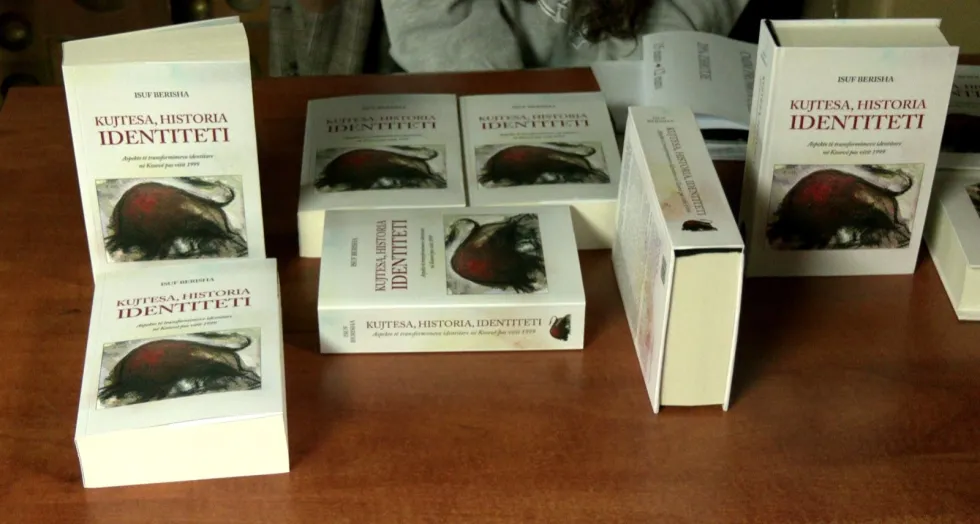
The issue of Kosovar identity has been a topic that has often sparked debate, but philosopher Isuf Berisha addresses this issue on an academic level, initially stripping identity of myths and defining it as inclusive. “Memory, History, Identity: Aspects of Identity Transformations in Kosovo after 1999,” treats Kosovar identity as an open alternative that does not exclude other identities. His book, launched on Tuesday in Pristina, has been considered one of the best works dedicated to the issue of identity on a global scale.
After the last war in 1999 in Kosovo, but also beyond, a debate has erupted about Kosovar identity. Philosopher Isuf Berisha, through his work, "Memory, History, Identity: Aspects of Identity Transformations in Kosovo after 1999", deeply addresses this issue through the ideas that have been put forward and also by radically analyzing the socio-cultural aspect regarding the identity of the society of the youngest state in Europe. For local scholars of philosophy and beyond, as well as for well-known names of philosophers, Berisha successfully manages to answer some essential questions regarding this issue.
On Tuesday evening, at the National Library of Kosovo, through a panel of academic experts – not often seen at book promotions – the work "Memory, History, Identity: Aspects of Identity Transformations in Kosovo after 1999" was promoted, initially published in Croatian as a doctoral thesis at the University of Zagreb and now also in Albanian, in a more expanded version.
Philosopher and professor at the University of Zagreb, Lino Veljak, said that in this book the author has presented and systematized in a systematic and critical manner the essential determinants of contemporary global debates on identity in order to derive a methodology from the highest quality world contributions to identity theories. He mentioned that he has done the same with the debates on this issue that took place in Kosovo and Albania. According to him, by limiting himself to the analysis of the debates that took place in Kosovo in the period after 1999, which focus on the issue of the relationship between Albanian and Kosovar identity, Berisha has successfully and convincingly answered a number of interesting and crucial questions.
"Why did the debate on Kosovar identity arouse such public interest and why did it begin precisely after the end of the war in 1999? What are the sociopolitical and cultural assumptions of this debate? What are the dynamics of identity constitution and what is the logic on the basis of which changes in the priority list of different identities occur?", are the questions mentioned by Veljak.
According to him, the author has properly taken into account that the concept of identity has two essential dimensions, on the one hand, it is an individual or personal identity, and on the other hand, the identity of collective entities. He said that in this case the question arises as to what is the relationship between these two identities?
also The ethics of reason within a discussion
“At first glance it is clear that without the first identity there is no second, it is clear that without individuals there is no society; the relationship, of course, is not one-way: there is no human being outside a community. Without personal identity there is no social identity, but vice versa: without the definition of the identity of a collectivity there are no individuals who can belong to that collectivity (because every individual must belong to several groups and at least one collectivity, otherwise he would be – as Aristotle knew – "or a god or an animal)," he said.
“Unlike the advocates of substantial identities (in fact: hypostasized and absolutized) based on mythical narratives, Berisha affirms the plurality of identities, rejecting the exclusivity of one of the identities (which is usually ethnic or national identity), thus rejecting the either-or logic. Aware that most participants in the debate on Kosovar/Albanian identity are not even informed about contemporary reflections on the issue of identity, he emphasizes that they understand the ethnic nation primarily as a homogeneous identity platform that neither tolerates identity differentiation within the respective society nor can tolerate other ethnic elements,” Veljak said. According to him, when it comes to Kosovo, what has been said applies to both Serbs – from Bishop Artemije to Ivica Daçić – and to supporters of the absolutization of Albanian national identity. He said that in this way, a “passionate anti-Kosovarism” is formed, in which Albanian and Serbian identities are positioned as exclusive in relation to the Kosovar (citizen) identity. He explained that it shows that Serbian and Albanian nationalism are antithetically solidary in their positions of denial of Kosovar identity.
"By defending the democratic right to self-identification and opposing the absolutization of those identities that are produced or defined by forced homogenization, Berisha has made an extraordinary contribution to raising awareness of the pluridimensionality of social and individual identities. This is an important lesson not only for society in Kosovo, but also for members of every nation in the world who have not freed themselves from inherited traumas or have remained trapped in prejudices and myths," he said.
At the very end, he said that this book by Isuf Berisha is the first philosophically based monograph dedicated to the issue of identity in the context of Kosovo. He concluded by saying that the publication of the book in a world language will also show that this work is globally important as an authoritative contribution to the critical opposition to the evil metaphysics of absolutized identities.
"And I'm sure it's no exaggeration to say that it's one of the best books dedicated to the issue of identity on a global scale," he said.
In the absence of university professor of philosophy, Astrit Salihu – due to a family matter – his presentation titled “The Inclusive Kosovar Identity” was read by the moderator. According to Salihu’s presentation, Isuf Berisha begins his book with an in-depth and comprehensive elaboration of the notion of identity.
"The premise of Kosovar identity in this book appears to us as defining the new reality, which we Albanians as the majority people of Kosovo and other communities living in Kosovo are living. We are talking about the context created after 1999 and with the declaration of Kosovo's independence. These two events create a new situation that is intertwined with the identity issue as a fundamental problem in this radical sociopolitical change," the statement reads. According to what Salihu wrote, Berisha approaches the issue of identity transformations in Kosovo in all its complexity, not only theoretical, but especially historical, contextual and political.
also Missing Albanian historical awareness in the face of the Serbian genocide
"He meticulously distinguishes the main levels of identity construction, such as the relationship with the other (which constitutes the foundation of identity), the national identity of Kosovo Albanians in relation to Kosovo identity, the identities of other communities in Kosovo in relation to Kosovo identity, as well as Kosovo identity in relation to Europe. Berisha does not leave anything from Kosovo reality out of the discussion, but of course, in the issue of Kosovo identity, the issue of the relationship of Kosovo Albanians with the construction of Kosovo identity dominates - "because over 90 percent of the population of Kosovo are Albanians," Salihu wrote. It is written there that it seems that the issue of Kosovar identity, more if not only, has become a problem for Kosovo Albanians.
"Berisha sees this as a new dynamic between national and territorial/political identity after the declaration of independence and the initiation of debates about a Kosovar identity among Kosovo Albanians. With a few exceptions, the initiative of this debate does not pass without emotional strain and often with pathetic overtones, confusing to the core and poor in reflection on the issue of identity. This initiative in Isuf Berisha takes the pure form of a calm look at the phenomenon of identity and a step-by-step achievement in finding the essential moments that build identity," the statement reads. According to what Salihu wrote, Berisha sees in his book the evolution of the identity of Kosovo Albanians as relational and in different periods in relationships with different others, initially in relation to the Serbs, as a historical relationship that culminates in the 90s, then, after the end of the war and with the declaration of independence, in relation to the international community and to Albania or the Albanian national identity.
"Preserving equilibrium and stable relations is currently possible by preserving the entity of Kosovo as an independent state. But this also implies an identity, because Berisha refers to the postulate that 'there is no entity without identity'. From this it follows that the Kosovar identity remains an open alternative not to the fusion of the Albanian national identity, but in its 'daily functional and productive' use, without excluding other ethnicities and nations, within this inclusive identity", Salihu's statement reads. According to him, Berisha sees the importance of thinking about inclusive and not exclusive identity here to offer another picture that would eventually be a much broader, inclusive and democratic platform. According to Salihu's statement, when Berisha aims to overcome the dramatic dilemma of the exclusive logic of either-or, he brings to mind the thought of Robert Venturi who aimed to affirm inclusive postmodern architecture as a counter-response to exclusive modernist architecture. According to him, shifted to the identity plane in the context of Kosovo, what Venturi affirms gives a deeper meaning to Berisha's initiative.
"Venturi defined either-or logic as 'easy unity of exclusivity', while both-and logic as 'difficult unity of inclusivity'. Isuf Berisha's book is a thoughtful introduction to the difficult unity of inclusivity. Only open, responsible and honest thinking can achieve this in this not-so-simple debate about the identity relationship between national and Kosovar identity," Salihu wrote.
Renowned linguist, academic Rexhep Ismajli, in his speech presented his reading in relation to Berisha's work, linking it mainly to the linguistic identity that Berisha also deals with.
"I am not a philosopher and I do not pretend to have an opinion on this aspect, but I have read Isuf Berisha's book with great attention and curiosity and I am satisfied with much that I have learned from him in this aspect. I have always been more interested in the issues related to the issue of identity from the perspective of a linguist, who, like it or not, notes limited explanations, but which may also be important for more general contexts", said Ismajli. According to him, Isuf Berisha in this context has dealt with discussions related to the history of the standard language, as they have appeared in recent times, especially in mainly journalistic reviews, which have been loaded with passionate, polemical, and other aspects.
"His presentations, as far as could be expected in a book like this, are accurate, with scrupulous references, thus adding a dimension to the views on Kosovar-Albanian discussions in the field of identities. I would add that identity issues in the field of language are even more substantially related to the history of language, which, in our specific case, unlike, say, the Croatians, can constitute one of the important elements of the constitution or historical transformations of identity dimensions," he said, among other things.
also "Serbian World" to Victim Blaming Propaganda
The author himself was brief in his speech. While thanking the penalists, he said that he had begun research in this field much earlier, referring to the time before the last war.
"But it was too early then," said Berisha, who was born in 1955. He completed his undergraduate studies in philosophy and sociology at the University of Pristina in 1981. He then completed his postgraduate studies at the Faculty of Philosophy of the University of Zagreb, where he defended his doctorate in 2017. During his career, he has worked as a professor, journalist and has also been involved in civil society. Between 1989 and 1994, he was the president of the Association of Philosophers and Sociologists of Kosovo. And with his latest study, it is estimated that he has rounded off one of the issues on which discussions have been loud, but never as in-depth as in Berisha's book.