


-
By:
New York Times

- March 12 2025 08: 05
- Share to:
Trafficking in women has been big business in China for decades. A long-standing cultural preference for sons, exacerbated by the one-child policy, has meant there are millions more men than women, many of whom have been unable to find partners. Poor, rural men in eastern China have begun buying women from the country's even poorer western regions. Xiaohuamei has been sold three times. The last time to a man in Dongji
A blogger visited the village of Dongji, in eastern China, to find a man who was known for raising eight children despite living in extreme poverty. The man has become a favorite interview subject for influencers trying to attract donations and clicks.
But that day, a child directed the blogger to someone who didn't appear in the other videos: his mother.
She was standing in a doorless hut in the family garden, on a strip of floor directly on the ground between a bed and a brick wall. She was wearing a thin T-shirt even though it was cold January. When the blogger asked her if she could understand him, she shook her head. A chain around her neck had tied her to the wall.
The video quickly spread online, and Chinese commentators immediately speculated that the woman might have been sold to the man in Dongji and forced to have children — a form of trafficking that is a long-standing problem in rural China. They called on the government to intervene.
Instead, local officials issued a brief statement to allay concerns: The woman was legally married to the man and was not trafficked. She was tied up because she had mental problems and sometimes hit people.
also From abuse to hope: women's fight against forced marriage in China
Public outrage only grew. People wrote in demanding to know why women could be treated like animals. Others printed pamphlets or visited the village to investigate the case themselves. This was more trafficking, people declared. It is an additional reason why many young women are hesitant to marry or have children, because the government treats marriage as a license to abuse.
The backlash from across the country lasted for weeks. Many observers called it the biggest moment for women's rights in recent Chinese history. The Chinese Communist Party sees the popular backlash as a challenge to its authority, but this one was so intense that even the party seemed to have trouble controlling it.
But it worked.
To find out how New York Times reporters tried to find out what happened to the chained woman and those who protested for her. They found a vast network of intimidation at home and abroad, involving mass surveillance, censorship and punishments – a campaign that continues today.
The crackdown shows how concerned the authorities are about the rise of movements seeking to improve the role of women in Chinese society. Although the party says it supports gender equality, the government has portrayed childbirth as a patriotic act, imprisoned women's rights activists and censored calls for stronger laws to protect women from abuse.
Although the campaign has forced women to hide their revolt, it has not extinguished it. In secret, a new generation of activists has emerged, more determined than ever to continue the fight.
Who is the woman in chains?
At first glance, Dongji looks like any other village in China's vast rural area. Two hours from the nearest city, it lies amid wheat and rice fields in Jiangsu province, half-empty, most of its residents having left in search of a better life.
But when the reporters visited, a house with double doors was being guarded by two men. A surveillance camera from a nearby pole was pointed at the entrance.
This was the street where the chained woman had lived.
Officially, there was no reason for their home to still be under surveillance as the government said the matter had been resolved.
After widespread backlash over the government’s first statement in January 2022, officials promised a new investigation. Over the next month, four government offices issued statements that were at times contradictory—offering different dates for when she was first chained, or suggesting that the woman may have been homeless or lost before arriving in Dongji. Finally, after intense public pressure, provincial officials issued what they called a final statement in late February of that year.
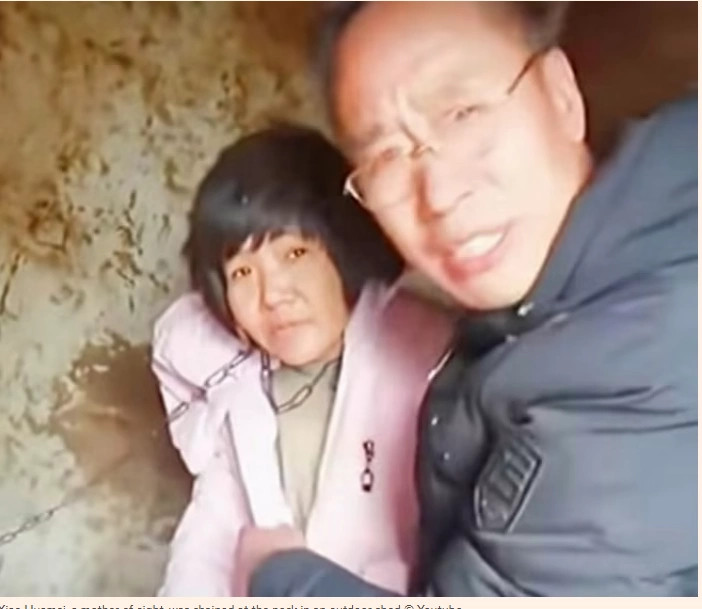
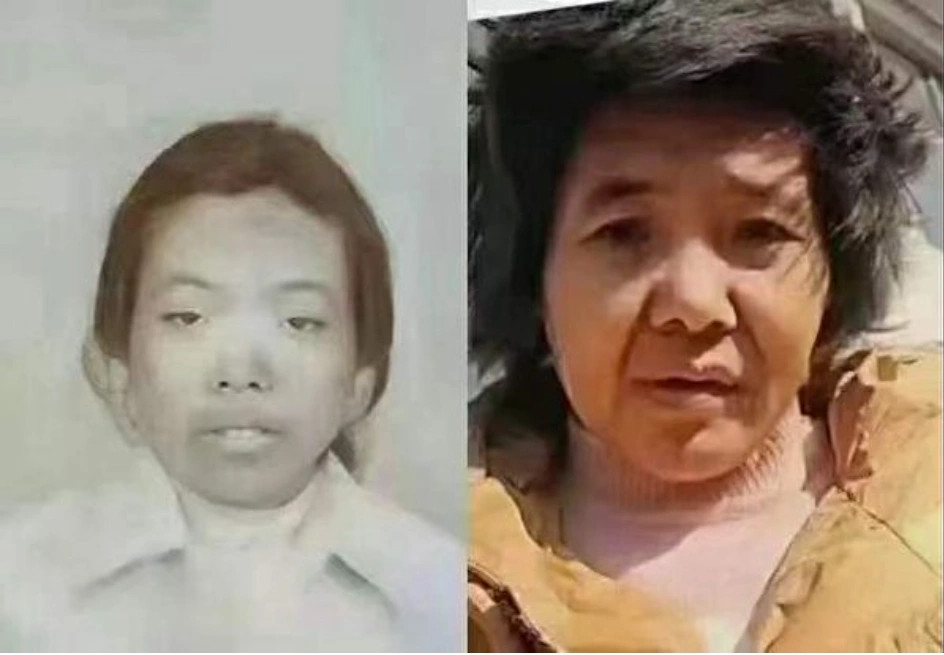
According to that report, the woman was named Xiaohuamei, or “little plum blossom” (the government did not specify whether this was a pseudonym or legal name). She was born in Yagu, a poor village in Yunnan province, southwest China.
As a teenager, she occasionally spoke or behaved in “abnormal” ways, according to the report, and in 1998, when she was in her 20s, a fellow villager promised to help her get treatment. Instead, the fellow villager sold her for $700.
Trafficking in women has been big business in China for decades. A long-standing cultural preference for sons, exacerbated by the one-child policy, has resulted in millions more men than women, many of whom have been unable to find partners. Poor, rural men in eastern China have begun buying women from the country's even poorer western regions.
Xiaohuamei had been sold three times, most recently to a man in Dongji - over 3,200 kilometres from her hometown - who wanted to marry off his son, Dong Zhimin, according to the government.
Over the course of 20 years, she gave birth to eight children even as her mental health deteriorated, according to the government, which cited interviews with Dong and villagers. When she first arrived in Dongji, she was able to take care of herself, but by the time she was found, she was having trouble communicating.
The government report did not say whether other villagers knew she was trafficked. But bloggers advocating for the charity have begun visiting Dongu and presenting him as an adoring father since 2021 (the woman has appeared in several videos, but unchained).
"My dream is to slowly raise children into healthy adults," Dong said during a conversation with a blogger before the cabin video was released.
He has privately tied the children's mother with chains and clotheslines since 2017, according to the government. He also failed to take her to the hospital when she was sick.
Censors have deleted videos of the family and the chained woman. In April 2023, Dong was sentenced to prison, along with five other people accused of trafficking.
The official story ends here.
Step one: Hide the victim
Anyone connected to the case or who attempted to speak out has been banned.
The victim is in the hospital, but her exact location is unknown.
When the team of journalists approached the house the men were guarding, they asked who they were. One made a call, while the other blocked the journalist from taking pictures.
Soon 10 more people arrived, including several police officers, propaganda officers and the village leader, who insisted that the scandal had been exaggerated.
“Everything is very normal, extremely normal,” he said. When they asked where the woman was, the officials said they believed she did not want visitors. They then escorted the journalists to the train station.
also Lonely Chinese men falling prey to fake brides
The woman may have chosen to stay out of the public eye. But the Chinese government often silences victims of crimes or accidents that generate public outrage. Relatives of those killed in plane crashes, COVID-19 patients, and survivors of domestic violence have all been barred from appearing, threatened, or arrested.
A few weeks later, the journalists returned again. This time, they visited the hospital that Chinese national television said the woman was taken to after the video went viral — her last known location.
The New York Times team followed up with Dr. Teng Xiaoting, the doctor who treated her. Teng said the woman is no longer there and she doesn't know where she went.
Other local residents had no information either. But many people in nearby villages said it was known that many women in the area, including in their own villages, had been bought from southwestern China. Some called it sad; others were more cold-blooded in their response to the situation.
But it was clear that talking about such trafficking could be dangerous.
As the New York Times team approached Dongji, a Volkswagen began following them. Then eight men from the village surrounded them and began calling them race traitors (both journalists are originally from China) and at several points pushed one of the journalists. One of them told them that if they were men they would beat them.
They escorted them to the main road after they had called the police. Along the way, one of the men told them that it was in the journalists' interest to be more careful.
"If you were both taken to the market and sold, what would you do?" he said.
Step Two: Silence the Conversations
After the woman's story was published in January 2022, the biggest crackdown was in Dongji. But the government acted nationwide to quell the debate it sparked.
Law students have observed that the penalty for buying a trafficked woman – three years in prison – was less than selling an endangered bird. Others have noted judges who have rejected divorce applications from women known to have been abused or trafficked and that the government has repeatedly rejected calls to criminalize marital rape.
To stop these conversations, police have tracked people like He Peirong, a veteran human rights activist, who traveled 320 km to the area around Dongji to search for other trafficked women.
When she returned home, the police knocked on her door, asking why she had gone. They visited her about 20 times over the next month, forcing her to delete her online posts about her trip and threatening to arrest her.
They also mentioned other journalists she had contacted, telling her they were monitoring her communications. They also forced her to go on a forced vacation to the nearby province of Anhui – a deliberate move to control the movements of dissidents.
Similar persecution has occurred on the other side of the country. A lawyer named Lu Tingge, a resident of Hebei province, about 1000 kilometers from Dongji, said in an interview that an official from Jiangsu traveled to the city to pressure him to withdraw a petition he had started seeking more information about the case (he refused, but said he never received the information).
Bookstores that had decided to promote feminist publications have been forced to remove them. A large number of articles about women online have been censored, China Digital Times, a censorship tracker, has archived about 100 articles, although there were many more that had been censored.
The campaign has also spread abroad. A woman living abroad said in an interview that police summoned her parents in China after she posted photos of herself chained online.
He, a veteran activist, has discovered that the government is more concerned with feminism than she thought. She had been arrested earlier for other activism, but this months-long pressure "has surpassed everything," she says.
Step Three: Arrest repeat offenders
To avoid arrest, He has stopped publishing about the case, and fled China for Thailand.
Those who refuse to stop have suffered the consequences.
Two other women also traveled to Jiangsu after the video emerged to visit the chained woman in hospital. Identifying themselves on social media only by the nicknames Wuyi and Quanmei, they said they were just ordinary women showing solidarity.
"Your sisters are coming," Wuyi posted.
They were banned from entering the village or the hospital, according to Wuyi's video. But they traveled around the city, with messages for the woman written in lipstick on their car.
They quickly attracted many followers, their updates were viewed hundreds of millions of times.
Not long after, they were arrested by local police, and after their release a few days later, Quanmei went silent online.
But Wuyi refused to be silenced. In a social media post, she claimed that police had put a bag over her head and beaten her. She posted a photo of a mark on her arm, saying she was shocked that her small actions had provoked such a harsh response.
"Everything I've always believed, everything my country has always taught me, all turned out to be lies," she wrote.
also Aging, China's Great Crisis
Two weeks later, Wuyi disappeared again. This time, police detained her for eight months, according to a relative. She has been released but has not released anything since.
Prepared by: Shkëlzen Dema

