


-
By:
Edona Binaku

- February 9, 2025 23:00 AM
- Share to:
"Albanian and Balkan music are essential in my musical DNA. The complex rhythms and rich melodies of this tradition helped me create a unique voice in the world of jazz," says renowned jazz guitarist Taulant Mehmeti in an interview for "Kohë Ditore." He returns to memories, talks about returning to the Pristina scene, about the passion that breaks borders, about Artificial Intelligence and about his third album dedicated to the visas of Kosovars.
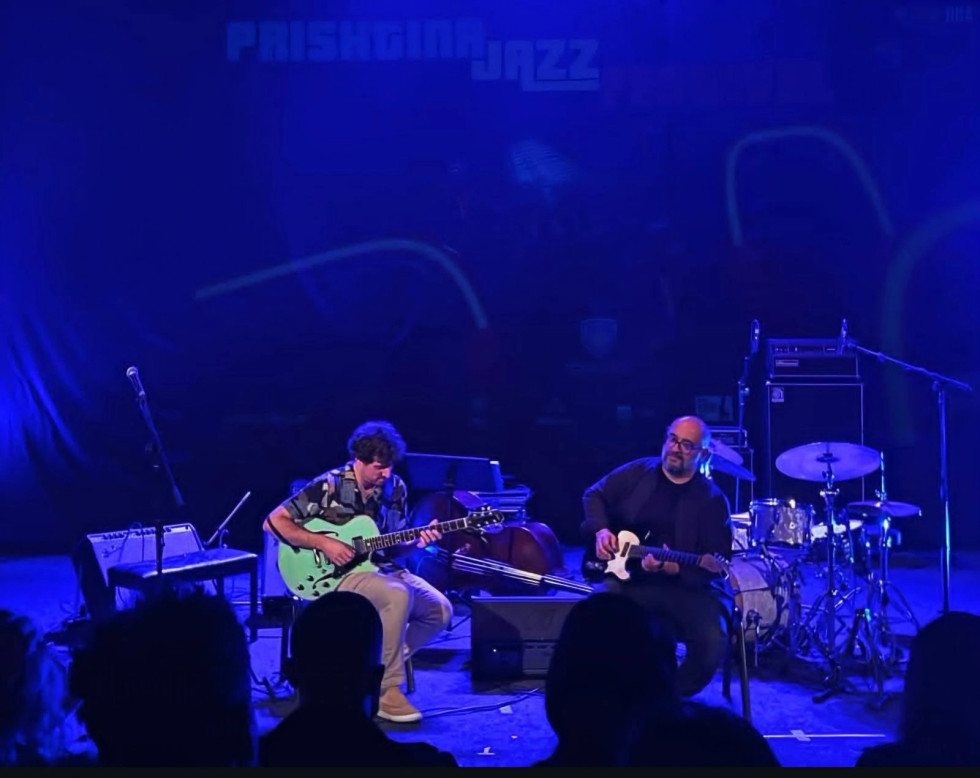
His journey into the world of jazz music is something like the work of defining this musical genre. For him, jazz combines “the freedom of improvisation with the discipline of structure, creating a unique harmony that makes it unrepeatable”. Jazz guitarist Taulant Mehmeti proves the freedom of improvisation on stage, the discipline of structure are the steps he has followed in his career, with the music he composes he has found unique harmony, and he himself is a unrepeatable jazz guitarist. Last November, Mehmeti was one of the main characters of the 12th edition of the “Prishtina Jazz Festival”. He returned to the stage of the “Oda” theater, where two decades ago, he first encountered jazz music. His career explosion was furious, when he landed in the USA in 2012, he studied at the “New School for Jazz and Contemporary Music”, but that was not enough. This year marks ten years since he stepped onto the famous “Blue Note” stage in New York, which marked a turning point in his career. In an interview for “Kohën Ditore”, Mehmeti returns to his memories, talks about returning to the Pristina stage, about the passion that breaks borders, about Artificial Intelligence and about his third album dedicated to the visas of Kosovars. “Albanian and Balkan music are essential in my musical DNA. The complex rhythms and rich melodies of this tradition helped me create a unique voice in the world of jazz”, says Mehmeti.
KOHA: In November (of last year) you returned to the “Prishtina Jazz Festival” at the “Oda” theater where two decades ago, or more precisely in 2005, you first encountered jazz music. What is the feeling of returning and would you like to remind us of your introduction to jazz music?
Mehmet: Returning to the “Prishtina Jazz Festival” was an extraordinary and emotional experience for me. It was a return to the roots of my musical journey, to that hall where I first felt the depth and complexity of jazz. In 2005, it all started as a curiosity towards this genre unknown to me, but which very quickly became a passion of my life. Returning after so many years was a mixture of nostalgia and pride, reflecting on the journey I have made since that first moment at the “Oda” theater.
TIME: In 2025 it will be ten years since you performed at one of the most famous jazz clubs in the world, at the “Blue Note” in New York? It happened three years after you went to the USA. You played with your mentor, Vic Juris. How do you remember that time, was this a turning point in your career? You also played at “Birdland”, “BB King's” and “Iridium”...
Mehmet: Performing at the Blue Note in 2015 was one of the highlights of my career. It was a great honor to perform alongside my mentor, Vic Juris, on a stage with such historical significance for world jazz. That experience marked a turning point, not only because it strengthened my confidence as a musician, but also because it gave me the opportunity to connect more deeply with the jazz community in the US. Also, performances at Birdland, BB King's, and Iridium helped me better understand the essence of the genre and its impact on a global level.
also Surrealist journey and epilogue with the world guitarist of Kosovo
"Unwavering passion for art can break the greatest boundaries"
KOHA: In an interview for "Kohë Ditore" in 2015, you said at the time that you managed to perform with some of those who, during your musical journey, you only saw on "YouTube"? Had you dreamed of such a course of your career?
Mehmet: When I watched great musicians on YouTube as a teenager, it was hard to imagine that one day I would be on the same stages as them. Performing alongside them was the realization of a dream that sometimes seemed unattainable. However, I have always believed that unwavering dedication and passion for the art can break the greatest boundaries. It was a natural flow of hard work and love for music.
KOHA: You studied at the "New School for Jazz and Contemporary Music" then completed your master's degree at "SUNY Purchase", where in 2017, you were the only one accepted out of 120 candidates?
Mehmet: Studying at the New School for Jazz and Contemporary Music and later at SUNY Purchase was both a challenge and a privilege. Being accepted into the master’s program in 2017, as the only one out of 120 candidates, was a moment that gave me a great sense of responsibility. This period was filled with intense work, but it also opened up the opportunity to learn from the best musicians in the world.
"Fleeing to the US was crucial for my career"
KOHA: Was moving to the US a defining moment in Taulant Mehmeti's career? What would have happened if you had decided to stay here?
Mehmet: Moving to the US was crucial for my career. The opportunities I found there – the mentors, the stages, and the musical community – were the main factors that shaped me as a musician. If I had stayed in Kosovo, I believe my journey would have been completely different. Kosovo has a rich artistic spirit, but the jazz scene and opportunities are very limited compared to what New York offers.
KOHA: You have taken lessons from Reggie Workman, Peter Bernstein, Vic Juris, Sam Yahel, Janet Lawson, Hal Galper, Andrew Cyrille, Cecil Bridgewater, Joanna Brakeen and many others? Who has had the most influence on you?
Mehmet: Each of my mentors has left a special mark on my formation as a musician. Vic Juris taught me the elegance of sound on the guitar; Reggie Workman opened up the horizons of improvisation for me; Peter Bernstein and Sam Yahel taught me how to stay authentic to myself. I can't single out a single name, as each of them helped me, in their own way, to build a unique style.
The transition to jazz there, improvisation was everyday life.
KOHA: However, let's go back to Kosovo, where it all began. The school where you studied described you as "a guitarist who, even before discovering jazz music at the age of 18, was always a natural improviser, bringing out the rich Balkan rhythms and Roma music that he had grown up listening to and performing." Has Albanian music influenced your unique style? Or how much has being unique in the world of jazz influenced you?
Mehmet: Albanian and Balkan music are essential to my musical DNA. The complex rhythms and rich melodies of this tradition helped me create a unique voice in the world of jazz. Growing up in an environment where improvisation was part of everyday life, the transition to jazz was an organic step. This heritage has given me the ability to bring new and authentic elements to my creativity.
KOHA: As far as I know, you took your first guitar lessons from guitarist Nexhat Macula, a well-known rock guitarist, and then from the prominent jazz guitarist Armend Xhaferi. You also have a song for Xhaferi, “Like Xhafa”...? How was your transition to jazz?
Mehmet: My first lessons with Nexhat Macula helped me build a strong foundation, while Armend Xhaferi introduced me to the world of jazz and improvisation. “Like Xhafa” is a dedication to Xhaferi, a man who had an extraordinary influence on my development as a musician. The transition from rock to jazz was a slow process, but full of passion and discovery.
also Surrealist journey and epilogue with the world guitarist of Kosovo
KOHA: And performing alone was not enough for you. Was it not enough to just perform when you started composing from the beginning or do you consider that in the world of music there must necessarily be original works. You continue to compose and in your works the influences of Albanian and Balkan music are evident, as in “Kosovology” and many others.
Mehmet: Composition has always been an integral part of my creativity. For me, performance and composition are inseparable. I feel that every musician needs to express their own voice through original creations. Compositions like “Kosovology” reflect this feeling, bringing Balkan influences into a global jazz context.
KOHA: You debuted with an album in 2019 with “Song to my Brother”, which also has a personal story – it is dedicated to your late brother – then you brought “Departures” where you collaborated with the famous, Peter Bernstein and now with “Visa for Aliens” which you also revealed a little at this year’s edition of “Prishtina Jazz Festival”. How similar are these albums to each other?
Mehmet: Each album represents a different phase of my life. “Song to my Brother” was a tribute to my late brother, full of strong personal emotions. Through the collaboration with Peter Bernstein, it was a reflection of my roots and my travels. “Visa for Aliens” expresses a more global perspective, reflecting on the changes and challenges of immigration and life in the US and the challenges of traveling as a Kosovar citizen.
"AI cannot replace the human spirit of art"
KOHA. I would like to talk about the latest album? What is the story behind it? It is also related to visa liberalization for Kosovars since you received your “Green Card” at the end of September?
Mehmet: “Visa for Aliens” is a reflection on the experience of immigration, with a connection to the liberalization of visas for Kosovars. As Kosovars, we have had an excessive difficulty in traveling freely and a great injustice towards us. A year after its launch, I also received a Green Card.
KOHA: Talk about aliens, extraterrestrials...Can we talk about Artificial Intelligence? How do you see this time of technological development. Do we have programs that compose, create music? Does this affect creativity, art? How do you see the relationship between AI and art? Or is there a replacement for the artist?
Mehmet: Artificial Intelligence is a powerful tool, but it cannot replace the human spirit of art. Programs can create music, but they lack the emotions, experiences, and sensitivity associated with real art. AI can be a help, but it cannot replace artists.
KOHA: A sensational career of yours. At the “Prishtina Jazz Festival” that returned after a decade of hiatus, we heard many musicians from Kosovo. Good musicians, including those from the new generation. But above all, we heard new compositions? Is there Albanian jazz in the full sense of the word and how does it differ from world jazz?
Mehmet: Albanian jazz is still developing, but already distinguished by its rich influences from traditional music. This is a genre that is taking on a unique shape, bringing an interesting blend of tradition and modernity.
KOHA: What is your relationship with the guitar – I have the impression that you are connected to the “Gibson” type. How do you describe this instrument, what is in your collection and how do you select the guitar? Do you also have a personalized guitar?
Mehmet: Gibson guitars have always been my favorites for their warm and rich sound. I have several special models in my collection, including a personalized Gibson that has a special connection to my style. I select guitars that best reflect the sensitivity and emotion I want to convey. I am now sponsored by an American company, Comins, by the famous jazz guitar luthier, Bill Comins, and I play three guitars that were custom-made for me by Comins Guitars.
KOHA: How would you describe jazz music? It is a way of life for you, it is based on improvisation, but in essence it has strict rules...
also Jazz is like a language where notes are words
Mehmet: Jazz for me is more than a genre – it is a way of life. It combines the freedom of improvisation with the discipline of structure, creating a unique harmony that makes it unrepeatable. Jazz is an art form that brings people together in the best way, regardless of race, religion or affiliation and other unnecessary divisions.

