


-
By:
Sinan Berisha

- December 20, 2025 08:00
- Share to:
"By June, we will make several agreements. Signing these agreements means the exchange of people, the exchange of ideas, the cooperation of projects, not only for projects in Kosovo, but also the competition in European projects related to several countries and several universities," Justina Shiroka-Pula, who was elected president of the Kosovo Academy of Sciences and Arts on Friday, told KOHĖN. She emphasized that the first focus of her leadership will be the opening of the Academy to higher education institutions and academies in the region and beyond.
The change in the leadership of the Kosovo Academy of Sciences and Arts, more than just another procedural act, brings to attention the question of what is expected today from the country's highest scientific and artistic institution, to what extent it fulfills the advisory and guiding function recognized by the law, and whether the Academy is managing to articulate a distinct voice in the cultural and intellectual processes that shape contemporary Kosovo society.
The Assembly of the Academy of Sciences and Arts of Kosovo elected on Friday the new president of this institution, Justina Shiroka-Pula, concluding a regular electoral process and opening a new leadership mandate in the highest institution of science and art in the country. The election was made in accordance with legal and statutory provisions, at a time when expectations towards the Academy have increased, both in terms of transparency and its public role. There was no opposing candidate and the vote was unanimous. Shiroka-Pula is the first woman to head ASHAK. She was previously vice-president. She had resigned in January 2023, “"due to the circumstances created in and around the Academy, and the impossibility of collegial and humane cooperation with the leadership of the Academy"As president, she has a four-year term.
Shiroka-Pula has announced that the signing of several concrete agreements is expected by June, which, according to her, aim not only at local projects, but also at the Academy's involvement in international research initiatives.
"By June, we will have made several agreements. Signing these agreements means the exchange of people, the exchange of ideas, the cooperation of projects, not only for projects in Kosovo, but also the competition in European projects related to several countries and several universities," said the new president of the Academy in an interview with KOHĖ.
He also highlighted the cooperation with the Albanian Academy of Sciences.
also Who is Justina Shiroka-Pula, the president of Kosovo?
"We would like to open good cooperation with other academies. With the Academy of Sciences of Albania, we are currently making the 'Albanian Encyclopedia', which I believe will have its first edition published in a couple of years. This has been financed by both the Government of Albania and the Government of Kosovo," she added.
Another pillar of the new mandate is expected to be the creation of the "Youth Academy", a collaboration platform for scholars and researchers aged 22 to 40, which aims to bring younger generations closer to academic work without directly involving them in the formal structure of the Academy.
"They are not part of the Academy, but it is an entrance, a way to cooperate with the Academy and with the academies in the region. We will hold more discussions, presentations, we will invite our staff, who have studied, who live abroad and who have been profiled, to come and give lectures and trainings and to open up in general in terms of the education system, research and in this matter to modernize ourselves", said academician Shiroka-Pula.
In the field of economic and social research, Shiroka-Pula emphasized that several projects carried out by the Academy are already part of European assessments of student and workforce skills, providing a comparative overview of the level of education and development in Kosovo.
"In the field of economics, we have done many research projects, with which we are ranking in the European list in terms of the skills of our students, our people and our businesses, and this is important, even what level of education is. In those researches that are abroad, the projects that we have done have been transferred there and we are ranked approximately... we have information abroad, we will also have information about what is happening with education, with businesses and with youth in Kosovo," she continued.
According to her, the placement of these projects abroad is necessary to truly understand Kosovo's position in relation to the region and Europe.
The biography published on the ASHAK website states that Shiroka-Pula was born in 1953 in Prishtina. He completed primary school (1968) and secondary school (1972) in Prishtina. He successfully graduated from the Faculty of Economics in Prishtina in 1976. He continued his postgraduate studies in the field of Theory and Policy of Economic Development at the Faculty of Economic Sciences in Zagreb, where he graduated in 1984. According to the biography, Shiroka-Pula received his doctorate at the Faculty of Economics in Prishtina (1977), defending his doctoral thesis entitled "Demographic Investments and the Economic Development of Kosovo".
Shiroka-Pula succeeded the previous chairman, academician Mehmet Kraja, who has been chairman since 2021. He has also been chairman since 2019 - when academician Nexhat Daci's mandate was terminated, after he turned 75.
The Assembly of ASHAK, in the regular elections for the Presidency of the Academy, which were held on Friday, elected academician Fejzullah Krasniqi as vice-president, while academician Bardh Rugova was elected scientific secretary.
also Justina Shiroka-Pula elected president of the Kosovo Academy of Sciences and Arts
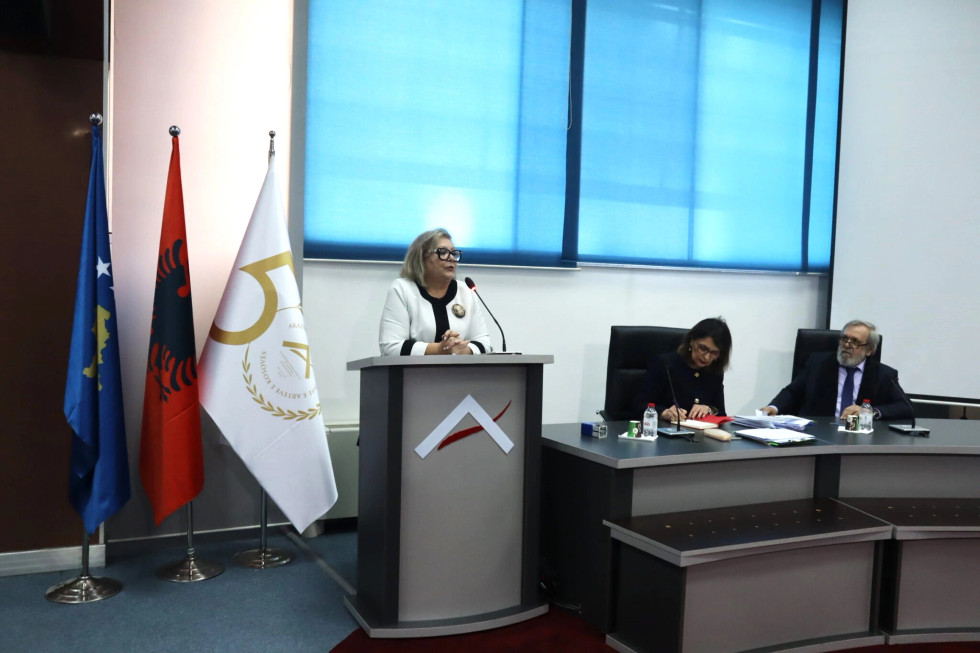
The ASHAK announcement states that the Academy Assembly has also approved the election of section secretaries.
Corresponding member Nysret Krasniqi has been elected secretary of the Linguistics and Literature Section, academic Frashër Demaj, secretary of the Social Sciences Section, corresponding member Enver Hamiti, secretary of the Natural Sciences Section, and corresponding member Ismet Jonuzi, secretary of the Arts Section.
ASHAK was founded in 1975 as the Kosovo Association of Sciences and Arts, and in 1978 it took the institutional form of an academy. From the beginning, its leadership has reflected not only academic developments, but also the political tensions of the time. The first mandates were marked by figures such as Esad Mekuli, Idriz Ajeti, Dervish Rozhaja and Syrja Pupovci, in a period when the Academy was consolidating itself as a center of Albanological studies, social sciences and artistic creativity.
The most serious institutional turn occurred in 1992, when the Serbian Parliament illegally declared the Academy closed. This decision caused a deep division in the academic body: some of the Serbian members accepted it and continued their activities in the Serbian Academy, while the Albanian and Bosnian members kept the ASHAK alive in new circumstances, often without minimal working conditions. This decade was also marked by major human losses and passive departures, which significantly weakened the institutional capacity, despite the election of new members.
In the years that followed, the Academy went through various leaderships, from Mark Krasniqi and Gazmend Zajmi, to Nexhat Daci, maintaining institutional continuity even during the war and after it. The mandates of Rexhep Ismajli, Besim Bokshi, Hivzi Islami and then Mehmet Kraja marked different phases of legal and functional stabilization, in a Kosovo now with consolidated state institutions.
Currently, the Academy's activities are regulated by the 2015 Law on the Academy of Arts and Sciences, which defines it as an independent public institution in the field of science and art, with scientific and artistic autonomy. The Academy operates through sections and governing bodies, the Assembly, the Presidency and the President, while its membership is lifelong and is divided into regular, correspondent, external and honorary categories.
Within this institutional framework, the new mandate opens with the aim of a more visible repositioning of the Academy in public life.
The newly elected President, Justina Shiroka-Pula, has emphasized that the first focus of her leadership will be the opening of the Academy to higher education institutions and academies in the region and beyond. According to her, the lack of active inter-institutional cooperation has been one of the main gaps in recent years, so the priority will be agreements that enable lecture exchanges, joint projects and competition in European programs.
also US Embassy expresses willingness to work with Shiroka-Pula
The new leadership term opens in the jubilee year of the Academy's half-century of existence, a moment that encourages reflection on the institutional legacy, but also on the challenges of the future. ASHAK marked its founding jubilee last week.
The election of the new president and the formation of the new Presidency mark another chapter in the history of ASHAK, at a time when the role of knowledge institutions is being constantly reconsidered in Kosovar society.

