

-
By:
Sanie Yusufi

- June 16, 2025 19:25
- Share to:
Kosovo's imports have increased by 15.5 percent compared to January-April 2024. Germany, Turkey and China are the three countries from which about 40 percent of goods were imported during this period January-April 2025. Exports shrank, while consumption continues to grow, supported by the diaspora and lending. Experts criticize the lack of support for local production and institutional disengagement
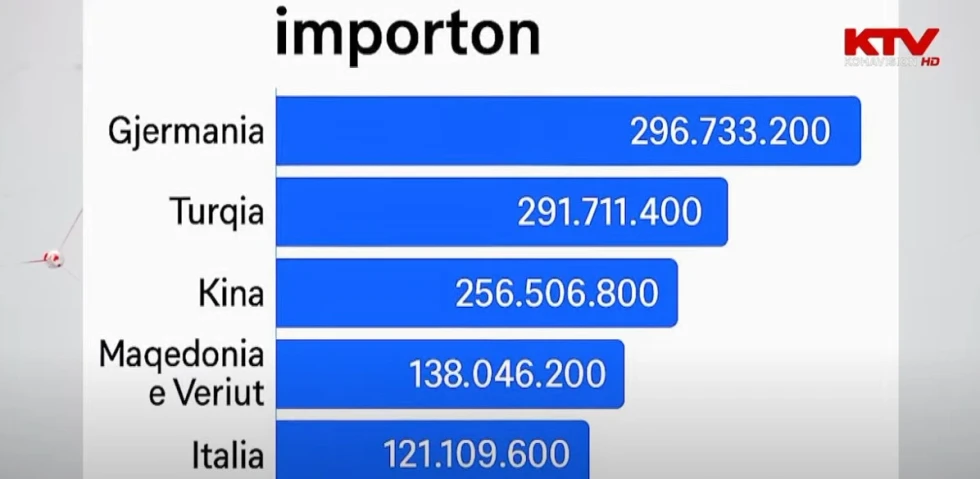
Germany, Turkey and China are Kosovo's three main import partners in the first quarter of this year.
From January to April, around 845 million euros were imported from these three countries alone, or around 40 percent of all imports, which were worth 2 billion and 152 million euros. This figure is 15.5 percent higher compared to January-April 2024. Last year, over 6 billion euros of goods were imported.
Kosovo imports mainly cars and other machinery from Germany.
Mainly steel bars, cigarettes, oil and medicines are imported from Turkey, while air conditioners, computers and telephones are imported from China.
The increase in imports, according to Blendi Hasaj, director of the GAP Institute, shows that Kosovo is a consumer economy and that it bases consumption on imports.
Consumption, according to him, continues to grow due to increased lending in the country and continued remittances from the diaspora, over 80 percent of which go to consumption.
also For five months, Kosovo imported nearly 3 billion euros of goods and exported around 420 million.
"The investments that the diaspora is making in real estate, which also promote the import of construction products and similar issues, are more or less what is driving consumption in the country, and this in the face of an economy that is failing to expand exports, or to have sufficient capacity to enter new markets, increase production volumes, advance certain practices in enterprises so that we can export more, and as a result, instead of having an improvement, we are experiencing stagnation," Hasaj assessed.
Kosovo's goods in international markets shrank by 10 million euros, compared to January-April 2024, when nearly 270 million euros of goods were exported.
KOHA has requested a response from the Ministry of Industry, Entrepreneurship and Trade on what measures this department has taken to reduce the trade deficit, but has not received a response from this department since Wednesday of last week.
The decline in exports, according to economics professor Ilir Hajdini, speaks to the lack of support for local production.
He says that embassies should also play a role in promoting local products.
also Exports declining and imports increasing, China leads in imports to Kosovo
"The idea is for embassies to organize various forums, to push businesses to participate in exhibitions, in various gatherings, which enable them to promote local products, then in cooperation with various governments to push them, because now we are seeing the EU is looking for alternative sources of supplies and suppliers since it is expected that we will have a weakening of economic relations between the EU and China and distant countries, and in order to increase the security of supplies, they are looking at the markets of Eastern Europe," said Hajdini.
Since 2018, Kosovo has changed its trading partners. While Serbian goods previously dominated the Kosovo market, they have begun to be replaced. Serbia is currently the ninth largest importer, after North Macedonia, which ranks fourth, and Albania, which is sixth. From these three countries in the region, goods worth around 318 million euros or 14.77 percent of total imports were imported during this period.