


The Special Prosecution of the Republic of Kosovo has filed an indictment against the defendant Fatmir Sheholli for two criminal offenses: "Espionage" and "Blackmail".
According to the indictment, from an unspecified date until October 9, 2025, Sheholli, in his capacity as a person recruited by the Serbian Intelligence Service, known as "BIA", assisted the activities of this service, acting according to the orders and duties of its officials.
He is accused of having collected, secured and transmitted through telephone messages data, information and documents related to political activities, the security situation and the functioning of the institutions of the Republic of Kosovo.
Sheholli is accused of the criminal offense of "Blackmail", after, during the years 2022 to December 2025, he blackmailed the injured party AJ, forcing him to act to the detriment of his property, in an amount exceeding 13,000.00 euros.
According to the indictment, Sheholli asked the injured party for money in the name of a loan, threatening that, if the money was not given, he would publish video recordings and information in the media that would seriously damage the injured party's honor, reputation and authority.
The case has been forwarded to the Basic Court in Pristina for review, while the defendant is in pre-trial detention.
SPRK: Sheholli attempted to influence the elections and planned to empty Kosovo through Islamic radicalization

With the aim of interfering in local elections of the Serbian community, the Serbian Security and Intelligence Agency - BIA, had given 5 thousand euros and some audio materials to Fatmir Sheholli, the Special Prosecution alleges in the indictment filed against him on Tuesday.
The document states that with the aim of discrediting him, the BIA gave Sheholli, a few days before the local elections held last year, materials containing audio and transcribed conversations of several senior officials of the Ministry for Communities and Returns, led by Nenad Rašić, a rival of the Serbian List.
According to the prosecution, Sheholli's task was to publish the materials in the media in Kosovo, a goal which the accused of espionage is said to have achieved.
"In accordance with the instructions received from the senior BIA official, the materials were handed over to the journalist Milaim Zeka, along with the amount of 1.000 euros, while also instructing him on the manner and time of their publication in his show 'Pa Rrotlla', and that only a few days before the voting day in the local elections, which through these concrete actions undertaken in function of the tasks assigned by the BIA, the defendant Milaim Zeka has seriously damaged state interests, discredited institutions and their officials, contributed to the deepening of social divisions, and enabled the direct intervention of a foreign intelligence service in an electoral process in the Republic of Kosovo," the indictment states.
The document states that Sheholli told journalist Zeka that he had obtained the material from the German Development Agency - GIZ.
Regarding these allegations, the Prosecution possesses photos, recordings and other evidence obtained through special measures such as monitoring and wiretapping of the accused.
On Sheholli's phone, the Prosecution found a photo with the caption "Top Secret 2" which contains a text in Serbian, which, according to the prosecution, is an action plan that aims to present Kosovo as a radicalized and extremist state.
"After we make an agreement with our operatives in Kosmet, collecting funds from Islamic embassies in Belgrade, most of this money will be invested in the construction of mosques. Mosques should be built in visible places such as near highways, schools, shopping centers, while mosques in large villages should be doubled and tripled," the indictment states.
In this confidential document, it is stated that an atmosphere should be created in Kosovo so that people feel as if they are living in a foreign country, where some of the young people will flee Kosovo and some will decide to convert to Islam.
The document states that the goal is to change the opinion of Western powers about Kosovo and thus enable the country to return under Serbian jurisdiction.
The indictment also describes a document called "Butterfly" which the prosecution found on Sheholli's phone.
"This is a document compiled by the Serbian State Security (RDB) structure in 2001, which describes an operational plan for compromising and recruiting Albin Kurti while he was serving his sentence in Serbian prisons. According to the content of the document, it was envisaged to use an operational source nicknamed "Leptiri" to provide compromising materials, with the aim of exerting pressure on him to cooperate with the RDB."
In addition to espionage, the SPRK holds Sheholli responsible for the criminal offense of "Blackmail".
According to the indictment, Sheholli possessed video recordings of a Kosovar businessman through which he blackmailed him, demanding money exceeding 13 thousand euros.
Sheholli was arrested on October 9th of last year and has been in custody since then.
He has worked as a journalist, advisor in the Municipality of Gracanica, and in the Ministry of Returns, he has also led a non-governmental organization and has even made numerous media appearances as a political analyst.
Sheholli also kept notes on Kosovo's critical infrastructure, including Ujman.

In the indictment filed for espionage and blackmail by the Kosovo Special Prosecution Office against Fatmir Sheholli, it is also mentioned that 22 small notebooks of various types were identified, in which there are manuscripts in Albanian and Serbian.
According to the indictment obtained by KOHA, the records contained information related to the activities of Serbian security institutions, surveillance measures against Albanian political figures, as well as data related to critical infrastructure, including the Ujman Dam.
It is further stated that from their analysis it is observed that Sheholli has kept numerous notes regarding security issues, politics and confidential information, recording names of people, phone numbers and financial calculations.
"However, from the analysis of the notebooks seized from the defendant Fatmir Sheholli, it results that he kept numerous notes related to security issues, politics and confidential information, recording names of people, phone numbers, operational data and financial calculations, which are typical forms of espionage. The notes contained information related to the activities of Serbian security institutions, surveillance measures against Albanian political figures, the activities of Serbian agents, as well as data related to critical infrastructure, including the Ujman Dam," it further states.
Also, notes with direct references to the BIA, national security events and individuals of various local, Serbian and international profiles have been identified. The content of these notes shows the defendant's ongoing interest in collecting, storing and organizing information of a security nature, which by their nature and content confirm that the defendant has undertaken espionage activities.
"The receipt of these periodic payments from Serbian state institutions that are directly linked to the BIA, linked to the defendant's engagement and activity, constitutes a notorious fact that proves his financing and engagement in the interests of a foreign state, specifically from Serbia, and in conjunction with other evidence in the case, it is proven beyond a well-founded doubt that the defendant has undertaken espionage activities for the benefit of the BIA and to the detriment of the interests of the Republic of Kosovo," the indictment states, among other things.
Sheholli distributed the document compiled by Serbia that aimed to recruit Kurti through pressure while he was in prison.

Albin Kurti with other Albanian prisoners in Pozarevac prison in Serbia (Photo: EPA)
The Special Prosecution of the Republic of Kosovo has filed an indictment against the defendant Fatmir Sheholli for two criminal offenses, "Espionage" and "Blackmail".
The indictment obtained by KOHA indicates that a document named "Butterfly" was found on the phone of the accused Sheholli, which was compiled by the Serbian State Security structures in 2001 and which describes an operational plan to compromise and recruit the current acting Prime Minister, Albin Kurti, while he was serving his sentence in Serbian prisons.
Through that material, the aim was to exert pressure on Kurti to cooperate with the RDB.
"From the analysis of evidence Z#4.1, namely the document named 'Leptiri', found on the phone of the defendant Fatmir Sheholli, it results that this is a document compiled by the structures of the Serbian State Security (RDB) in 2001, which describes an operational plan for the compromise and recruitment of Albin Kurti during the time he was serving his sentence in Serbian prisons. From the analysis of the communications extracted from the defendant's phone, it results that he forwarded this document to various persons, and requested its translation from Serbian into Albanian. These actions, assessed together with the other communications and materials found on the defendant's phone, are relevant to prove his contacts, connections and cooperation with persons and structures related to the Serbian security services, as well as his role in forwarding and distributing materials originating from these structures," the indictment states.
From the investigation according to the indictment, it results that Sheholli forwarded this document to various persons and requested its translation from Serbian into Albanian. Sheholli, according to the indictment and as he claimed, sent this document to "Milazim Gashi, a friend of mine who is in the Albanian SHISH named Dritan Gjoni - head of the SHISH in Durrës, he sent it to Blerim Canaj and a person named Bashkim Pushkolli, but I am not sure if I sent it to him".
Based on the Facebook communication, Sheholli sent the document to Canaj on March 26, 2024.
"These actions, assessed together with the communications and other materials recorded on the defendant's phone, are relevant to proving his contacts, connections and cooperation with persons and structures related to the Serbian security services, as well as his role in the transmission and distribution of materials originating from these structures," the indictment obtained by KOHA states, among other things, in the part where Kurti is mentioned.
It is further stated that this evidence seized from Sheholli is a document signed by the head of Sector III of the Serbian State Security (RDB).
The indictment of the Special Prosecution Office states that the defendant's own testimony proves that "where does this document come from?"
- Defendant: Bojan Dimic sent this document to my phone.
- Prosecutor: To whom did you distribute the "Butterfly" document that you received from Bojan Dimic?
- Defendant: I sent this to Milazim Gashi, a friend of mine who is in the SHISH of Albania named Dritan Gjoni - Head of SHISH in Durres, I sent it to Blerim Canaj and a person named Bashkim Pushkolli but I'm not sure if I sent it to him.
Kurti was arrested on April 27, 1999 in Pristina. Until May 2, 1999, he was in Pristina prison. From May 2 to June 10, in Lipjan prison. From June 10 to December 13, 1999, in Pozarevac prison. From there, he was transferred to Niš prison, where he remained until December 7, 2001.
Document found on Sheholli's phone, Serbia's aim to empty Kosovo through Islamic radicalization
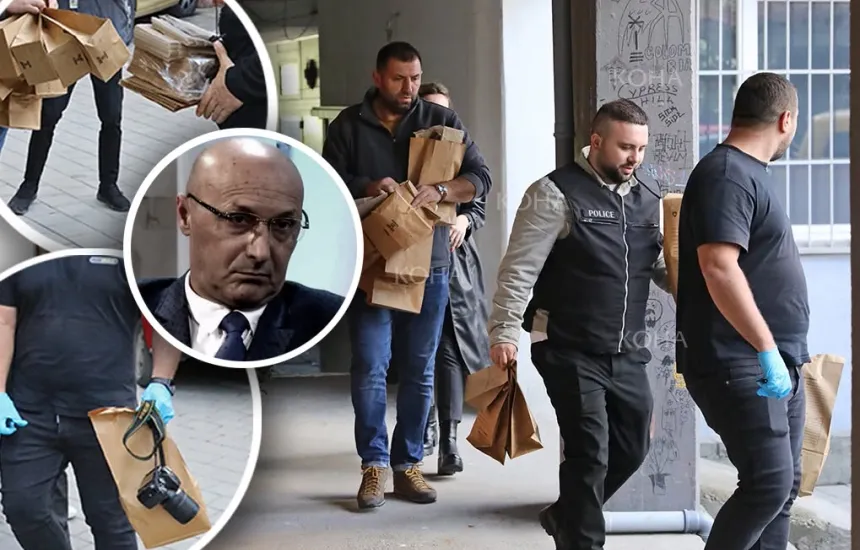
Footage from the Police and Prosecution's raid on Fatmir Sheholli's apartment on the day of his arrest (October 9, 2025)
Photo: Driton Paçarada
The Kosovo Special Prosecution Office on Tuesday filed an indictment against Fatmir Sheholi for espionage and blackmail.
Among the evidence included in the indictment, which KOHA has obtained, is a "Top Secret 2" document found on Sheholli's cell phone, which aims to expand the influence of Islamic radicalization in Kosovo and the region.
In that document, which Sheholli sent to a person named Viktor Makedonija on August 5, 2025, the plan is outlined for the construction of mosques in visible locations near highways, schools, shopping centers, and also to triple the number of mosques in large villages. It is also requested that madrasas be spread throughout the country. The mosques, according to the document, would be built with funds collected "from Islamic embassies in Belgrade."
"The leaders of the Islamic communities of Serbia, Macedonia, Bosnia, Kosmet are under our control and are working to include as many people of Albanian nationality as possible with influence in sports, media, music and politics. Even in some political parties we have our people who work for us and who strongly support Islam and who are connected to Islamic leaders who are spreading Islam even in places where there has never been a mosque. In Western countries, our people have been delegated from the Islamic communities of Kosovo and Sandzak who are under the orders of our embassies in Switzerland, Germany and Belgium. With this, we will manage to divide the Albanians who live abroad, mainly in Switzerland and Germany, where the richest and most powerful Albanians who have supported Rugova live," the document states.
According to the document, the goal is to create an atmosphere in Kosovo where people feel as if they are living in a foreign country, and in this way, some of the youth will flee abroad and others will decide to convert to Islam.
"After 20 years, Kosovo will look like Kandahar. Western powers will change their minds about Kosovo and thus decide to return Kosovo to the jurisdiction of Serbia. When this is achieved, Serbia will have a free hand to repeat the persecution of Albanians in Turkey, but this time not through force but through religious leaders for employment and by offering them super conditions for migration to Turkey. For this, Serbia has the green light from the Turkish state," the document states.
The prosecution claims that the content of this document, viewed in conjunction with other evidence administered, is relevant to proving the nature of the defendant's contacts and activities in relation to the structures of the Serbian intelligence service BIA.