


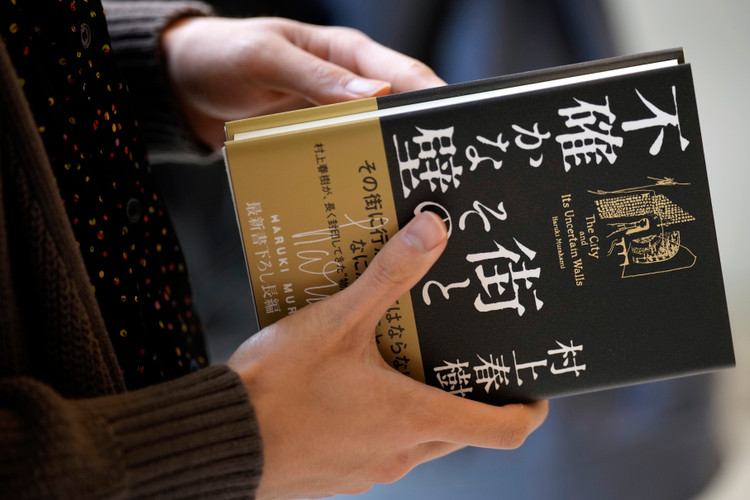
Haruki Murakami wrote about a walled city when he was still in the prime of his fame. More than four decades later, as a well-known and experienced novelist, he gave the novel a new lease of life as The City and Its Uncertain Walls.
Three years ago he felt it was time to revisit the story that he thought was imperfect but had important elements, such as the wall and the shadow, and treat them again based on what he felt.
"Because of the coronavirus... I hardly went out and most of the time I stayed at home as I dealt with what I had inside most of the time. Then I thought maybe it's time to write that novel," said Murakami. And he did it "as if he took it from the back of a drawer".
He started writing it in January 2020 and finished it in December 2022, years which were marked by many shocking events. "When I write a novel, I just know it's time," he said.
Murakami noted that during this time also Russia's war against Ukraine, shaken globalism and the Pandora's box of social media.
also Murakami takes the pulse of society in the face of trauma
"In a period when society was going through shocking changes where staying locked inside the wall or going to the other side of the wall had become the most important thing," Murakami had said before the publication of the book in Tokyo, in an interview with journalists selected, including those of "The Associated Press".
The City and Its Uncertain Walls was released in print and digital formats on Thursday by Shinchosha Publishing Co. There is nothing concrete about the English translation yet. This is his first novel after the 2017 bestseller, Killing Commendatore.
Murakami was not in Japan when the book was published. He has held seminars related to characters in his works at Wellesley College, the women's school in Massachusetts where former US presidential candidate Hillary Clinton and the late Secretary of State Madeleine Albright attended.
Initially, Murakami's intention was to rewrite the 1980 story "The City and Its Unsecured Walls" and improve it. But the story did not end there, and Murakami continued to write. The version published in the literary magazine Bungakukai was rewritten, then became the first chapter of what later became a three-part, 672-page novel.
In the second part, the protagonist takes a job as a library manager in a small town in Fukushima, where he meets his mysterious ancestor, and as the story draws to a close, he also meets a teenage boy.
Dozens of enthusiasts of Murakami's novels celebrated the release of his new book outside a historic bookstore in central Tokyo in a countdown event at midnight on Wednesday. Those who could not be there came to buy the book on Thursday morning.
"I'm very excited," said Kaori Otoh, an avid fan of Murakami's work, as she held Murakami's newest book in her hand. "I have to fight the urge to read the book during work hours." Kotaro Watanabe, 32, said he planned to read all night at a cafe with his friends. He has read the previous two parts of the walled city. "I can't wait to find out how this story ends differently," he said.
Murakami has said that getting to the other side of the wall requires determination, faith and physical strength. "You must squeeze all your powers, otherwise you cannot go to the other side of the world." The stories "are not at all pessimistic", he said. "Despite many strange things and the dark side, my stories are basically positive", the writer said. "I think the stories should be positive."
In some of his earlier stories, the protagonists travel between two worlds, through a wall, a well or a cave.
"I think that sliding through a wall, a process that involves going to the other side of the world and coming back from there, is an extremely important step," Murakami said.
He has said that there are many kinds of walls – between the conscious and the unconscious, the real and the unreal, and the physical walls that divide societies, like the one that once stood in Berlin and the barriers between Israel and the Palestinian territories.
also Salman Rushdie does not participate in the promotion of his first novel after the attack
Murakami has said that while writing the novel, he kept thinking about the meaning of the wall in this story. He said that walls can have different meanings and purposes, depending on who is inside.
Equally important to Murakami and his stories is the shadow. He says that the shadow is a form of his subconscious, or an alter ego, which resembles his negative side and helps him to know himself.
"Writing a novel, for me, means digging to that depth", he said. The distinction between the main body and the shadow becomes blurred in the book, which broadened the scope of the story. He said it was a difficult process and he had to rewrite it several times.
“I'm in my mid-70s now and I don't know how many more novels I can write. So I strongly felt that I should write this story with love and spend time to do so", he said.
Murakami, who debuted in 1979 with Hear the Wind Sing, has said that the original version of his new novel contained the key elements of wall and shadow, but that it was too complex for a novelist to handle. of the second rank.
It was then developed as part of "Hard-Boiled Wonderland and the End of the World", a bestseller of 1985. It is a combination of two pop stories and science fiction, filled with action and a fictional world of an isolated city with walls of the dead. If we look at it from today's point of view, Murakami has stated that even that effort was premature. He left that effort in the drawer, to rewrite it only after 35 years, although the story remained in his mind, "like a small fish knife stuck in his throat", he said.
Murakami has said that he began to feel confident about his ability to write when he was in the middle of his career, around 2000, just before he wrote Skull on the Shore, his best-selling novel, published in 2002. "Since then, a lot of time has passed and I thought that maybe now, finally, I can rewrite the incomplete work in 'The City and its Unsecured Walls'".
Now 74, twice as old as he was then, Murakami has said he is more taken with the stillness of his 1985 novel "World's End" than the pop action depicted in the next novel "Hard-Boiled Wonderland".
"You can't change it, and I think it's quite natural," he said. But he never tires of balancing writing novels, translating his favorite Western literature and, in recent years, hosting his own radio show. "I really like to write. It's fun to write and rewriting is even more fun."
It's his morning routine and he's run 40 marathons. "Translating, running and collecting used recordings", he said, as he mentioned his hobby. "I don't have time for nightlife, which might have been a good thing."
also From the Berlin Wall to Kosovo: When history binds the fates of nations
Taken from "The Associated Press".
Translated by: Mirjete Sadiku

