


"In the Mood for Love" is a cinematic marvel that transcends linguistic boundaries, speaking a universal language of longed-for desires and unfulfilled dreams. The director intends to fascinate us through the effects that only the art of film can give, revealing its subtleties and immersing us in the emotional depth. Time has shown that this film is a rare classic in the field of world cinema
Wong Kar-wait's In the Mood for Love serves as a testament to the exquisite craft of cinema – a dance between visual poetry and emotional depth. Within the frames lies a narrative that transcends time, revealing the fraught details of human relationships and the terrifying beauty of unspoken desires.
Su Li-zhen and Chow Mo-Wan, the main characters in "In the Mood for Love" find themselves entangled in a complex web of relationships, theirs and their partners'. Su Li-zhen's husband is absent from the film and busy with work, he often leaves her alone, inadvertently creating a void in their marriage. On the other hand, Chow Mo-Wan's wife is often distant due to her work, leaving him isolated in their shared home. Su Li-zhen and Chow Mo-Wan's partners are absent figures in the film, physically present but emotionally distant, paving the way for a subtle but essential connection between Su Li-Zhen and Chow Mo-Wan. The apparent neglect of their partners contributes to an emotional demand between them and their hidden bond that develops between Su Li-zhen and Chow Mo-wan as they seek pleasure and meaning in each other's company amid their challenges marital separation.
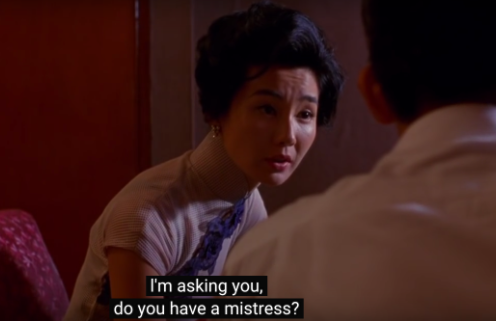
Examining memory, perspective and emotion
Against the backdrop of 1960s Hong Kong, Wong Kar-wai creates a world where elegance collides with melancholy, where glittering aesthetics mask the longing the heart feels. Every moment from the film's opening is a tapestry of slow imagery and evocative music. The film amazes the audience in a sphere where every frame is attached to nostalgia and restrained passion.
Wong Kar-Wai obsessed with the passing of time and infected with the romantic vision of a vanished past, "In the Mood for Love" is a typical film of his. However, by deprecating voice-over-image narration, Wong finds alternative avenues into the inner lives of his characters that expand cinema's potential to examine memory, perspective, and emotion.
At first, the new neighbor couples move into their new apartments on the same day, but the movers accidentally mess up their possessions. This proves the prediction, as their space, relationships and identities will inevitably be involved.
Significantly, Li-Zhen's husband and Mo-Wan's wife never appear directly in front of the camera, but are usually introduced through the phone, hidden from view as through gates, but not looking at their faces or facing the mirror . This has the effect of presenting them as "others", outside the main narrative of the film and deliberately distances them from the audience.
Wong suggests that through this theatrical technique, we see both relationships – the adventure of betrayal and the suppressed friendship of the protagonist couple. This absence of them also causes a structural discontinuity: if we cannot see them, then we judge them not as individuals, but as catalysts for the emotional experience of our protagonists.
The common cry before the disappearance
Also, Wong limits the issue of introducing a couple that these characters are played by Maggie Chung and Tony Leung, two of the most handsome actors in Hong Kong cinema. However, we also witness the suffering of the couple who are unable to realize their love – the cramped and overcrowded environment and the lack of privacy from gossiping neighbors and colleagues affect Li-Zhen and Mo-Wan's relationship. Wong gives us a glimpse into their struggles through a shared, agonizing cry before they disappear from the film entirely.
We also witness a brief sequence where Li-Zhen is seen crying in the bathroom; this is also repeated later when Li-Zhen allows herself to be intimidated by a sermon from her landlady. In both scenes, the editing prevents the moment from going too long, the director sharply closes the scene and shows the women's emotions explode in two parallel frames. The main difference is that Li-Zhen's pain is based on what she wants to do. She experiences a simulation of the other woman's experience, driving her into pure despair.
Likewise, after Mo-Wan and Li-Zhen have confirmed their knowledge of their partners' adventure, we see them flirting with each other on the street. The genre and narrative lead us to assume that their love is over, but Li-Zhen suddenly stops. She criticizes Mo-Wan for her portrayal of her husband. The scene resumes similarly, but with small differences: because now we realize that they are pretending to be the unfaithful couple, starting the adventure.
The sequence acts diegetically – the couple has an attempt at a second role-play. In the following scene, the couple imagines Li-Zhen confronting her husband with her suspicions. This time, Mo-Wan disagrees with Li-Zhen's performance and the scene begins again until Li-Zhen breaks down in tears at the pain this has caused her. The scene starts again as before, but with small differences: now we realize that they are pretending to be the cheating couple, starting their adventure. This is a consequence of a seemingly simple question from the previous scene about the beginning of the relationship.
Usually, imitation introduces us to the real emotion and replaces the actual event. All the while, the couple is afraid of rumors that their open and visible relationship could cause trouble, although their spouses are the real traitors and both protagonists seem to avoid them. Likewise, Li-Zhen's employer's extramarital affair is ironically managed through Li-Zhen's help with diary-keeping, gift-buying, and relationship advice. Meanwhile, Mo-Wan's friend Ar Ping is not shy about openly discussing his bad debts and brothel visits. The fear and regret that Li-Zhen and Mo-Wan experience comes from within, deepening their awareness and anxiety about what others might say, rather than what they actually say.
Wong presents us with an overcrowded Hong Kong through cinematography and mise-en-scène design, portraying the characters with elegance, grasping at doors or leaning on mobiles.
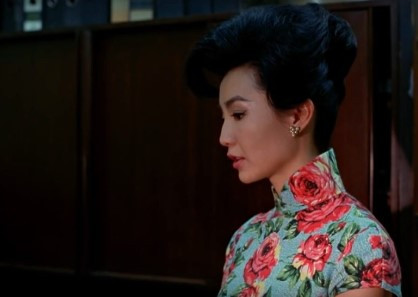
Maggie Chung is styled in 22 different chiangsans (traditional dresses) decorated with perfect elegance to play the role of Li-Zhen, making her look like a work of art – sculpted, desirable, inevitable. Mengyang Cui (author) has noted the importance of costume in the scene where Li-Zhen briefly confronts her love rivals who come from behind for a game of mahjong.
Li-Zhen's plain high collar chongsam stands out from Mrs.'s ornate dress. Chow, which is designed in the western style. Li-Zhen's elaborate and untouchable hair style differs from the other characters' hair styles that adhere to 1960s fashion. Chow, too, comes with a dashing movement that contrasts with the elegance and poise that Maggie Chung brings to her role. This short sequence, Cui says, proves Wong's method of expressing certain meanings or feelings by hiding them and partially revealing them.
We might add that this is precisely the function of Chung's elaborate dress. Wong also uses those chongsams to overlay the narrative through several montages that seem designed to disorient the viewer. The shooting technique that Wong uses is when the camera pans between two characters and this looks like a continuous scene, but we notice that it takes place at different times only by the sudden change of clothing, perhaps these shots suggest how the repetition and rituals dominate the relationship between Li-Zhen and Mo-Wan.
The distance between memories and the present
In a dual form, the film's final title also meditates on the distance between past and present memories. The past is something he can see but not touch, and whatever he sees is dim and indistinct.
Have we gotten to know the perspective of Mo-Wan's worldview? This presents a challenge – the pair miss each other in the final scenes of the film, especially when Mo-Wan returns to the old apartment in 1966. He cannot come to terms with Li-Zhen's separation from her husband and the role of her as a mother, which we can presuppose, but not fully confirm. Wong has us lost by the overload of doubt and unclear sensations along the logic of the event.
Wong as the master of the camera offers us a multiple expressionism of perspectives and invites us to also oppose but also accept the absurd. Li Zhen's climb up the stairs to Moan's hotel room seems like an avenue that creates the possibility of their relationship coming to fruition. Logically, she travels to her goal, but the montage gives us the impression of doubt and internal moral conflict. Moan's closing of the doors as she leaves also clearly marks the number 2046, notifying the viewer of the date of Hong Kong's annexation by China—an odd effect that stands out in such an emotionally charged film, past the narrative to a fact that will happen.
"In the Mood for Love" is a cinematic marvel that transcends linguistic boundaries, speaking a universal language of longed-for desires and unfulfilled dreams. The director aims to fascinate us through the effects that only the art of film can give, revealing its subtleties and immersing us in the emotional depth. Time has shown that this film is a rare classic in the field of world cinema.