


Roman culture did not eliminate Illyrian culture, it stayed close to it, developed with it in a dialectical relationship, preserving its elements. These reinforce the Illyrian-Roman character of the material culture. Nor did the Latin language take the place of the Illyrian language, it did not become the living language of the people - just like the Greek language before and after - which was the language of culture, trade, official administrative language
In the municipality of Lis, there are Latin inscriptions so far only inside the city. More Latin inscriptions, almost half of their total amount, have been given by the city of Dyrrah and its district. In the villages they are very few, one per village, mostly from the XNUMXst century AD, then there are no more. We find it interesting to find recently in the village of Baldushk in Tirana a votive monument of the Dioscuri from the XNUMXnd century AD, where the dedication is written in Latin and Greek.
While in the inscriptions of rural localities the anthroponomy is Latin and is understandable, because we are dealing with new italics - in those of the city of Dyrrah it is mixed. There are not a few inscriptions bearing traditional Illyrian names, such as: Sura, Anula, Anai, Anaja, Pladomen, Beni or ethnic Illyrians such as: Scodrina, Epetinus, Naissus and Nutria. There are also Illyrian names in Skampa's inscriptions. The names Plator, Dona, Advena and Satria indicate the existence of a local population before the arrival of the Italics. There was a limited spread of Latin inscriptions in the urbanized province of Atintania, in a developed Illyrian environment with strong Hellenistic influences. They are mainly found in the city of Bylis and its close suburbs. The last province with Latin inscriptions is Kaonia - they were used almost exclusively in the city of Butrot.
Reduction of Latin inscriptions
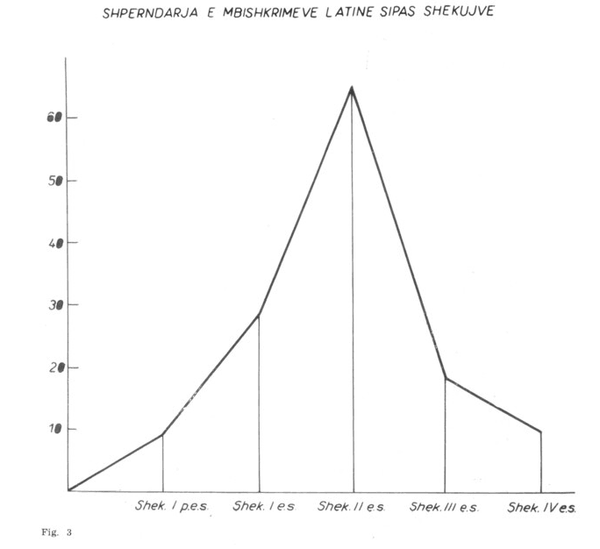
If the geography of the spread of inscriptions is limited, their division has given this diagram: the first Latin inscriptions, quite few, appear in the second half of the century. Ours, they are being added in the century. I of our era and reach the largest number in the XNUMXnd century. In the XNUMXrd century of our era, their number decreases a lot and they coexist with inscriptions in the Greek language even in the Roman colonies.
In the XNUMXth century AD, before the fall of the Roman Empire, there are no more Latin inscriptions, excluding milestone stones and any with religious content or related to military constructions. Without going into other data, I want to point out a detail that is revealing and deserves attention: the small number of Roman soldiers in the Latin inscriptions of Southern Illyria.
also Survival of Illyrian traces
Of the few we have, three come from Dyrrah and belong to the soldiers of the legions formed in the province of Macedonia, while the other two from Bylisi and Skampa are related to Roman citizens, who made their military careers outside of Illyria. In relation to this fact, it is good to remember a phenomenon that has caught the eye of some researchers: in the epitaphs of Illyrian soldiers, found inside and outside of Illyria, with the exception of some dyrrahas, there are none that come from the provinces of Southern Illyria.
Romanization is not proven by archaeology
I believe that the data presented provide an answer to the most important issues related to the southern Illyrians in the century. I-III of our era. We have tried, following the various processes of transformations that occurred in the first two centuries of our era, to point out their consequences. On their basis, one cannot talk about anthropogenic changes, which have given a new appearance to our territory. Roman culture did not eliminate Illyrian culture, it stayed close to it, developed with it in a dialectical relationship, preserving its elements. These reinforce the Illyrian-Roman character of the material culture. Nor did the Latin language take the place of the Illyrian language, it did not become the living language of the people - just like the Greek language before and after - which was the language of culture, trade, official administrative language. The attempts of old and new historiography to increase the weight of the Italic and Latin-speaking population in relation to the Illyrian population and consequently the Romanization of the latter, are not proven either by ancient written sources or by archeology data. Nothing proves it, not even the Latin inscriptions with their "spread and density". An influx of Romans and Italics in South Illyria, as in other Roman provinces. The Roman colonies with their suburbs remained isolated and were destined, as happened later, to dissolve into the local population, being eliminated as such.
Revitalizing the local element
It is self-evident that none of these facts support the opinions that the southern Illyrians escaped Romanization only in a closed province like Mati or that after the XNUMXrd century there were no more Illyrians, but a Romanized population. In our days, the problem of Romanization and the process of carrying it out among the peoples that were part of the Roman Empire has been widely addressed. It has already been accepted that Romanization was conditioned in the first place by the extent of the spread of the Latin language. And it seems right to us that "a Romanized population is a population that speaks Latin, that has acquired a worldview, because it has adapted Roman beliefs and customs and elements of spiritual culture. However, the linguistic fact remains decisive, without which one cannot speak of a true Romanization". In the southern part of Illyria, this linguistic fact is absent. However, there are other facts that do not speak in favor of romanization, but in its opposite. They become clearer in the XNUMXth century AD.
An Illyrian renaissance
At the end of the XNUMXrd century and especially in the XNUMXth century of our era, the Roman Empire enters a period of long crisis, which will end with its disintegration. Tracing through archeology data the internal development of the southern Illyrian territory at this time, we notice that the transformation processes are carried out this time in a new direction, in the continuous revitalization of the local population and in the strengthening of its ethnic character.
A new stage begins, which we have called the Illyrian renaissance, with visible changes in the economic, social and cultural life of the autochthonous population and with the revival of the old structure. The almost three-century period of the Roman colonies, their economic and cultural importance and the Romanization policy of the Roman Empire comes to an end. The archaeological material is quite expressive, it shows the density of material culture and the increase of production, the preservation of the tradition of Illyrian civic ceramics, etc.
A special value is the fact that it is not the cities or towns that have weakened or decreased in number that play the main role, but the rural settlements that increased numerically and with a demographic increase, related to the importance that agriculture had gained at that time. The inhabitants of these settlements appear to us rather as free peasants, organized in the old communities, who, in the long resistance against the invaders, had shown a strong stability and had constituted the most compact group of the Illyrian population. Along with agriculture, various craftsmen also developed, which in the southern part of Illyria produced a wide circle of consumers, often having their workshops near rural settlements. We will talk about these social layers below, without forgetting one thing: their manifestations are still modest.
A population devoted to agriculture
also The helmet of the Illyrian military aristocracy
For the knowledge of the development of agriculture and Illyrian rural settlements in the XNUMXth century, several small cemeteries with an unusual inventory for the first centuries of our era are of great value. In the inventory of open graves, agricultural tools and woodworking tools are common, sometimes predominant; they are mostly accompanied by clay pots, metal ornaments and rarely weapons. Judging from their inventory, these graves all belong to a population that practiced agriculture. This inventory is rarely rich.
As we have found it in the tombs, it can be taken as an indicator of a certain well-being and at the same time of a certain equality that existed among the population to which it belonged. From the inventory of the graves, we have accumulated quite meaningful facts, which shed light on the state of the Illyrian peasantry in the III-IV centuries.
It had in use agricultural tools of all kinds, inherited from the pre-Roman period and taken over by the Romans, a developed and multicultural agriculture. As a whole, they are products of local blacksmiths. But this is only one side. Taking a look at their locations, we notice that graves with an inventory of agricultural tools and other objects have not only been discovered in the coastal lowlands (in the area of Durrës, Lushnja, Fier), but also in mountainous interior regions where there are no archaeological finds for the first centuries of our era in Mat, Mirdita, Dibër, Gramsh, Mokër, etc.
Ancestors of arboreal fibulae
In all the sites, the agricultural tools have similar shapes, which shows that interprovincial relations had already been established, which led to the unification of the material culture throughout the territory of Southern Illyria. In the century IV change, become more diverse, some types of jewelry, mainly those related to the traditional clothing of the Illyrian population. They actually belong to the stock of Roman provincial material culture of the late Empire, but they have sometimes acquired new properties: particular types used in some provinces are preferred, while other forms of ornaments have a different distribution.
For this we have considered three types of fibulas. The first are the "Armbrustfibel" chest fibulae, of the onion head type, which are found throughout the territory of Southern Illyria. In the finds made in the provinces of Labiania, Parthina and Dasaretia, fibulas of this type are more massive and in some localities will continue even in the XNUMXth and XNUMXth centuries. In these regions, the first specimens of massive fibulae with bent legs, predecessors of fibulae characteristic of the Koman arboreal culture, characteristic of heavy clothing, were also found. In the provinces of Atintania and Kaonia, fibulas of the "tweezers" type are preferred, suitable for a lighter outfit. By tracing the inscriptions of the III-IV centuries, found in our country, we have encountered "a new linguistic fact", different from that of the first two centuries of our era: the language of the inscriptions, like the language of the superstructure, is Greek ; at first it coexists with the Latin language, to then become the only language of inscriptional documents in the provinces south of the Mat River.
The reappearance of Illyrian names
The inscriptions we collected this time are few, a total of 85. Most of them came to light in the cities of Apollonia, Amanti, Bylis and Butrot, and the others come from rural localities. The geography of their spread is quite different from that of Latin inscriptions. They have been found in villages, where before there were no inscriptions, in new villages. The priority is the province of Atintania, which continued to be - of course more modest in size - still more urbanized. Kaonia, Parthinia and Dasaretia also have Greek inscriptions. The distinctive feature of these inscriptions is anthroponymy. Latin names and traditional Hellenic names are still read in them, the old Illyrian names have also been preserved, some of which - such as Ghent, Plator, Klitus, Epicades - remind you of well-known figures from the history of the Illyrians. The province of Dasaretia has only Illyrian names. The last group, without a doubt the most important, consists of the new names belonging to the lower citizen and peasant classes, who had become an active and more promising element for the future. (Anthis = Flower, Smaragdos = Emerald, Pathos = Desire, Hariton = Beauty, Praktikos = Active, Damalis = Heifer, etc.). The Illyrian peasant population, as before and in the new stage of resistance against the Romans, shows a visible vitality in the field of art as well. At this time we find the end of the long reign of classical art that freed the local creative forces, until then suppressed by this art. Clear evidence of this renaissance of the art of sculpture and of great documentary value are some reliefs found in recent years, which open a beautiful and unknown page of Illyrian art. The reliefs represent local residents, working people, farmers and artisans, and as works of folk stonemasons, express the worldview and culture of the local population. Although they sometimes seem to repeat well-known iconographic scenes, they are independently crafted works with a completely defined artistic conception. As primitive as they may seem with their slightly odd proportions, they have a special charm.
Continued in the next issue of the Culture Supplement
also Rome in the Balkans, Illyricum at the crossroads and the origin of peoples
Paper read at the II Assembly of Illyrian Studies, Tirana, 1985.
The mestizos belong to the Editorial Office

