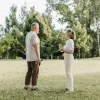
Aging is seen as something to hide, not to be honored, when once aging also showed a kind of wisdom since the old man was the one who had experienced life and knew more than everyone else. Grandmothers no longer proudly show their wrinkles, but spend on “anti-aging” treatments. Men are afraid of gray hair and add artificial hair. Youth has become a violent standard, forcing everyone to compete with their 10-20 years younger versions. This is no longer a matter of health, but an identity obsession. A construction of a culture where appearance is more important than content
Yllka Macedonian
Since the dawn of humanity, man has lived with a curse that has followed him like an inevitable shadow: death. And in the face of this curse and this helplessness, man (mortal) has nurtured a dream as old as myth itself, to stay young forever. This is not simply a desire for a longer life, but for youth, for that youthful glow, for smooth skin, for a physique, for a wrinkle-free appearance.
In our times, this desire has become more evident than ever before. All the mirrors of the world – from social networks to cosmetic advertisements – urge us to be youthful, beautiful, eternal. Plastic surgery, serums, filters, fitness, strange diets – all are eager attempts to cheat time. But is this just an aesthetic issue? Or is there a deeper anxiety behind it – the fear of death, of oblivion, of disappearance?
Since the Epic of Gilgamesh, one of the earliest known texts, man has faced this dilemma. Gilgamesh, after losing his friend Enkidu, is shocked by death as the end that awaits him and sets out on a journey to find the herb that will make his life eternal. He fails even when he finds it, reasoning that eternal life is reserved for the gods and man remains mortal.
The themes of youth, immortality, divinity, gods, demigods, and all other creatures that essentially had a lifespan are themes that have intrigued the human mind and creativity.
also Doctor with 30 years of experience: The obsession with living long has gone too far
“The Picture of Dorian Gray” by Oscar Wilde is a masterpiece about Dorian, a handsome young man who curses his portrait to age in his place. He gains eternal youth, but the price is his soul. The portrait becomes increasingly uglier, reflecting the sins that his youthful body hides. The eternal beauty turns into a dark form.
Even films, including “The Age of Adaline,” raise similar questions. Adaline, who no longer ages after a mysterious accident, lives a long but lonely life. She loses everyone she loves, because everyone else dies except her. Eternal youth does not bring her happiness, on the contrary, it isolates her.
Aging is seen as something to hide, not to be honored, when once aging also showed a kind of wisdom since the old man was the one who had experienced life and knew more than everyone else. Grandmothers no longer proudly show their wrinkles, but spend on "anti-aging" treatments. Men are afraid of gray hair and add artificial hair. Youth has become a violent standard, forcing everyone to compete with their 10-20 years younger versions.
This is no longer a health issue, but an identity obsession. A construction of a culture where appearance is more important than content, and time is seen as an enemy – not an ally.
Is aging really a curse? Or a privilege? In a world where so many people die young – from disease, from wars, from accidents – is having the opportunity to grow old really a blessing? Does having wrinkles mean you’ve laughed a lot, cried a lot, lived a lot? Is every wrinkle a memory. Is every gray hair a testament to life?
Japanese writer Haruki Murakami says: “In the end, death is not the opposite of life, but a part of it.” And perhaps that is why eternal youth is just a beautiful fantasy – because without end, life loses meaning. It becomes flat, endless, and, consequently, worthless.
also Don't scare yourself into aging: Simple ways to protect your brain
The elixir of eternal youth has probably never existed, and it's a good thing it doesn't. Because man is beautiful precisely because of his limitations – that there is no time to waste, that everything is stronger when we know that life has an end.
Maybe we don't need an elixir. Maybe we need a deeper way of living – more present, more loving, more meaningful. Because living authentically is the highest form of eternity.