


-
By:
Col. Mehmeti

- June 13, 2021 10:13
- Share to:
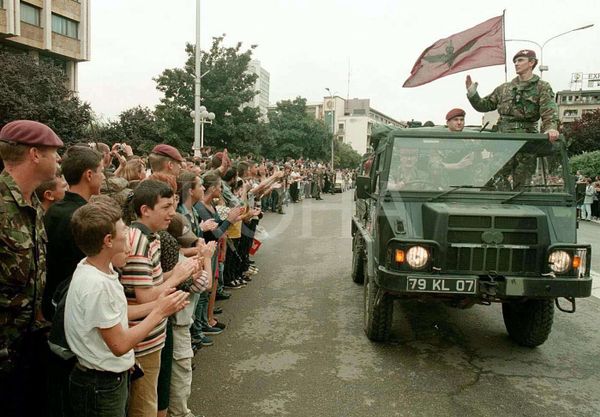
Here and 22 years ago, June 12 in Kosovo would gain the status of a memorable date for posterity. For the citizens of the capital, on June 11, liberation was approaching when the boot of the last Serbian soldier began to be removed. With small children rushing towards the British soldiers and crowds of people welcoming the Allied troops, the events of that time have another narrative. Heard, experienced, but not understood. Because what started as "marsh-brosok na Prishtinu", not only resulted in the Russian occupation of the heart of Kosovo, but almost brought a third world war a few months before the twentieth century ended its long drama . But the anxiety of the nightmarish Russian toy of "Babushka" preserves the consequences even today: the division of the northern part of the country
The twentieth century, as the era of extremes as Eric J. Hobsbawm called it, would close its curtain with another drama. What had begun in 1914 with trench warfare, bayonets and operations, in 1939 with a bid for world supremacy, would be followed by the last act in trolling the old continent. From the dispute between the Bulgarian and Greek armies about who would enter Thessaloniki first in 1912 to the "D-Day" of the Battle of Normandy, the story of a century of extremes would be added to what happened in and around Pristina. .
As the 22th year since the liberation of the capital of Kosovo draws to a close, a story that includes an ephemeral Russian occupation, diplomatic irritation and gun-running does not resonate as something that has been heard enough. Or at least not in her head.
As Erasmus said
When the West crushed the last aggressive state, the "Normandy" of the allies in Kosovo, ruined by Serbian crimes, was different. Unlike the critical event 55 years ago when Allied soldiers were being reaped from the scythe of death by machine guns and enemy fire, the West was now being welcomed by the Albanians, whose plea for help was honored for the first time in a century predestined by diplomacy. in London, Paris and Yalta.
With NATO's intervention for the rights of Albanians, what Erasmus of Rotterdam once said took on a tangible meaning. "If the war becomes inevitable, he wrote, all the atrocities and disasters fall on the heads of those who are guilty of starting it."
also Drama in 24 hours: the Russian occupation of the heart of Kosovo and Liberation Day
"Toropit'sya!"
A "Toropit'sya!" (Hurry) as a result must have bored the camp routine of the Russian soldiers serving as peacekeepers in Bosnia. Until Friday, June 11, was approaching, the pitch black night was buzzing with something incomprehensible.
In the ruckus of military boots, the orders of superiors and the rush of tanks and armored cars, it was impossible to understand why that sudden haste. In the end, soldiers only "implement orders".
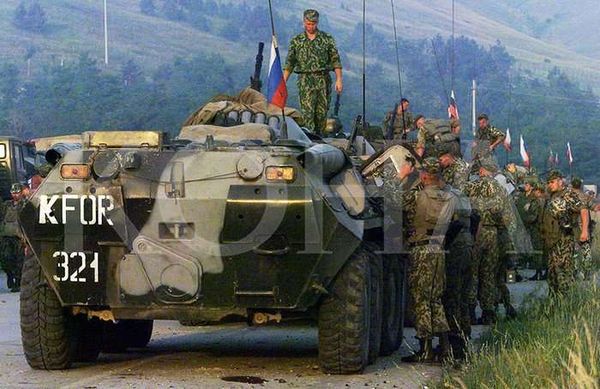
Someone had taken care to change the mission acronym of the tanks from "SFOR" to "KFOR".
General Zavarzin teaches...
That same day, the West had declared the end of the effort for Kosovo.
Even the "East", with Russia barely preserving the former ghost of Mujshara, had agreed to deploy international peacekeepers in Kosovo.
The sense of normality was reinforced when during the day Russian President Boris Yeltsin himself described as a diplomatic victory for Russia its contribution to the end of the war in "Yugoslavia".
And yet, a convoy of 30 tanks and armored vehicles was leaving Bosnia, coming back through the border signs at the Pavlovića Ćuprija crossing.
Under the command of General Viktor Zavarzin, 230 Russian soldiers could not have imagined that when they left Belgrade and headed south to Niš they were heading for a drama that would almost ignite the last unexploded power of the Third War.
A moving masquerade
The sky of Pristina had not yet turned turquoise, when around 5:00 in the morning there was a noise of movements, vikamas and cheers in Serbian from the center of the city.
Dozens of Serbs, mostly elderly, had occupied both sides of the street in the center of Pristina and were greeting the Russian motorized convoy.
Serbian and Russian flags flew among the Serbian residents, the only ones left after the entire Albanian population had been removed from the capital of Kosovo. In the span of a few minutes that the surreal masquerade lasted, already when the morning white was shining more fully, the lights of the trucks and armored cars of the Russian convoy seemed like a theatrical sign of a spectacle... that almost none of the noisy crowd guessed that what were his goals.
"Without warning"
In fact, every history of the last three decades of Kosovo tends to spend the most ink on the long debate over whether or not to intervene militarily to end the Serbian genocide of the Albanian population. Although Yeltsin had not opposed the West in this effort, "Russia has always been a strong ally of Serbia and was the main supporter of Serbian positions in Kosovo", writes Robert Elsie in the "Historical Dictionary of Kosovo".
In the voice devoted to relations with Russia, he notes that, despite declarative objections, in the end Russian forces participated in military operations that resulted in the withdrawal of Serbian troops.
"The Russians were expected to have their sector in Kosovo and they felt cheated when they didn't get it. Without any prior warning, a contingent of 200 Russian troops entered Kosovo from Bosnia and seized Pristina Airport on June 12, 1999 before NATO forces arrived, causing a tense standoff with the alliance," Elsie writes. .
Beyond any prediction
But this Russian lesson had not gone unnoticed. Since last night, information and information about the suspicious movements of the Russians had been knocking at the Supreme Offices of the Allied Powers. And this could not but break the spirit, especially among the allied forces stationed in Macedonia who, according to the sold plan, would have to enter Kosovo first.
It was 5:25 a.m. local time when British detachments from Bllaca and French military units from Slupçani and Likova started to cross the border.
In the annals of NATO history, this operation would be remembered as "Joint Guard", but it turned out beyond all expectations.
The British planes of the "5th Airborne Brigade" began to cross the sky above the Kaçanik Gorge to clear the way for the "4th Armored Brigade", which had to arrive as soon as possible in Pristina.
"And I see no bravery"
As much as it was a war almost lost with time, because at the same time the Russian troops had already entered Pristina and were moving to occupy the Slatina airport, every minute was precious.
A stern-faced captain was put in charge of the unit with paratroopers who were to be the first to move towards Pristina. His name was James Blunt, who after a few years would be humiliated as one of the most popular British singers.
Four years later, he would record the song "No Bravery" as a tribute to his days in Pristina: "There are children sitting here/ Arms reaching for the sky/ Tears on the cheeks dry/ ...And I don't see bravery/ No I see bravery in your eyes/ Except sadness/".
Serbian criminals flee
When the British and Norwegian units were being launched down Veternik, Russian troops had already landed at the airport. From the southern "gate" of Pristina, the British units traversed the western neighborhoods of the capital as if in a semi-circle.
Film footage and photographs managed to capture only a glimpse of that not very frequent drama in history: columns and columns of motorized brigades of the Serbian army were retreating and following the road north towards Nis.
"There is complete confusion"
also 21 years...
According to the French researcher, Laurence Binet, the sudden Russian maneuver caused a significant confusion within NATO, which had the tag to deploy peacekeeping troops in Kosovo.
"The move was completely unexpected for the troops stationed in Bosnia to enter Pristina via Yugoslavia before the agreement was reached on the nature of the Russian contribution to KFOR", writes Binet in his book "Violence against Kosovar Albanians, NATO's intervention 1998-1999" .
Even in Brussels, the shock was felt strongly. "There is a complete confusion", was the answer of a NATO official.
But the Russians were doing the phlegmatic, what I don't know yet what is likely. In a statement for CNN, the Russian Foreign Minister, Igor Ivanov, was quoted as saying that the arrival of Russian soldiers was "unplanned" and that there was no authorization from the Kremlin. "The situation is being investigated", Ivanov added, "and the troops have been ordered to leave Kosovo immediately and wait for further instructions".
Genesis of division
But what happened on that June day in Pristina? Historians, researchers and journalists have piece by piece reconstructed the mosaic of what constitutes the Russian occupation of Pristina and the heart of Kosovo.
An expert on Eurasian affairs and circumstances, Gordon M. Hahn, places this Russian effort within the difficult relations between the Kremlin and the West during the 90s.
For those who had followed the kaleidoscope of Moscow's internal politics, this action was seen as "an act of resistance after a decade of humiliation by Western dictates".
"The so-called 'march to Pristina', which took place on June 11, 1999, when Russian forces who were on a United Nations peacekeeping mission in Bosnia on the eve of the first Yugoslav war were resettled in Kosovo, unilaterally, at Pristina International Airport in order to establish an independent mission under Russian command", writes Hahn in his book "Ukraine Over the Edge: Russia, the West and the 'New Cold War'".
"The Russians rejected subordination under the command of NATO and demanded that a peacekeeping operation be set up to protect the Serb-inhabited north of Kosovo and perhaps even make a separate Serbian enclave".
"Thumping the table"
But only one man would raise the alarm about the extent of the Russian danger. Not understood even by his inner circle, this brought him face-to-face even with his own subordinates. Upon being informed of the Russian move, the supreme commander of the allied forces, Wesley Clark, would order the British and French advance troops to go by helicopter to Slatina and take the airport out of the hands of the Russians.
The day after the Russian invasion, Clark would arrive at the Allied offices in Skopje. He was the only one who "beat the table with his fist", demanding that all roads be blocked to the Russians.
Clash of star generals
This persistence would confront him badly with the British general Mike Jackson, who was appointed as KFOR commander. The latter was not saying that he was not obeying the American's order. The following dialogue vividly brings out the great conflict within the Allied camp:
Jackson: "You don't have that authority."
Clark: “I have this authority. I have the general secretary behind me in this".
Jackson: "Sir, I will not start World War III for you...".
Clark: “Mike, I'm not asking you to start World War III. I am asking you to block the roads so that we do not face an issue that will produce a crisis...there is no need to be confrontational…”.
Jackson: “Sir, I am a three-star general; you can't give me orders like this…I have my own judgment”.
Clark: "Mike, I'm a four-star general, and I can say these things."
The airport is occupied by the Russians
As military historian Lajos F. Szászdi notes, after failing to convince Jackson to follow through on his order to commit American helicopters, Clark would turn to his next subordinate, Admiral James Ellis, commander of the US Sixth Fleet in the Mediterranean. to send American helicopters in order to prevent Russian aviation from landing in Slatina.
"When the British and French troops tried to go to the airport, the Russians, claiming that it is their 'sector' for peacekeeping inside Kosovo, opposed the entry of the NATO contingents that approached the complex. The Russian occupation of the Pristina Airport was a courageous act, which confused NATO's initial plans", writes Szászdi in his book "Russian Civil-Military Relations and the Origins of the Second Chechen War".
Among the Russian provocations
Jackson himself may have felt within himself that his "superior" had been right: the Russian contingent looked like a hard bone. As soon as he arrived at Slatina airport, even as he was giving a press statement, "Russian personnel in armored cars were pointed up and down menacingly as if to remind everyone that they got there first."
What created an image in the Russian media and popular literature as "Prishtinski brosok" (March of Pristina), in those days brought full tensions.
The possibility of clashes was also close physically: even footage from the "Associated Press" chronicles how British and Russian soldiers targeted each other with their "finger on the trigger".
And sometimes he shot to cool the blood so much that Jackson and Zavarzin clinked glasses of whiskey. The latter would therefore be presented as a "hero" in the Kremlin. On July 8, Marshal Sergeyev, the Russian Minister of Defense, received orders from Yeltsin to make appropriate preparations for him to be decorated with medals.
"Thank you for Kosovo", the Russian president told Zavarzin.
No matter how much he insisted on diplomacy and force, he pretended to compete in a duel, the Russian "bear" would succumb to "starvation" in a short time. With airspace blocked across Eastern Europe, the infamous Russian contingent would soon feel the need for food. Those who on Saturday morning paraded as "triumphs" in front of a crowd of Serbs, in the following days "went around asking for alms for bread and water", which were then taken by the Italians, the French and the British.
also MrizMeanwhile, according to Elsiet: "The Russian troops spent a full 14 months at Pristina Airport before handing it over." "At the beginning of 2003, Russian forces withdrew from Kosovo, triggering financial issues."
