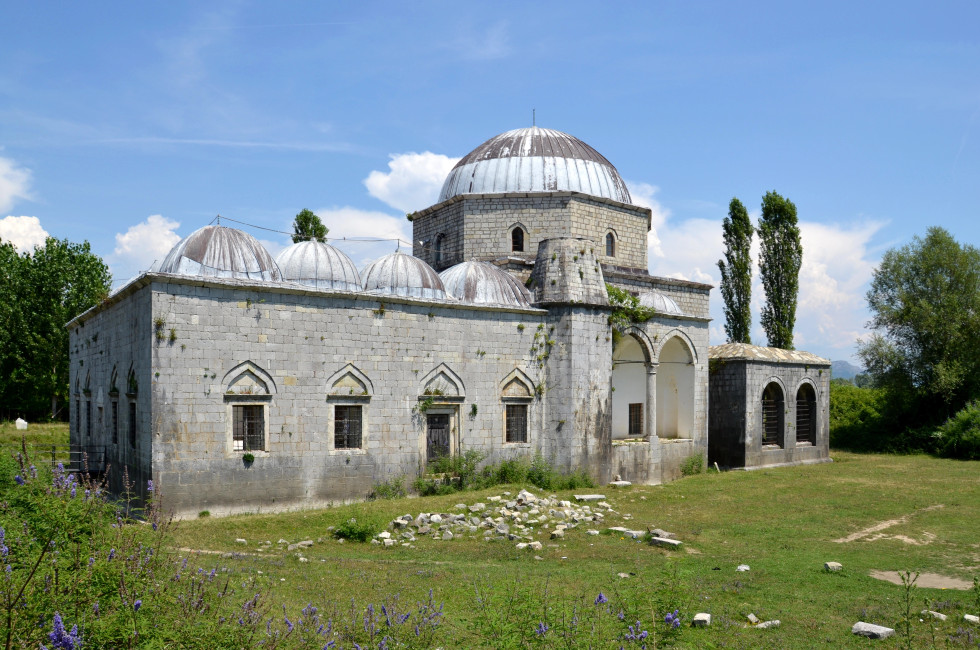


The Lead Mosque in Shkodra was inaugurated on Thursday after its complete restoration. At the ceremony in the presence of the mayor of Shkodra, Benet Beci, the ambassador of Turkey in Tirana, Tayyar Kağan Atay, and the mufti of Shkodra, Imam Muhamed Sytari, a project like this was described as the revival of one of the most precious monuments, over 250 years old.
Mayor Beci is quoted as saying that the full restoration of the Lead Mosque is a moment of pride as it restores the dignity of this unique cult object in the entire Balkans.
"You have turned a precious diamond of this city into a valuable asset, not only of history, but also of an architectural work of which we were very proud. Its return to the city is not only a gift, but also an opportunity to visit. This is the historical area for which we have made a project that will be an added value of the entrance to Shkodra", said the mayor of Shkodra.
Ambassador Tayyar Kağan Atay, in his speech, not only praised the investment made by the Turkish government, but also the complete restoration of this facility, which comes as a cooperation between the Governments of Turkey and Albania.
The mufti of Shkodra, Imam Muhamed Sytari, said that "this is a long-standing dream."
"The Lead Mosque is now emerging from the floodwaters and taking on a new look and entering a new era that keeps it connected to its centuries-old spirit," he is quoted as saying.

The Lead Mosque has been considered one of the 50 most beautiful monuments in the world and is the largest Ottoman-style mosque preserved in Albania, with a combination of other architectures.
also Monuments under monitoring after floods in Albania
The mosque, according to historiography, was built by Mehmet Pasha Bushati in 1773-1774, serving for a long time as the largest mosque in the country. It has a combination of Turkish and Arabic architecture and this is evident from the entrance. It enters an inner courtyard, covered with 12 domes and the main drum that goes up to a height of 20 meters. It is the tallest mosque in Albania dating back to the Ottoman period.
In 1948, the Lead Mosque was declared a cultural monument, receiving the status of state protection. In 1967, when religion was officially banned in Albania, the mosque suffered damage, especially with the demolition of the minaret, and at various times it was not officially used for religious services. The revitalization of this unique mosque in Shkodra included not only its deep restoration, but also the transformation of the surrounding space.