


-
By:
Shaban Maxharraj

- 21 May 2026 08:00
- Share to:
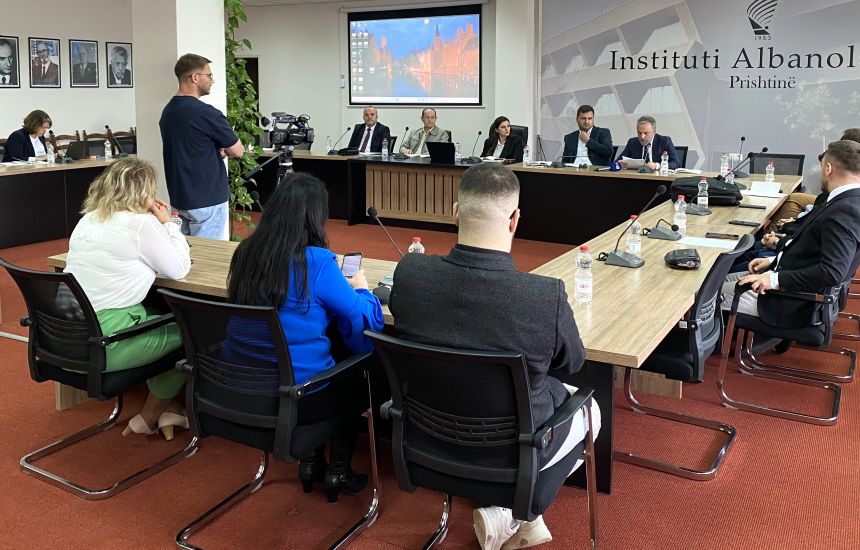
“Albanian historiography versus European historiography” was the topic of the history session on the third day of the “Albanology Week” where historians brought new findings on various topics. One of the topics was the days when the Ottoman Empire was showing signs of decay and an agreement of 1812 that provided for autonomy for the Serbs. Another topic was “Albania and Albanians in the Croatian discourse” as well as the Kosovo war, for which there are more foreign publications than domestic ones.
Comparing Albanian and European historiography always brings interesting data regarding the description of events and the views of the authors. In the history session, within the framework of the “Albanology Week” in Pristina, historians presented their papers that reveal different views from foreign authors, but also differences with Albanian ones. On the topic “Albanian historiography versus European historiography”, the participants in two working sessions presented their findings. Among the topics presented was that the Polish diaspora aimed for a large state of the South Slavs.
Historian Memli Krasniqi, scientific advisor at the IAP, with the paper titled “Polish political and cultural elites and the European discourse on the Balkans: influences, mediations and limitations in the context of the 'Eastern Question' (19th century)”, brought data that speak of the days when the Ottoman Empire showed signs of decay. His paper speaks of new goals. According to him, new political and civilizational values, inspired by the French Revolution and the Napoleonic era, began to penetrate even the Christian populations of the Balkans who were still living under Ottoman rule.
According to him, the weakening of the Ottoman Empire, which became particularly evident in the late 18th and early 19th centuries, attracted the attention of the European Great Powers, especially Tsarist Russia. He said that in this context, the Russian Empress Catherine the Great drafted in 1782 the project known as the “Greek Project”, which aimed to reorganize the European part of the Ottoman Empire through the creation of new political formations such as “Dacia” and “Great Greece”, with the capital in Constantinople.
Elaborating on that time in a geopolitical context, he said that the United Kingdom was strongly committed to maintaining geopolitical balance in the Mediterranean, considering Russian expansion into warm waters as a direct threat to its strategic and commercial interests.
"The Polish nationalist Adam Jerzy Czartoryski also acted in this political and ideological spirit, who, in his capacity as Minister of Foreign Affairs of Tsarist Russia, had drafted a secret memorandum on the political reorganization of Europe. In this project, in addition to the idea of a German federation, the creation of an expanded Poland was also envisaged, which would include parts of Prussia," he said.
He mentioned the Treaty of Bucharest between the Russian Empire and the Ottoman Empire in 1812, as an agreement that provided for autonomy for the Serbs. He said that at this early stage of his political activity, Adam Jerzy Czartoryski supported the Pan-Slavic concept and advised the Slavic peoples to orient themselves towards the Russian Empire. He later explained that after the failure of the Polish uprising of 1830, his positions changed radically and he began to oppose Russian influence in Eastern and Southeastern Europe.
also The seminar closes its 44th edition, bringing new knowledge and ideas to Albanology
"In these circumstances, Polish immigrant circles began to project the creation of a large state of the South Slavs, with Serbia as the political and military core, which in foreign policy would rely on France and the United Kingdom. Essentially, in the Balkans, the collapse of three great empires was being projected: the Ottoman Empire, Russia and the Austrian Empire, from the ruins of which new national states such as Poland, Czechoslovakia and an expanded Serbian state would have to arise," Krasniqi said.
Elaborating on the circumstances of those years, he has come to the conclusion that the European Pan-Slavic movements, whose ideological foundations were shaped in the first decades of the 19th century, aimed at the political and national emancipation of the Slavic peoples on the basis of Western state-building and civilizational models, but at the same time limiting the influence of the Russian Empire in Central and Southeastern Europe.
"In this context, political projects associated with Polish intellectual and diplomatic circles, especially those of the group known as 'Hotel Lambert', contributed to shaping ideas on the creation of Slavic national states such as Poland, Czechoslovakia and Yugoslavia," he said. He continued with the further history, where according to him these projects found support in France and Great Britain, as long as these countries were considered strategic barriers to Russian expansion and later to Soviet domination in Europe.
"However, the realization of these political and geostrategic projects often took place to the detriment of other non-Slavic peoples of Central Europe and the Balkans, especially Albanians, Hungarians and Germans," he said, then moving on to 1912, when Albania was declared a state, to continue until the end of the 20th century, when Albanians have two states in the Balkans.
"However, as in the 19th century, today the integration processes in the Balkans remain linked to historical rivalries, geopolitical interests and internal state-forming problems. For this reason, the perspective of Albanians in the 21st century will depend not only on international developments, but also on the ability of Albanian societies themselves to build functional institutions, the rule of law and coordinated national policies in accordance with European standards," said Krasniqi.
Historian Lulëzim Lajçi, also a scientific advisor at the IAP, presented the Croatian discourse on Albanians. “Albania and Albanians in the Croatian discourse: the contribution of scholars, travel writers and publicists” is the title of his paper. According to Lajçi, during the “Illyrian Movement” the most serious works on Albanians and their history appeared, and not by chance in “Danica Ilirska”. According to him, it is clear that the magazine “Danica Ilirska” wanted to inform its readers as much as possible about Albanians and their past. He said that in 1881, in the “Geografska biblioteka za mladež i puk”, published by Alfred Holder in Vienna, a book dedicated to Albania by Gjuro Gjurković was published.
He said that this is a geographical-historical overview of Albania, not in today's political borders, but in the volume that ethnically belonged to Albanians. Trying to fix the territory in which Albanians live, he mentions that this is a region surrounded by: Tivar, Sjenica, Prijepolje, Vranje, Skopje, Manastir, Kastoria, Gjirokastra, Arta and the Adriatic Sea.
According to him, within this territory the author describes the country, the people, their customs, folk songs, language and more. Lajçi said that the book has also been translated into Croatian and explained that in the introduction to this monograph the author presents the existing state of treatment of Albanian history, language and culture until the time when he visited Albanian territories in 1869 and 1873, when he writes that "Albanians are the descendants of the Pelasgians; that Albania is more of a national term than a political one and that Albanians until his time had never had a single Albanian state, because during Byzantine, Bulgarian, Serbian or Ottoman rule they were fragmented".
He said that, writing about the history of the Albanians, the author offers a brief overview of the circumstances that came to life during the Slavic invasions, the Norman conquests, the period of Dushan and the Balshajs, the time of Skanderbeg and Ali Pasha Tepelena, the Albanians in Plav and Guci, respectively the Albanians of the southern Sandzak of Novi Pazar. In this context, he also provides data on the migrations of Albanians to Zadar and Istra, the Albanian colonies in the Kingdom of Naples, as well as the migration of the Kastriots after the death of Skanderbeg.
He then focused on some details of the descriptions and indicated that at the end of this monograph the author proposes to all those who wish to become more closely acquainted with the Albanian language the studies of Mikloshiq, Hani and Dozon.
also Kosovo culture with more projects with Serbia than with Albania
"And for those who wish to learn more about the history of Albanians, the author offers a bibliography that he compiled from new and old studies that speak to all that he wrote above," said Lajçi.
On the third day of the “Week…”, historians presented various papers. Historian Durim Abdullahu spoke about the historiography of the last war in Kosovo, revealing different sources, views and narratives, to conclude that there are more works by internationals than local ones. He cited a number of reports from various organizations. Historian and head of the History Department at the IAP, Nuredin Ahmeti, spoke about the contribution of foreign scholars to the Scientific Conference for the 100th anniversary of the League of Prizren. Archaeologist Arjanit Buçinca brought the perspective of French archaeologists Pierre Cabanes and Jean-Luc Lamboley on the Illyrians, while archaeologist Zana Hoxha spoke about paleochristian architecture in Kosovo. And young historians Albin Halimi and Dren Brahimaj compared European and Albanian historiography on the Second World War in Kosovo. They have revealed how events like the Tivar Massacre, the Shaban Polluzha War, and others were almost completely ignored by Albanian historiography until the early 90s.

