


The ancient city of Laodicea in present-day Turkey has unearthed an extraordinary artifact: a two-meter-tall statue of the goddess Athena. The two-thousand-year-old sculpture was found in the city's western theater, where it lay face down amid the ruins. The way it was made demonstrates the ancient sculptor's high craftsmanship.
Archaeologists, exploring the ancient city of Laodicea in western Turkey, have discovered a monumental marble statue of the goddess Athena, about two thousand years old, wearing the armor of the mythological figure, Medusa.
The sculpture, about two meters high, was found in the city's western theater, where it stood among the ruins, lying face down. Although it is missing its head and parts of its hands, the preserved segments clearly show an extraordinary artistic value and a high level of carving. The statue is made of white marble and depicts Athena wearing a long tunic, a characteristic sleeveless garment, fastened at the shoulders, typical of women. The fabric is modeled with great care and the sides vary in depth and width, creating the impression of a natural fall of the material and testifying to the high skill of the ancient sculptor.
A cloak is draped over her shoulders and secured with a fibula at her neck, which constitutes a relatively rare iconographic variant for the representations of this goddess.
The aegis is particularly striking. It is decorated with scale-shaped motifs and surrounded by serpentine shapes. In the center is the representation of the severed head of Medusa Gorgon. It is a protective symbol that, according to belief, had an apotropaic function, warding off evil. An interesting detail is the diagonal side or stripe on the aegis, very rare in known representations of Athens and which may indicate a local artistic interpretation or a specific workshop.
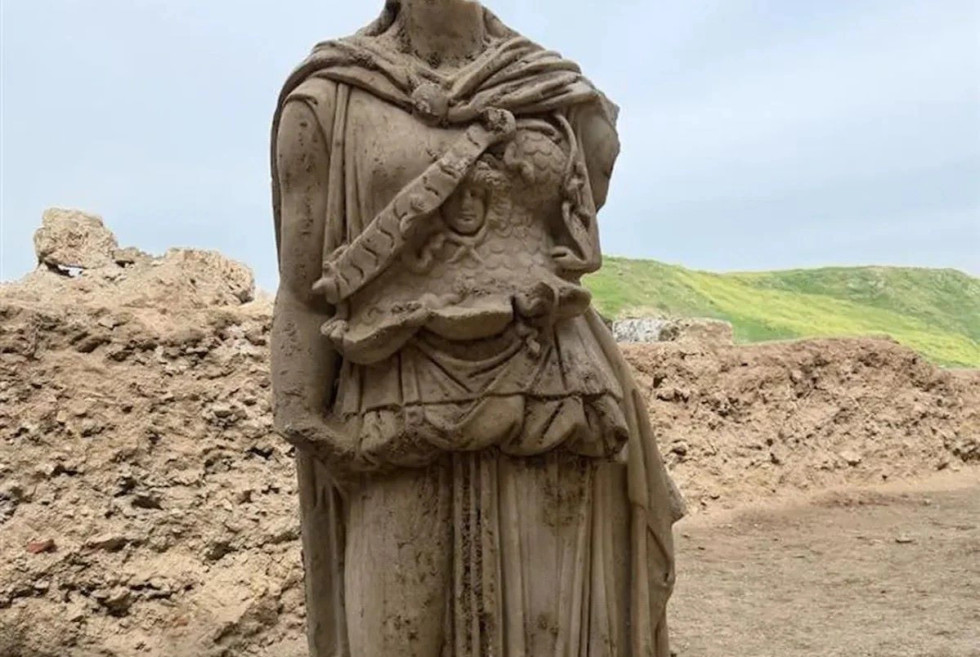
Stylistic characteristics place this work in the period of the reign of Emperor Augustus (27 BC – 14 AD), when there was a revival of classical artistic forms within Roman ideology. Additional evidence for the function of the sculpture is its back, which is left more roughly worked, suggesting that it was placed between columns, as part of the theater's scenography.
The theater at Laodicea, built in the Hellenistic period, was richly decorated and adorned with sculptures of deities, rulers, and scenes from the Odyssey, including the encounters with Polyphemus, the Lastrygonians, and Scylla. These representations indicate that the space had not only a performative function, but also a narrative and educational one, serving as a visual medium for the unfolding of mythological stories.
also 105 square meter mosaic in ancient city in Turkey
The city was founded by the ruler Antiochus II of Teos in the 3rd century BC, naming it after his wife, Laodicea. During the Roman period, Laodicea became an important commercial and cultural center in the province of Asia, known especially for the production of textiles. It is in this context that the cult of Athena should be seen, not only as the goddess of war and wisdom, but also as the protector of weaving and crafts.
The latest discovery is part of intensive archaeological research carried out during 2024 and 2025, during which a large number of sculptures related to the Homeric epics were found. Restoration work on the western theater will continue throughout 2026, with the aim of better preserving and interpreting this extremely important site.


