


-
By:
Besarte Elshani

- 23 May 2025 08:15
- Share to:
It has been gone for more than seven decades, it lives on in old photos and memories, but thanks to technology, a new chapter opens for the Old Bazaar of Pristina with the application “Be here then”, which revives it as a memory and experience. It allows users to walk through the Old Bazaar and meet characters who share their memories of it. In essence, a project like this has also been described as illuminating the future through the past
Apart from being the main center of commerce in Pristina, the Old Bazaar also gave the city a part of its identity and cultural heritage until the early 50s when it was destroyed. The space has been dismantled, but with the help of technology, the aim is to give voice to history through narratives and digital urban experience.
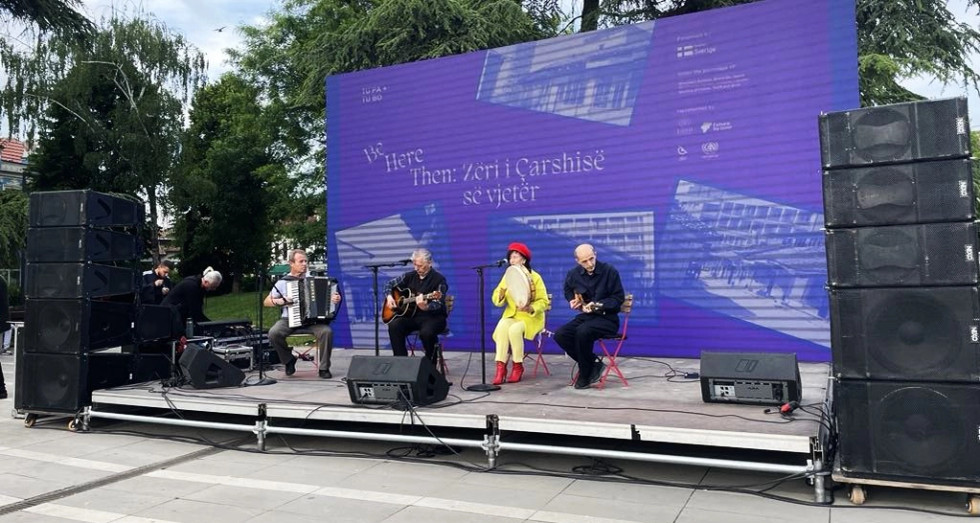
In the space considered the heart of that monumental area that no longer exists, the launch of the "Be here then" application has been inaugurated, which aims to revive the collective memory of the Old Bazaar.
Animated figures with scan codes and fragments of stories have been placed in the “Adem Jashari” square in Pristina. Not by chance, since this same space where the monument known as “Brotherhood-Unity” is located, the Kosovo Assembly and the Municipality of Pristina and the surrounding areas, belonged to this space. It was a re-experience in completely new conditions, in an alienated space.
From what has been seen in the app, "Be here then" allows users to walk through the Old Bazaar, destroyed over seven decades ago, and meet characters who share their memories of the Bazaar.
The activity "Be here then: The Voice of the Old Bazaar" was organized within the framework of the "See, Do" project funded by the Government of Sweden and implemented by Lund University in partnership with "Future by Lund", "Anibar" and UN-Habitat Kosovo", with the support of the Ministry of Culture.
also Van Gogh's World in Pristina as a unique experience beyond visual art
Ylva Sahlstrand, deputy head of the development sector at the Swedish Embassy in Kosovo, said that cultural values can be revived through art.
"What is very important is that we have some Swedish values to share with you and it is reciprocal: we learn from you, you learn from us. What you will see is the 'You see, you do' project and we have tried to show how different actors collaborate, who perhaps have not collaborated before. We must know that we must collaborate in order to revive these values of ours, whether through music, art, in order to showcase our art," she said.
As an example of this, he took the work "Tell me Your Story" by the Japanese artist Chiharu Shiota, who temporarily revived the Great Hamam of Pristina during the 100 days of the "Manifesta 14" biennial in Pristina, in the summer of 2022.
"Now I am very happy that this part of Pristina will once again be illuminated through technology that has not been used before. This application is very appropriate in this regard. Through the past we can illuminate the future and then this can also affect economic development. It will also be interesting for tourists," said Sahlstrand.
The co-founder and executive director of "Anibar", Vullnet Sanaja, said that we intend to do a similar project for other cities.
"We are very happy to be part of this process together with our partners. We have the privilege of working on a project like the one for the Old Bazaar of Pristina. We hope to do the same project for other cities, to see how we can transform our approach to these different spaces," he said.
Project Manager at UN-Habitat, Zana Sokoli, said that the message of the app is that history must continue to be passed on. According to her, "the past builds the future."
"Since some parts of the past can no longer be physically seen, because they do not exist, like the work of the Bazaar, we have decided that as an institution we will continuously support sustainable urban development, heritage and 'Anibari' with their part of design and animation, to use the technology that everyone is afraid of and the skills we have in design, to bring something that will help future generations connect with the place they come from, for us to be promoted more and for tourists to know more about us," she said.
also "Rilindja - Voices in Memory" unites librarians for future strategies
After World War II, under the slogan "Let's destroy the old, let's build the new," one of Pristina's most important cultural assets was destroyed.
According to the organization "Cultural Heritage Without Borders" in Kosovo, the main streets around which the Bazaar developed were the Old Street, which is also considered its core, (today the KLA street) and the Korzoja, which was also the main promenade of Pristina at that time and connected the Bazaar with the rest of the city where the Llokaqi Mosque was located (today a business building near the Theater).
"Traditionally, the main function of the Bazaar has been trade and craftsmanship, therefore shops have been the structures that have dominated its composition. In Pristina, all the characteristic crafts of the time have developed, such as: pleated skirt makers, saddlers, shoemakers, tailors, blacksmiths, carpenters, blacksmiths, tailors, barbers, tinsmiths, leatherworkers, ropemakers, farriers and others," it is written in the publication of "CHwB Kosova" entitled "Heritage of Pristina" from 2008.
The acting Minister of Culture, Hajrulla Çeku, and a representative from the Municipality, who were in the opening program of the event, were not present.
The urban development associate at UN-Habitat in Kosovo, Lyra Bakija-Vula, considered the "Be here then" application not only as technology, but also a memory and voice of previous generations.
"At a time when many are afraid of technology and what it can bring, we have chosen a different path: to use technology to bring the past to life, to remember values, to reflect on our development and to celebrate our cultural heritage. It is a special pleasure that we are holding this event precisely in this square, in the heart of the city, where the history of Pristina has begun to reveal itself," she said.
It is generally considered a unique experience that connects the past with technology.
also The treasury of Kosovo's art as a dialogue of times and revival together with the Gallery
A video animation created by the animators of “Anibar” was also presented, as were the characters who narrated the story. Edvin Susuri, team leader of “Anibar”, presented the application. According to the explanation, through the images it is revealed that there are also archival, historical and photographic data. They are displayed automatically, based on the images that the application records from the images of today's space. It projects the relevant space of the former Bazaar.
Even the food and music that accompanied the event were based on the Old Bazaar. Nezafete Shala performed a civic song with a band, while the walk through the spaces where the Bazaar once stood was led by urban planner, Blerina Boshnjaku - Nela.

