


Boghdan Sulanov, the vocalist in the current metal rock band called "YAD" walks backstage. He walks past a guitarist who has just finished an adrenaline-pumping performance, leaving him covered in sweat, and reaches the small table filled with audio equipment, tea and cookies. From under the table, he pulls out a backpack with the clothes he will soon wear on stage.
The concert hall, an intimate venue in the western Ukrainian city of Lviv, is covered in music posters, and on a night in early February, it's packed with several hundred rock enthusiasts eagerly awaiting the next performance. The atmosphere is electric and Sulanov is excited.
"Young people did not appreciate music in the same way as before the war," said the 33-year-old, referring to the complete Russian occupation of the eastern part of Ukraine on February 24, 2022.
"Our band always sings about our problems, and right now, we sing about the fact that we want to survive", said Sulanov while being carried away by the atmosphere behind the scenes.
During the weekends, Sulanov works as a software developer, but in his spare time he shines with rock. "All of us have to work, but we also need energy, and that can come from music," he said before politely excusing himself that he had to prepare for the concert.
also After four years of war, dance has become a form of resistance for Ukrainians
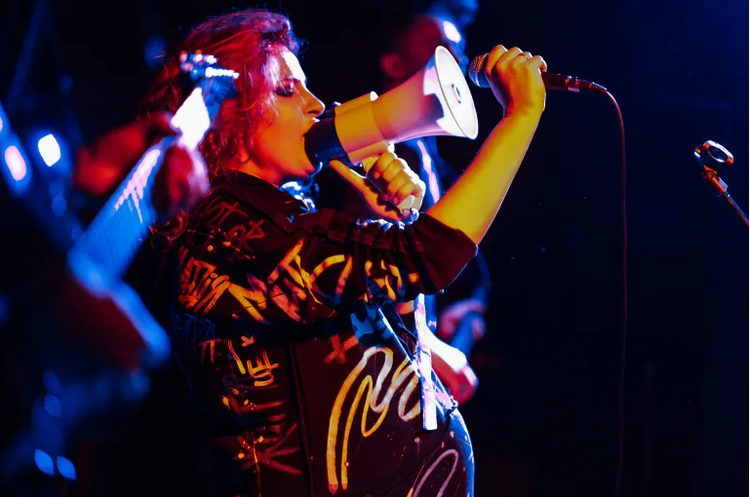
On stage, Bohdana Nykyforchyn, a 35-year-old singer with dyed red hair, screams into the microphone as her bandmate hits the drums.
Nykyforchyn transforms the room through a range of emotions, alternating between soft melodic tones and more aggressive, fast-paced vocals. At one point, her voice cracks and she looks like she's about to cry. Then she explains why. "I am eight months pregnant and my dream was to climb this stage," she said. “When the second song started, I felt all my emotions swell. My hormones are all over the place!”
Backstage, Sulanov has changed into his character as he appears on stage, dressed all in white. His eyes look out through a bang with the words "not nice" written on it.
The members of "YAD" run on stage and the audience, ranging from teenagers to middle-aged rockers with graying hair, erupts with excitement. People standing in the front row shout out the words to their songs, including a boy who appears to be about 10 years old. The guitarist stops wandering around the stage when he spots the guy and shakes his hand.
Marichka Chichkova, the event organizer who is helping out at the bar, admits that even though 'heavy metal' is not her favorite genre of music, she is happy to see everyone enjoying themselves. She looks up at the stage and says, “It's also liberating for the musicians; this is also very important".
Since the outbreak of war, underground music scenes in major Ukrainian cities such as Lviv and Kiev have seen a surge in creativity and popularity as musicians and music lovers alike. They seek to escape from the realities of wartime. In particular, techno and rock music have seen a new generation of DJs and bands burst onto the scene, incorporating the sounds and experiences of war into their music.
The place where Sulanov was playing is located in the basement of an elegant baroque building in the center of Lviv. It was used as a bomb shelter in the first weeks of the war, but after April 1, 2022, when Chichkova organized a charity concert, regular musical events have been held there.
Many of the bands that perform there, including YAD, donate any proceeds to the Ukrainian military.
In the break between the two performances, the event's organizers take the stage and auction off two items, a T-shirt and a framed family photo, to raise money for the war effort.
When "YAD" ends the performance with wild applause, everyone walks out onto the cobblestone square. People pile into the countless trams that line the historic quarter, making their way home before the wartime curfew begins at 23 p.m.
Max Antoniuk, a 30-year-old passionate about music, was impressed by the evening's line-up. Since the start of the war, there has been "an explosion of music-making", he explained excitedly. Previously, as he said, many musicians were motivated by the desire to be snapped up by a big music label, but now artists in Ukraine are "producing music without commercial interest", giving a big boost to the 'underground' music scene.
Denys Levchunets, an engineer by profession, is learning to play the guitar from one of the members of "YAD", this reflects how Ukrainian music trends have changed since the beginning of the war. "Now our existence is threatened, the topics have changed and the language has changed", explained the 30-year-old. "Many artists who used the Russian language before now only use the Ukrainian language," while musicians are more focused on topics such as Ukrainian historical heritage and national identity as well as issues related to freedom and democracy.
Ukrainians are also listening to local artists much more than they used to. Levchunets has climbed into the top 30 charts in Ukraine on Spotify and counts only two foreign artists, one Russian and one from the United States; the rest are Ukrainians. Before the war, he explained, foreign artists dominated this chart.
An eight-hour train ride east of Lviv, in the historic Podil district of Ukraine's bustling cosmopolitan capital, Kiev, is Closer, an underground techno club.
Various electronic beats flow through the dilapidated network of pedestrian crossings and graffitied buildings located next to the Dnieper River that bisects the city. It is late afternoon and the clubbers gather on a small terrace to smoke and get some fresh air.
There is a diverse mix of clothing on display. A soldier walks by in combat pants sharing a joke with his friends as they head for the dance floor; no one gives you a glance.
In one of the rooms where a man with a shaved head stands guard, a Ukrainian flag hangs on a wall while a DJ blasts a slow beat with a heavy start. The dance stage is crowded, including several men in sunglasses, who move lightly from side to side. When the music kicks in, they break into dance, raising their arms in the air as the lights fall on the room with dizzying frequency.
Mischa Muzychny from Zaporizhia in southeastern Ukraine wearing a leopard print shirt dances on the dance floor. "I love 'trance' music – it's my life," the 20-year-old explained enthusiastically.
Since the war started, he said, "I feel that I want to dance as much as possible, I want to dance until my hands and legs give up!".
also "I wondered if I was a coward": 5 Ukrainian men tell how war has changed them
Her friend, Milan, also 20 years old, is calmer in character and said that music "makes me happier during the war. We should feel relaxed. We can't stop doing things. We have to feel the rhythm and just calm down."
Tanya, a shy 18-year-old, said: “Clubs are like a place where I can be myself and no one can judge me. A place where I can calm down from the war and all the bad news."
Andrei Savinykh, a 36-year-old DJ with a neat mustache and clean blond hair who goes by the stage name "DJ Superelite," sips a beer in a small room at the cozy back of a bar in downtown Kyiv. Electronic music with slow and pleasant rhythms fills the space lit by soft red bulbs.
He is measured as he speaks as he rests on a large pillow next to his dog. "It is completely different to perform now than before the war", he said. "Now it's a fresher feeling. People dance like there's no tomorrow."
“Things are more interesting now; people feel closer to each other", he said.
Savinykh, who often performs at Closer, said nightclubs in Ukraine previously practiced "strict face control" where people were not allowed in if they "looked good or knew the DJ". He said that now "people are more sensitive and this approach is no longer practiced".
Savinykh recently had the opportunity to perform in Berlin. Ukrainian men between the ages of 18 and 60 are barred from leaving the country under martial law. However, exceptions may be granted to musicians, artists and other cultural figures deemed to be promoting Ukrainian culture abroad. Going abroad had helped him reflect on what has changed in the last year in the country. He had realized that the music industry in wartime Ukraine had "created a new generation of talent" compared to other countries.
"There are new DJs performing here all the time," he said. "Yesterday, I saw one who performed and he was only 20 years old, but he looked as experienced as me."
War is creating a unique sound. "There are more Ukrainian interpretations in the music, it's more patriotic," he said, adding that most of the music feels darker. He takes the example of music produced by a friend who served on the front lines. “If you listen carefully, you can hear the war; there is a sacred base with a ra-ta-ta-ta, like a gun", he said, gesturing with his hands as if he were shooting a gun.
Savinykh has said that techno as "part of underground music in Kiev" has become much more popular since the war. "Underground music is more important, because artists just do what they want, what they feel", he said. "It's more than true and that's what people need right now."
The sound of electronic music fills an industrial district in Kiev. It's Saturday around 21pm, and all the businesses in the place are closed. Suddenly the door of a gray concrete building with a crumbling facade opens and warm red light penetrates. Two people pass by and light a cigarette. Inside is the perfectly designed room, complete with a Persian rug. A large sculpture of a portrait hangs in front of the DJ mixer, and giant speakers blast out a booming sound.
A DJ hunches over his booth. His performance is projected on the screen behind him. It is a private event with about 20 people. Some are preparing to leave to go home before 23pm, the rest – who would face arrest if they drive or walk in public after this time – will party the night away.
Nelson Vasetska, a friendly designer in her 40s and one of the organizers of the event, explains that while many thought of music as an escape during the first months of the war, she had a much different response. Vasetska, who makes electronic music as a hobby and at such events, said she felt she "had to be quiet" during the period when Russian troops surrounded the suburbs of Kiev before they left in April 2022. "Even in the summer when we started holding our first events for people, I didn't play, I didn't look for new music", she said. She has felt emotionally and physically exhausted from the war.
It wasn't until early 2023 that she experienced what she describes as a "sudden need to play along with the need to breathe."
Although the music she now plays has "elements" of her pre-war tunes, it is still "also completely new", she said.
"In some places, my music is broken - the rhythm is disturbed but when I play it, I forget everything."
Vasetska has said that the war has affected many aspects of her life, both at home and at work. For her, the music she's making signals the end of her old life and a new beginning. "Maybe music brought me back to life, or maybe the other way around," she said.
The next morning, many of Vasetka's friends stay there to clean up the place. She takes the stage playing electronic music with a softer beat and melodic vocals while people drink water and enjoy the strong rays of sunlight streaming in through the door.
also Mothers, fighters, activists: the millennial women who are holding Ukraine together
The music is stopped at midday and as people return home, the familiar air raid sirens float across the city. Shops shut their doors as part of air raid protocol forcing customers into the streets. It's back to wartime reality, but for one night, Vasetska and her guests were able to lose themselves in the comforting sounds of Ukraine's underground music scene.
(Taken from "Al Jazeera", author: Nils Adler, translated by: Besarte Elshani)

