


-
By:
Sinan Berisha

- June 8, 2025 12:00
- Share to:
Pianist Marcel Mora's recital concert, in addition to his technical virtuosity, also revealed an experimental and refined approach to classical interpretation. The program, divided into two parts, included big names such as Schumann and Beethoven, as well as lesser-known composers from Cuba and Sweden, who gave color and freshness to the concert.
With a deeply emotional performance and a repertoire selection that traveled from romantic Germany to the rhythms of Cuba and Nordic sounds, pianist Marcel Mora brought a rare musical evening to Prishtina. As part of the 15th edition of the “Chopin Piano Fest”, Mora performed on Friday night at the University Library Amphitheater, where the audience experienced not only his technical virtuosity, but also an experimental and refined approach to classical interpretation. The program, divided into two parts, included great names such as Schumann and Beethoven, as well as lesser-known composers from Cuba and Sweden, who gave color and freshness to the concert.
Marcel Mora is a pianist of Cuban origin, who lives and works in Sweden. He was professionally trained in the musical environments of Northern Europe, while in his repertoire he always tries to maintain a strong connection with his Cuban roots. This was also proven on the night of the concert, where his interpretation of the works of Juan de Moya Portuondo and Ignacio Cervantes brought a sweet feeling, full of rhythm and tropical warmth to the hall.
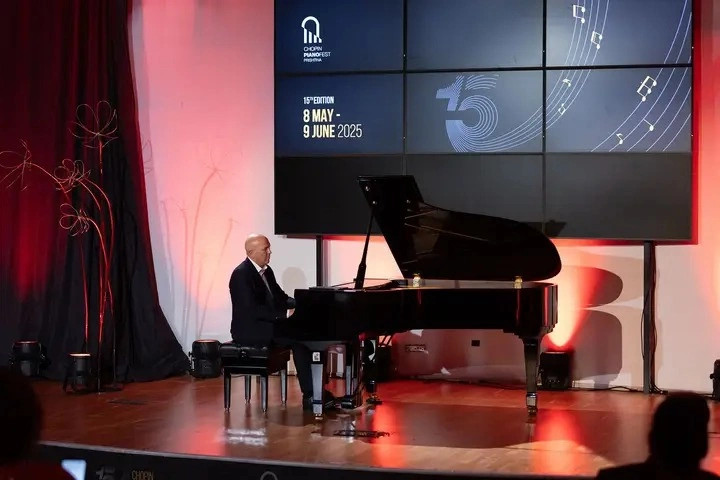
In the first half of the concert, he opened the evening with Robert Schumann’s “Arabesque Op. 18”, where he brought an inner sensitivity and clear articulation. He then continued with Beethoven’s “Sonata No. 14 in C-dur, Op. 27, No. 2” with the movements “Adagio Sostenuto”, “Allegreto” and “Presto Agitato”. He treated this sonata not as a technical challenge, but as a slow narrative that culminates in an emotional explosion in the third movement.
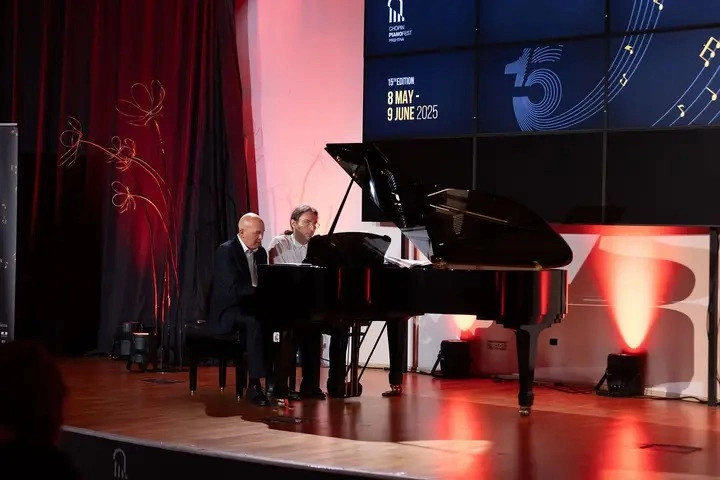
The second part brought a special collaboration with pianist Melos Buza, with whom they performed the works for four hands “3 Danzas for 4 hands” with the tempos “El Sol de Cuba”, “Hueso na ma” and “El Platano Verde” by Juan de Moya Portuondos and then the pieces “La camaguenyana”, Los delirios de Rosita” and “Los muñecos” by Ignacio Cervantes. The audience was particularly involved during “Los muñecos” by Cervantes, where one segment of the performance stood out for its approach: instead of the usual sounds of the keyboard, the pianists’ hands lightly touched the body of the piano with their fists, creating a rhythmic and acoustic effect.
After a short break, the second half included the solo pieces “Frosoblomster for Piano Op. 16” with the movements “Sommarsang”, “Gratulation” and “Intag I sommarhagen” by Wilhelm Peterson-Berger. After them, the piece “3 Tonbilder for Piano Op. 4” with the movements “Pa vattenne”, “Barnmenuett” and “Om kvallen” by Elfrida Andree was played. At the very end, the pianist also played the pieces “A la antigua”, Ante el Escorial”, “Malaguena” and “La comparsa” by Ernesto Lecuona, to conclude the night with a different color from the previous nights of the festival.
also The piano maestro deconstructs the classical universe with a unique modern approach
At the end of the evening, the audience applauded with great enthusiasm. The pianist, who appeared before the Pristina audience for the first time, accepted this reaction with humility and excitement. He revealed his impressions of this first experience in the capital, and shared a personal detail that gives this evening even more weight.
"It was a pleasure for me to perform for the first time in Pristina, I feel very happy because the audience was enjoying the concert, so when the audience is happy, I am happy too. I will be settling in Pristina for two years for work reasons, so I will be here for the next two years," pianist Marcel Mora told KOHĪNA at the end of the concert.
The selection of repertoire was not accidental. Mora had constructed a musical narrative that spans several continents, incorporating elements of different musical traditions.
"The pieces I selected tonight at the beginning of the concert were European pieces from Germany, then I moved on to four-hand piano playing, because I wanted to invite a Kosovar pianist, while the second part contained music from my homelands, Cuba and Sweden, because I am a Swedish citizen now. I played all the pieces with pleasure, especially since today is Sweden Day," he added regarding the program.
For the festival organizers, this concert represented more than just a musical evening – it was the fruit of a new diplomatic and cultural collaboration. The festival’s organizing director, Besa Luzha, shared the behind-the-scenes story that led to this collaboration and the appreciation for a pianist who is now part of the local community.
also “Chopin Piano Festi” with the colors of Kosovo's musical landscape
"Tonight was the penultimate night and pianist Marcel Mora, who currently lives in Pristina and in collaboration with the Swedish Embassy, informed us that they have a pianist among their staff, we wanted to start a collaboration with Sweden, because it is the first time we are collaborating with them," Luzha told KOHĖN.
After a busy season with interpretations of great European classics, the organizers wanted to bring a lighter, but no less artistically profound, spirit to the end of the festival.
"We realized that he is originally from Cuba and when we talked to him about the program, we said why not bring us a little atmosphere of those countries, we have already had a long marathon of concerts with a very diverse repertoire of piano masterpieces, and now we wanted a different color, a refreshing one and to see another musical flavor of another continent that we have not heard so often on our stage, so Marcel brought us such an evening, different rhythms and some freshness before a conclusion that we will have on Monday with pianist Peter Donohoe", Luzha explained the motive for the invitation to the Cuban-Swedish pianist.
The impact of the pianist's performance was felt not only by the organizers, but also by the audience, who experienced this evening as a beautiful break from the routine of the classical repertoire. Among them was the singer Vlera Kastrati, who shared her impressions of the evening.
"I had a great time, really, because I know Marcel personally and I've heard that he's a good pianist, but it's different when you see the person on stage. What made tonight a great night, compared to many other nights I've been to, is the fact that it brought something new, Cuban music that for us is almost unknown at the level of classical music, so it was a very nice freshness," singer Vlera Kastrati told KOHĖN.
also Four hands on a piano reveal the musicality that springs from the soul
With the concert of Marcel Moras, the “Chopin Piano Festi” has entered the final phase of its jubilee edition. After fourteen nights with performers from all over the world, there is only one evening left to conclude this rich musical cycle. On Monday, the festival will close with the British pianist Peter Donohoe. The music of the artists who have participated in this edition has proven that sounds, even when they come from different shores of the world, can find a common home in the soul of the listener.

