


-
By:
Syle Ukshini

- July 26, 2026 08:00
- Share to:
As the cases of Ferizaj, Skopje and Hani i Elezit will show, the change of toponyms was not an isolated administrative act, but part of a broader strategy of symbolic Serbization of the territory. The case of Ferizaj is particularly significant for understanding how the renaming policy was used as an instrument of Serbization of the territory. Austro-Hungarian sources show that before 1912 the city was known as Ferizaj, while multilingual documentation also includes the forms Ferizović, Ferisović and Ferisovitsch, which clearly preserved the basis of Albanian toponymy.
The Serbian occupation of the Vilayet of Kosovo during the Balkan Wars (1912–1913) brought not only territorial and administrative changes, but also a systematic transformation of the symbolic landscape of the occupied territories. The change of toponyms constituted one of the main instruments of this policy, through which the Serbian administration aimed not only to consolidate political control over the occupied territory, but also to reshape its historical and cultural identity, in accordance with the Serbian state narrative. To argue this thesis, this study relies on Austro-Hungarian consular reports, maps of the period, contemporary newspapers, international law documents and historiographical literature. The traditional names of cities and settlements, used during the Ottoman period by the local population and by European diplomatic representatives, began to be replaced by Slavic forms or by new names associated with historical figures, dynasties and Serbian state symbols.
Propaganda of the occupation as "liberation"
This policy aimed to create a new political and historical geography, in which the occupation would be presented as “liberation”, while the annexed territories would be presented as spaces that had been historically Serbian. In this sense, the renaming of settlements did not represent only an administrative or linguistic change, but a deliberate intervention in the historical memory and cultural identity of the territory. Methodologically, this study relies on the comparative historical method and discourse analysis, contrasting Austro-Hungarian consular reports, Serbian administrative documentation, cartography of the period, the European press and historiographical literature. The comparative approach enables the identification of differences between the historical names used before the 1912 occupation and the nomenclature institutionalized by the Serbian administration after the establishment of its power.
Sources indicate that the renaming took place in parallel with the establishment of the Serbian administration. Studies of historical onomastics emphasize that the identification of the authentic form of a toponym requires support in the earliest archival sources, in manuscript documents and in contemporary cartography, as later forms may reflect processes of linguistic adaptation, administrative standardization or political intervention. In this sense, the comparative analysis of Austro-Hungarian consular reports, German maps and documentation from the period before 1912 is methodologically necessary to distinguish historical names from the institutionalized nomenclature after the Serbian occupation.
As Ernst Eichler points out, “The origin of every toponym is closely linked to objective reality and social conditions.” This observation provides an important theoretical starting point for the analysis of the politics of renaming settlements in Kosovo after 1912, placing the change of toponyms in direct relation to the political, social, and historical transformations brought about by the occupation.
also Hani i Elezit and the name that immortalized the Serbian general
The case of Kosovo after 1912, however, does not belong to this model. The replacement of historical names such as Ferizaj with Uroševac, Üsküb with Skoplje, and Hani i Elezit with General Janković was not the result of a spontaneous linguistic process, but part of an institutionalized state renaming policy, implemented by the occupying administration to affirm the new political sovereignty, to transform the symbolic landscape of the territory, and to integrate it into the Serbian historical and national narrative.

Toponymy as an instrument of power: a comparative perspective
The literature on critical toponymy explains that renaming space is a common mechanism for the production of symbolic sovereignty, the construction of collective memory, and the legitimization of power. As Reuben Rose-Redwood, Derek Alderman, and Maoz Azaryahu point out, contemporary studies on toponymy have moved from traditional analysis of etymology to examining the politics of naming places, treating toponymy as a contested practice of exercising symbolic power over space. According to them, “the naming of places is one of the primary means of attempting to construct clearly demarcated spatial identities,” while the renaming of places serves to produce a new symbolic and political order over the territory.
This theoretical approach is also supported by Lawrence Berg and Jani Vuolteenaho, who define critical toponymy as the study of the interplay between language, power relations, and the politics of place-naming, arguing that official names do not simply reflect geographical reality, but are part of processes of state formation, nationalization, and symbolic control of territory. In this sense, the change of toponyms appears as a characteristic practice of conquest, colonialism, revolution, and changes of political regimes, where the new power aims to replace the inherited symbolic landscape with a new historical and ideological order.
In particular, Maoz Azaryahu argues that official names are “an important expression of power” and that their change is part of a “semiotic revolution,” through which new regimes rewrite the symbolic landscape and institutionalize their version of history. According to him, the renaming of places is not just an administrative act, but a mechanism through which history is transformed into geography and political memory becomes part of everyday life.
From this comparative perspective, the policy of the Serbian administration in Kosovo after 1912 does not represent an isolated case, but fits the patterns that the international literature identifies in the contexts of conquests and nation-state building. The replacement of traditional Albanian names such as Ferizaj, Üsküb and Hani i Elezit with Uroševac, Skoplje and General Janković did not have only an administrative function. It aimed to present the new power as historical continuity, to symbolically appropriate the territory and to build a new narrative about its identity. In this sense, the case of Kosovo represents a concrete example of what the international literature describes as the use of toponymy for the production of symbolic sovereignty and for the legitimization of the political order established by the conqueror.
Maps of territorial legitimation
As the cases of Ferizaj, Skopje and Hani i Elezit will show, the change of toponyms was not an isolated administrative act, but part of a broader strategy of symbolic serbization of the territory. The role of ethnic cartography in the Balkans during the late 19th and early 20th centuries should be seen in the same logic. As Gábor Demeter, Zsolt Bottlik and Krisztián Csaplár-Degovics note, ethnographic maps did not only have a descriptive function, but were used as instruments for the legitimization of territorial claims and the construction of national narratives. In this sense, cartography and toponymy constituted two complementary mechanisms of the same political strategy: maps created a visual representation of the claimed space, while the renaming of settlements institutionalized this claim in the administration and in public life. Consequently, the replacement of traditional Albanian names after 1912 was not an isolated administrative practice, but part of a broader pattern of symbolic nationalization of territory, also known in the international literature on the political history of the Balkans (Gábor Demeter, Zsolt Bottlik, and Krisztián Csaplár-Degovics, “Ethnic Mapping on the Balkans (1840–1925): A Brief Comparative Summary of Concepts and Methods of Visualization,” Hungarian Geographical Bulletin 9 (2010): pp. 65–66). The literature on the politics of toponymy shows that the renaming of geographical space has served as a mechanism for consolidating political control and reshaping territorial identity, being not an exclusive feature of Kosovo, but a documented practice in various contexts of occupation, annexation, and colonization. In 1936, the Nazi authorities undertook a systematic policy of Germanizing place names and surnames, transforming toponymy and anthroponymy into instruments of the policy of nationalizing space. However, after the end of World War II, traditional Polish names were restored and standardized by a Polish government commission, restoring the historical nomenclature and largely undoing the changes imposed during the Nazi occupation.
After the Munich Agreement (1938), the German administration in the Sudetenland institutionalized German nomenclature in the administration and official documentation, treating the territory as part of the Reich. Similarly, the Italian fascist regime used the policy of naming cities, streets, and administrative centers in Libya, Eritrea, and Ethiopia as part of the project of Italianizing colonial space. These cases demonstrate that renaming space has often served as a means of symbolically consolidating power in occupied territories. From this comparative perspective, the policy of the Serbian administration in Kosovo after 1912 does not represent an isolated phenomenon, but part of a broader historical pattern, in which control over territory is accompanied by control over language, cartography, and historical memory. Although the study addresses several cases of toponymic change in Kosovo after 1912, the analysis focuses mainly on the case of Ferizaj, which, thanks to the wealth of diplomatic, cartographic and historiographic sources, provides the most complete basis for examining the renaming policy. The cases of Skopje and Hani i Elezit serve as comparative examples to verify that this practice was not isolated.
Historical toponymy
- Ferizaj
- Uskub
- Elez's inn
Variants before 1912
also Ferizaj – a product of Serbian state policy
- Ferizović, Verisović, Ferisovitsch
- Uskub
- Elez's inn
Name imposed after the invasion
- Ferizaj
- Skopje
- General Janković
The first source that documents it
- Neue Freie Presse, Nušić, Hashani;
- Jack
- Neue Brake Presse
- Carnegie
Major changes in toponyms in the occupied territories (1912–1914)
The empirical analysis of this study is based mainly on the case of Ferizaj, which, thanks to the wealth of diplomatic, cartographic and historiographic sources, represents the most complete study of the renaming policy implemented by the Serbian administration after 1912. The cases of Skopje and Hani i Elezit are included as comparative cases, with the aim of verifying the model identified in Ferizaj and highlighting other dimensions of toponymy policy.
Ferizaj as a case study: from historical name to Uroševac
The case of Ferizaj is particularly significant for understanding how the renaming policy was used as an instrument of the Serbification of the territory. Austro-Hungarian sources show that before 1912 the city was known as Ferizaj, while in multilingual documentation the forms Ferizović, Ferisović and Ferisovitsch are also found, which clearly preserved the basis of Albanian toponymy. Another important evidence before the Balkan Wars is found in the work of the German publicist Ernst Jäckh, “Im türkischen Kriegslager durch Albanien“ (1911, p. 49). Describing the Ferizaj Assembly of 1908, Jäckh devotes a separate chapter entitled “Die Bessa von Ferisovitsch (“Besa of Ferisovitsch”) and identifies the settlement as “der albanische Ort Ferisovitsch“ (“the Albanian settlement Ferisovitsch”).
“A half-day trip north of Skopje (Üsküb), along the eastern Macedonian-Albanian railway Thessaloniki–Mitrovicë, lies the Albanian settlement of Ferisovitsch (Ferizaj), in a meadow valley between rocks and forests,” writes Jäckh.
For the author, Ferisovitsch was not only a station on the Thessaloniki–Mitrovicë railway, but also the center where the great Albanian rally related to the Young Turk Revolution took place. The use of this form in a German publication from 1911 proves that the name Ferisovitsch was part of the European nomenclature before the Serbian invasion of 1912 and reinforces the fact that the name Uroševac was not yet in use in contemporary literature. The early origin of the name Ferizaj is also confirmed by the testimonies of European travel writers. Describing his journey through Kosovo in the mid-19th century, Ami Boué mentions Hani i Sazlië, a well-known stopping point on the Skopje–Prishtina trade route, located about five and a half hours from Prishtina. This description proves the importance of this route long before the development of the modern city of Ferizaj.
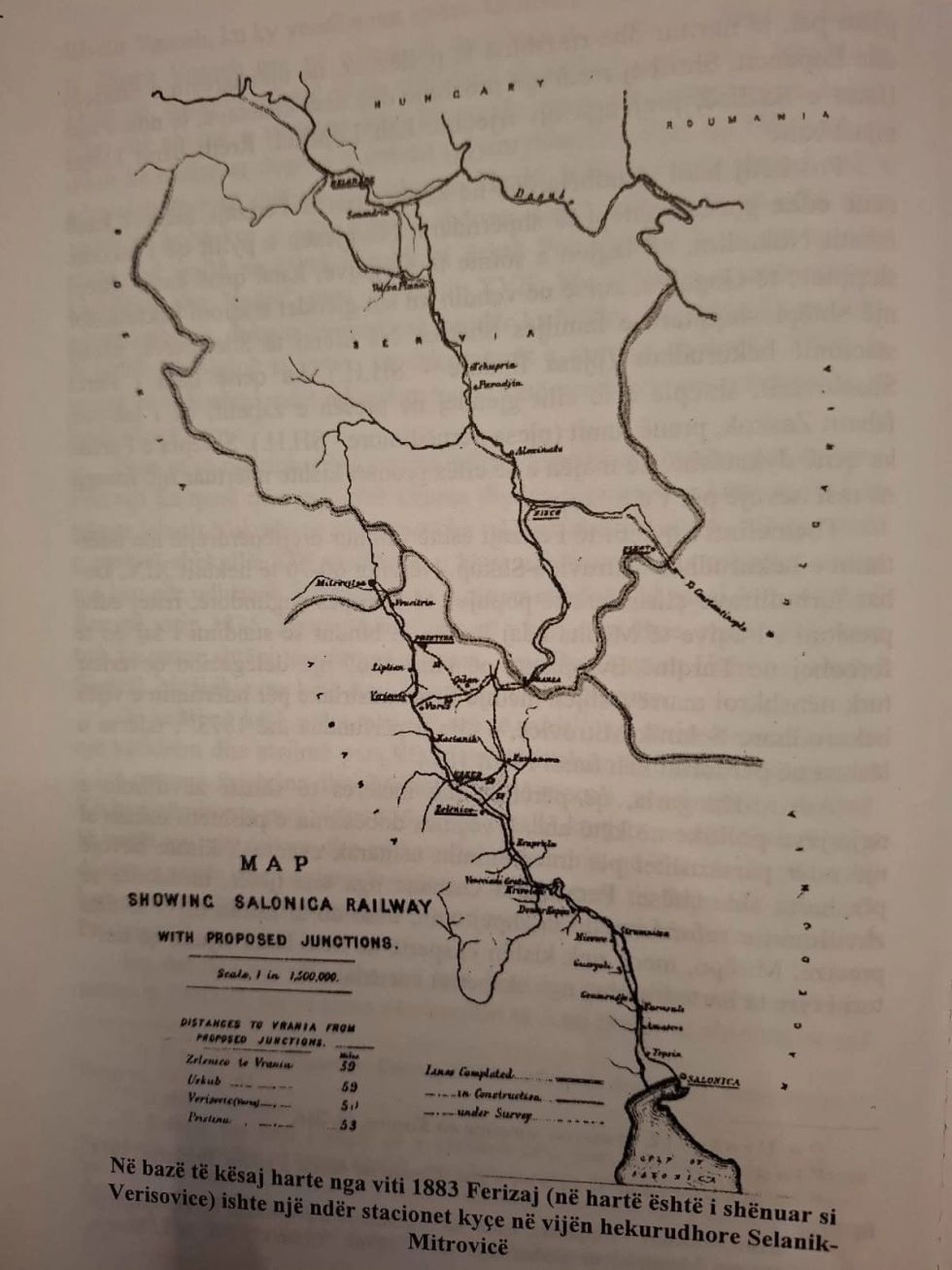
Additional evidence for the use of the forms Ferisovitsch/Ferisović is provided by two German maps of an ethnographic and religious nature, published at the beginning of the 20th century, in 1900 and 1904 respectively. In both the Nationalitäten-Karte der Vilajete Kosovo, Saloniki, Scutari, Janina und Monastir (1904) and the Religions-Karte der Vilajete Kosovo, Saloniki, Scutari, Janina und Monastir (1900), the city is marked with the name Ferosović/Ferisović, while the form Uroševac does not appear. This fact reinforces the evidence of Austro-Hungarian consular documents and the work of Ernst Jäckh that, before the Serbian invasion of 1912, the historical name associated with Ferizaj was still used in German and Austro-Hungarian cartography. The origin and international use of the name Ferizaj/Ferisović is also confirmed by a late 19th-century British map, which depicts the Thessaloniki–Mitrovicë railway project. On this map, Ferizaj is marked with the form “Verisovitch” and is presented as one of the important nodes of the proposed railway line. This cartographic evidence shows that the name Verisovitch was part of international use long before the institutionalization of the name Uroševac by the occupying Serbian administration in 1912.
The case of Ferizaj proves that the institutionalization of the name Uroševac was part of the process of establishing the new Serbian administration. The earliest and most reliable evidence for the use of the name Uroševac after the Serbian occupation is found in the Austrian newspaper “Neue Freie Presse”, which in November 1912 already records the city under this name. This contemporary source proves that the renaming began immediately after the establishment of the Serbian military administration. In contrast, some literature of Yugoslav origin connects the institutionalization of the name with the year 1914, while other authors oscillate between 1912 and 1914. This chronological discrepancy is not without importance, because the shift of the date of the renaming two years later disconnects the process from the context of the military occupation, massacres and mass expulsions of Albanians during the years 1912–1913. Contemporary sources show, on the contrary, that the Serbization of toponymy began in parallel with the establishment of the occupying administration and was part of the policy of consolidating power in the occupied territories. Consequently, the distinction between the actual use of the name and its administrative institutionalization must be kept clear in historiographical analysis.
also Serbian toponyms are "maintained" by the veto of Serbian MPs
To be continued in the next issue of the Culture Supplement
Footnotes have been removed by the Editor