


-
By:
Besarte Elshani

- 29 October 2023 21:00
- Share to:
With "Oj Kosovë" by La Fazani, the winning song of the historical edition of the Song Festival on Radio Television of Kosovo, multiple realities are broken down: textually, that of Kosovo in the song, indirectly, the reality of the Festival that shines for three days in the burnt hall and as a whole , new trends in music. That the Festival was a celebration and a successfully passed test is the common point. But if it is the reconnection of the musical tradition or the continuation of "Chords of Kosovo", the approaches are different
The historic Song Festival on Radio Television of Kosovo with three magical nights returned the musical artistic scene to its beginnings. The beautiful sounds of music and poetic lines were broken down between new trends and tradition. Art – especially song – as a powerful tool for criticism.
This was done by the winning song "Oj Kosovë" by singer-songwriter Arbër Salihu. Whether it was the best, there were other songs for the first prize and history, is another matter.
The historic event, by the organizers of art lovers, has been rated as a celebration for authentic Albanian song. Attempts to start a new chapter and at least for three nights the image was brilliant, even though it "hides" the gloomy reality, starting from the hall where it was held.
That the festival was a celebration and a successfully passed test is the common point. For the reconnection of the musical tradition or the continuation of "Chords of Kosovo", the approaches are different.
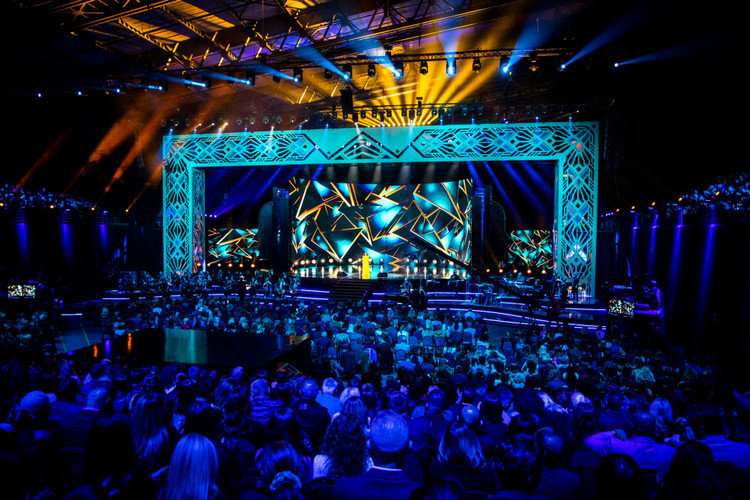
The finale of the Song Festival brought an equally powerful performance. The hall adapted for 1600 people was full. The address of the Festival was the space in the hall where the signs of destruction have been patched and that with the end of the event they also mark the return of a part to its previous state.
also La Fazani, beyond verses, also ironizes visual kitsch with "Oj Kosovë"
A scenario that fits the concept of the Festival - led over three nights by Adi Krasta, Besim Dina, Edona Kasapolli and Edona Reshitaj - with singing and dancing performances, as well as interpretation of poems, along with the messages of great artists on stage. However, the focus was the announcement of the winning song, historic, of the first edition of the Song Festival - "Oj Kosovë" by the artist Arbër Salihu known as La Fazani.
Criticism of the state, society and the artist himself
The verses of the song are critical and self-critical. For the state, society and for the artist himself. Within a verse he sings of the glory and desire for the glory of the state. Negative effects are covered with folklore colors that sound brave and ready for self-sacrifice. "I gave my life for you, just don't add too many rands to me", is one of the lines. The choreographic point that accompanies the traditional Albanian dance in the background, which is actually performed by foreign artists, also clearly speaks of the neglect of tradition.
It resembles provocation and courage, a contrast of good and evil. They also talk about the desire to run away, which for many is not possible. On the other side: very rhythmic, with the colors of hip-hop, where he criticizes himself between the lines. He even talks about the realization of the Festival at a time when the winner does not have the right to participate in the European song contest "Eurovision".
La Fazani, only the participation in the Festival has been considered historic. He said that through his artistic creation he wanted to convey messages.
"For me, it was no longer important to go to Eurovision, it was important to participate in this festival. Even winning was not important. I only wanted to contribute, to bring an inspiration that is my style that I have cultivated", said Salihu for TIME. "Sincere love is there, but there is definitely criticism as much as you want about our state as a society. The criticism is generally on us, I also criticize myself in this song", he said about the song.
According to Salihu, the song "Oh Kosovo" is a documentation of the feelings that the country is going through. "There must be this power of art, because the feelings we experience must be documented. It would be tragic if there were no songs, movies, books, everything that documents feelings. What I try to do with my music is to document the feelings we are going through", he further said.
The award was given by Prime Minister Albin Kurti.
"So much energy and beauty for more than two hours, an unforgettable experience and a special experience I believe for each of us who was here", Prime Minister Kurti said on stage before giving the award to La Fazani.
The artist Angus Dei received the second prize with the song "One heart for two", while Albin Nikprelaj won the third prize with the song "Ajo". The Orchestra Award was also given, which was received by Saranda Alija for the song "Mendoj ku je".
The songs were evaluated by the jury consisting of singer Alma Bektashi, artist Zake Prelvukaj, singer-songwriter Alban Nimani, composer Adrian Hila and Swedish singer Ulja Sjostrom.
Celebration, continuation or new chapter
The artistic director of the Song Festival, Florent Boshnjaku, has considered the festival as a celebration.
"This festival should be a party, and it was a party. In the end La Fazani won, it was still a party. This year, the victory of one or the other really didn't matter, I think it was really a celebration for the artistic community and for the whole country", Boshnjaku said.
The theme of "Chords of Kosovo" comes into play, because for many years there were pledges and promises for the return of such an event and the Festival is often considered as the embodiment of initiatives like these. "Chords of Kosovo", one of the oldest cultural events organized in the country, one of the most prominent festivals in Kosovo that started its journey in 1963. The 90s were a time of challenges for the event that, despite attempts to keep it in level, in 1995 it was discontinued.
The Bosnian said that the Albanian musical tradition did not begin with the Song Festival.
"We have an extraordinary musical tradition. There is no question that this tradition has simply been interrupted and is continuing. Normally in a different format and in a different way, with new musical trends", said the author of many popular songs.
The accompaniment of original music by the Song Festival Orchestra has also played a key role in the presentation of the songs. Alfred Kaçinari, Edon Ramadani and Valton Beqiri were the conductors of the Orchestra for three nights.
Conductor and orchestrator Edon Ramadani also made a connection with the former festival.
"After a long-term disconnection since the cessation of operation of 'Kosovo Chords' sometime in the 90s, due to repression. It was not easy to bring such a festival back to the stage considering that we are dealing with a rather large orchestral formation, the singers seem to sing live. We are very happy. This is of course a continuation of many concerts and other projects, that even though the 'Chords of Kosovo' festival has stopped its work for many years, after the war we had many projects, maybe with even bigger formations", Ramadani said. , while the songs have been evaluated differently in terms of styles, as well as in terms of composition.
The music professor, Lejla Pula, who as a child was a participant of the "Chords of Kosovo" festival, said that there were beautiful and more modern songs at the Song Festival.
"It is true that it is the first song festival after the war, but I grew up with 'Kosovo Chords' and I can say that really cultivating the values of genuine song is extremely important", she said.
also The video clip of the winning song of the Song Festival is published
Singer Shpresa Gashi, one of the most prominent voices of Albanian music, has said that new standards have been created in the singing scene that are leading to the loss of cultural and national identity.
"In Kosovo, the old value system was overturned and now new standards are being created. But there was a discontinuity after the war between the traditional and the modern. When this happens, the tradition is interrupted, when the tradition is interrupted, the cultural and national identity is lost. During the Serbian repression, the institutions were extinguished and they were replaced by some private ones, in vain, that privatized the standards, personalized them and, unfortunately, destroyed them, perverted them. I hope that perversion will be eradicated", said Gashi from the stage of the Festival.
Contrary to the distance that the main organizers maintain with "Accorde..." - which was also seen in the three nights of the Festival when the historical event was not mentioned anywhere - violinist Festim Fanaj considered the Song Festival a rebirth of "Accorde..." that were interrupted by the violent measures against the Albanians.
"We had the 'Kosovo Accords' before, unfortunately they were not renewed after the war until now. The event is a kind of renaissance of 'Kosovo Chords'. This year we have mobilized instrumentalists who are among the best that Kosovo has in the rhythm sector, as well as strings and brass", said Fanaj, a member of the Festival Orchestra.
Distancing from the "Kosovo Accords"
But the general director of the Song Festival, Adrian Krasta, distanced the two events, saying that there is no connection between them. For "Kosovo Chords" he said that it was an activity in the Yugoslav context where expression through song was limited.
"For those who enjoy history and the fact - which is verifiable information - 'Kosovo Chords', although it was a very important activity for the Albanian voice, it was an activity in the Yugoslav context. In other words, political and artistic Yugoslavia had created an activity in different poles. But the Albanians at that time were not free to do what they wanted. The pressure was there. We are in another Kosovo, we are not in a Yugoslav Kosovo, we are in a Kosovar Kosovo. A Kosovo of all nationalities, multi-ethnic, but in an independent Kosovo", said the director of the Song Festival. In this context, according to him, a festival that would be born after twenty or so years, undoubtedly with the best values of all the best activities.
"But it does not force us to have points of contact or points of disconnection", he continued in his answer when asked about the points that connect and separate the two events.
Regarding the revitalized and transformed space of the sports hall in the Palace of Youth and Sports in use of the Song Festival at RTK, he said that it should serve the arts and culture. It has asked not to return to its former destiny.
"I would have prayed for the first three years of the Festival to take place on the same stage, as this is a big, very expensive investment. I hope that this hall is no longer used for parking, enough, the cars have a place somewhere else. Art and culture should be made in this place, and this environment should be used in the interest of the public", said Krasta.
The final ten as a mosaic
There were 18 competing songs that were presented to the public of the jury in the first two nights of the Song Festival on Friday night. From them, ten finalists of the first edition were chosen, who performed on the final night.
On the second night, Albin Nikprelaj with the song "Ajo", Auron Deva with "The Price of Love", "Angus Dei" with "One heart for two", Arbër Salihu with "Oj Kosovë", "Urban Band" with "Dreams are not to blame", Nita Latifi with "Stupidity" and Neki Emra with "Heroi im". Hilmi Obertinca with the song "Pa ty s'm rihet", Saranda Alija with "Mendoj ku je" and Klea Dina with the song "Trenat" have also qualified for the finals.
The member of the jury, the singer Alma Bektashi, after the end of the program of the second night, said that it was not easy to select the songs because of their different styles.
"There were different songs, different styles, different singers. I think that the professional jury has decided that the selected songs are the ones that have fulfilled the conditions to continue to the finals", said the singer Bektashi for TIME.
They are songs of different styles where the traditional meets the modern. From the sounds of the couplet to the rhythms and elements of electronic music, the finalist songs included dedications to family, love and country. The powerful and emotional interpretation was also the image of the semi-final night of the Festival. Yes, this night was the channel from which the institutions of the country and the artistic scene were presented. The entire public in the hall stood up as a sign of respect for the Kosovo Police and the Kosovo Security Force. Sports and cinematography are also promoted.
The debut song of Albania in 2004 in "Eurovision" - "Image of you" by Anjeza Shahini was brought back on stage. Her interpretation was another highlight of the evening. Vaçe Zela's "Late night", Nexhmija Pagarusha's "Baresha" and Muharrem Qena's "Can you say easily without pain" were also performed. They are the treasure of the Albanian song, as well as the song "Këngët e bilbili" by Jusuf Gërvalla, which was interpreted by the singer-songwriter Shpat Deda.
The first edition of the Festival was organized without the membership of Radio Television of Kosovo in the European Broadcasting Union (EBU), which enables Kosovo to participate in the European Song Contest. However, one of its goals is to connect local artists with the European music scene. With the Song Festival, a path has already been opened.
The push for the revitalization of the Youth Palace
In February of this year, through a memorandum of cooperation, the Ministry of Culture pledged 750 euros for RTK for three years. This year, 300 euros were given and went to the Festival, even though the Memorandum also mentions the establishment of a television channel for art and culture.
A few days ago, the mayor of Pristina, Përparim Rama, said that as the capital, together with the Palace of Youth and the Public Housing Enterprise, they have allocated 350 euros of investment "to bring to life this project of reviving the icon of the capital".
also The historic edition of the Song Festival at RTK
On Saturday night, he said that the revitalization of the entire Youth Palace is being planned.
"We are doing the feasibility of the entire space, we have done the analyzes with the city architect and now we have a new program, with a public-private partnership to revitalize the entire Palace of Youth. This shows that if we want to do work, we can do it. There is no reason not to revitalize all these icons, especially the icons of the capital. Starting with the wonderful Palace of Youth", said President Rama to KOĖN, Saturday night before the start of the final night.

