


-
By:
Skender Latifi

- June 23, 2024 08:00
- Share to:
Since the summer of 1373, today's Preševo Valley, along with its status as Ottoman vassal territories, will simultaneously become a kind of springboard for Ottoman penetration towards the southern parts of the Balkans, but above all, this area will be important special for the Ottoman forces in the preparatory phase of the Battle of Kosovo in 1389. So, the service of the territories in favor of the Ottomans by Kostadin Dragash, at the same time marks the end of the semi-dependent and independent principalities in the Balkans at that time. Previously, the Ottoman Empire in the Balkans had encountered groups that kept their memories mainly related to the various ruling dynasties, terrible wars, invasions, expulsions, and the Ottomans consciously destroyed these branches of the old ruling dynasties, not to erase them. the political past of the new citizens, but with the aim of maintaining internal peace...
Presheva Valley and Bulgaria's Ihtiman
The Ottoman era traces its beginnings in the Presheva Valley to the place called Ihtiman, which today is a small town in western Bulgaria. More precisely, it is located about fifty kilometers from the center of Sofia. Before Sultan Murat I set out to realize his goals in the interior of the Balkans, only two years after the Battle of Marica (1371), in the spring of 1373 the Ottoman army was temporarily stationed in the nearby field of Ihtiman, which at that time would it was a not so important Balkan village.
"During the march from Filibja (today's Plovdiv) to Ihtiman, the sultan stopped from time to time to rest and when he reached the place where the road split in two directions, to Sofia and to the land of Kostadin (Qystendil) he preferred to went from this second one", wrote Idris Bitlisi in his book in the Persian language "Hest Bihisht" (Eight Heavens).
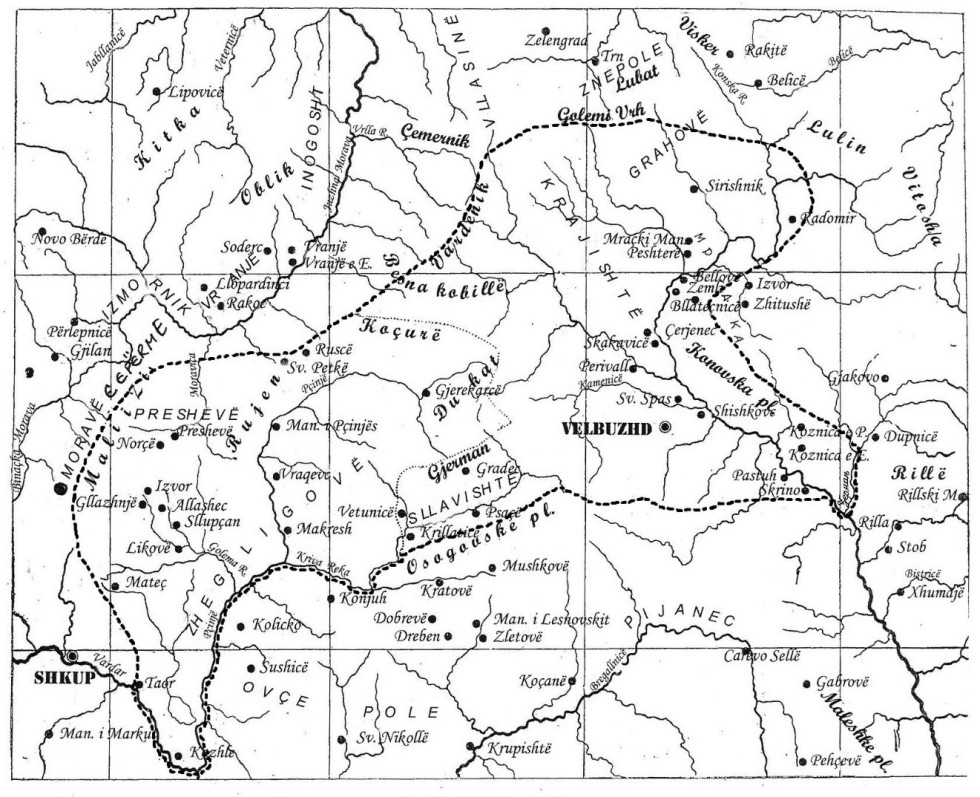
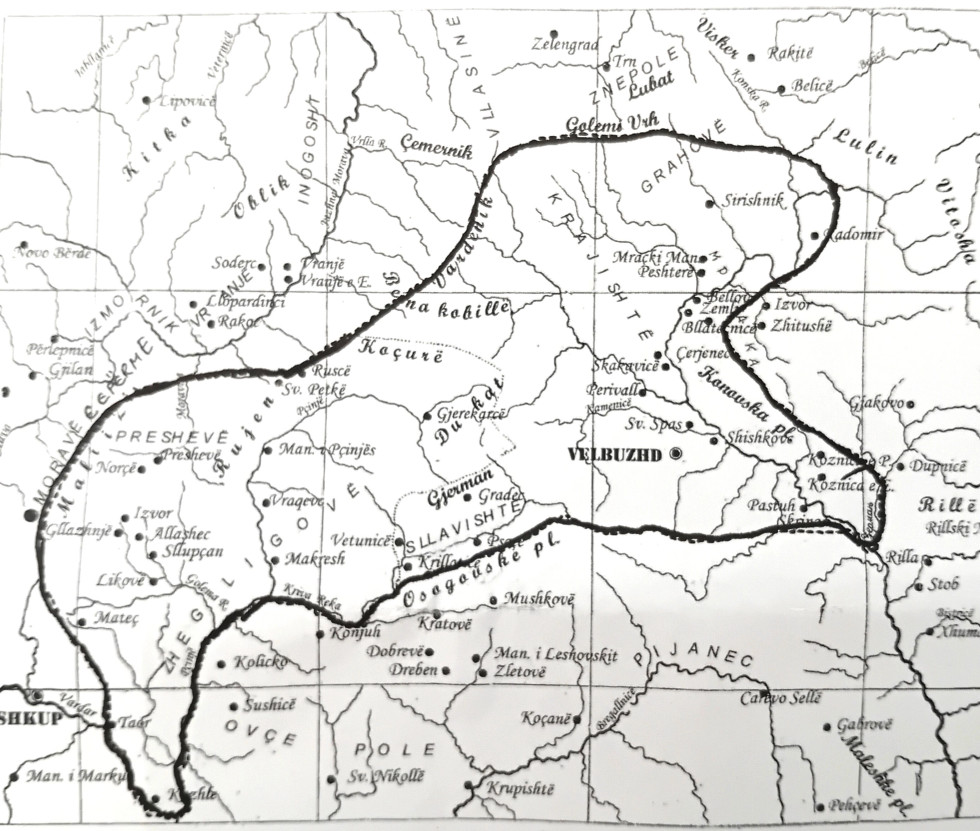
Let's remember that within the territory of the country or the principality of Kostadin Dragash, centered in Vellbuzhdë, the present-day Preševo Valley was included, extending to the borders between Karadak of Preševo and Gjilan, the province of Kumanovo up to the southern shores of Karadak of Skopje, while its border outside today's Albanian lands was the river Struma. More precisely, this territory acquired the form of a principality, in the last quarter of the 1925th century, but one of the ambiguities that has remained unexplained to this day is the origin or national affiliation of Kostadin Dragash. Thus, some Serbian authors have tried to "create" family ties to the Dragashes at all costs in order to "transfer" them more easily to the Nemanjid family, while the Bulgarian authors keep Kostadin of Bulgarian origin, being called in line seen in the existence until today of the monastery of Zemen (until 70 of Bellova) located in southwestern Bulgaria, about XNUMX kilometers from Sofia, erected by Kostadin's father - Dejan, where his portrait is also a proof and of his mother Eudokia or Doja. As another argument that goes in favor of Bulgarian historians, it is the seat of the principality of Kostadin, which, as is known, was located in today's Kystendil in Bulgaria.
"He could have been a middle-aged Bulgarian", said the well-known Konstantin Jireçek (1854 - 1918). In efforts to shed light on the origin of the Dragash family, the Bulgarian historian Hristo Matanov (Христо Матанов) has written that "we cannot be maximalists, because we must not forget that, like the Dragash, but also other feudal families, the family genealogy is unclear and the more we search for their origin, the more the ambiguities increase. In my opinion, we are not dealing with the failure to find the necessary information, but rather the lack of accurate information", he said.
also The Bulgarian return and "Presheva Valley as Unknown Albania"
However, the well-known Byzantinologist George Ostrogorsky (1902 -1976) was determined! "The last name Dragash was carried by both sons of Dejan, maybe even their father. Therefore, the question can rightly be raised as to why in Serbian historiography the thesis that Jovani and Kostadini were called Dejanovic dominates, when it is known that the surname Dejanovici or Dejanovick, by which the brothers Kostadini and Jovani were known, was never used in historical sources of the time", Ostrogorsky clarified, adding that "the name Kostadin was rare in the South Slavic environment, and that Kostadin Dragashi was usually spelled as Kostadin, while he himself was signed as 'lord (dominus) Kostadini'".
But, in relation to the rule of the Dragashes, the Bulgarian authors "remained puzzled" as to why the Dragashes did not give their rule Bulgarian colors or character! Based on a hypothesis of the Bulgarian researcher, Ivan Dujchev (Иван Дуйчев 1907 - 1986), the reason why Dejan turned his back on the Bulgarian king Ivan Alexander and supported the Serbian Dushan was that "around 1344-1345, the Bulgarian king married the Jew Sarah - Theodora".
So, according to the Bulgarian researcher, it was anti-Jewishness as the main trigger that pushed Dejani to switch to Dushan's side!
While according to the Bulgarian researcher, Matanov, the creation of the principality of Kostadin was "the result of the Serbian expansion of the end of the 20th century and the beginning of the 000th century, and such feudal principalities were semi-dependent and independent". While the principality of Mr. Kostadin Dragashi included a territory of about 44 square kilometers and about 000 inhabitants lived in it. So, this territory was quite populated, since approximately 11 inhabitants lived in one square kilometer. As for Kostadin Dragash's relations with the well-known arboretum families, we can say that they were established in the spirit of the times and were especially strengthened through the institution of marriages. Thus "Theodora the sister of Kostadin Dragash was married to George I of Balshaj" while in the field of monetary policy development, archaeological findings have proven that "all types of Kostadin's coins were minted in Ohrid by the well-known arborist rulers, Gropajt ". Such coins were even found in the church of Saint Sophia in Ohrid as recently as 1952.
Did the valley people fight on the side of Sultan Murat and why?
Although there are still disagreements about the year when the provincial ruler of the Preševo Valley, Kostadin Dragashi became an Ottoman vassal, the year 1373 should be more accurate. Information about this event is provided by the well-known Bosnian researcher Nedim Filipović (1915-1984).
"The personal intervention of Sultan Murat I, which the chronicles of the time record as likely in the spring of 1372, will have been decisive in pushing Kostadin to peacefully accept the Ottoman power. This event happened in the summer of 1373", he asserted.
Idris Bitlisi provided a slightly more detailed description of this issue. "Costadin did not join the infidel rulers. He immediately went before the sultan to receive him... Also in every town and village of his vilayet, he arranged receptions for the guests, and as a sign of gratitude and hospitality, he entertained the padishah, presenting him with gifts worthy of an emperor . The ruler himself (Kostadin) accompanied the sultan, but he also united his army with the Islamic army!", he added.
So, since the summer of 1373, the present-day areas of the Preševo Valley, in addition to the status as Ottoman vassal territories, will simultaneously become a kind of springboard for the Ottoman penetration towards the southern areas of the Balkans, but first of all this area will be with special importance for the Ottoman forces in the preparatory phase of the Battle of Kosovo. So, the service of the territories in favor of the Ottomans by Kostadin, simultaneously marks the end of the semi-dependent and independent principalities in the Balkans at that time. Previously, the Ottoman Empire in the Balkans had encountered groups of those who kept their memories mainly related to the various ruling dynasties, terrible wars, invasions, expulsions and "the Ottomans consciously destroyed these branches of the old ruling dynasties, not that to erase the political memories of young citizens now, but in order to prevent divisions and preserve internal peace", said the well-known historian of Tatar origin, Kemal H. Karpat (1923 - 2019).
However, Kostadin Dragash's efforts to maintain a certain degree of independence of the province that he ruled until 1373, including a part of the Presheva Valley, even under the Ottomans, in all likelihood did not succeed.
"After the surrender of Vellbuzhda (Qystendil), Murat had returned to Adrianople, and stayed there more happily than in Bursa. For the first time in six consecutive years he enjoyed peace. However, news that Byzantine troops were occasionally disrupting the 'peace' had worried the Sultan.
Therefore, in the context of the following developments, as we mentioned above, the role of today's province of the Presheva Valley also increased, through which the safest passage of the Ottoman troops to Kosovo had to be ensured.
"It is more than certain that the Turks passed through the lands of Kostadin Dragash unhindered, in the case of attacks on the lands that were not yet subdued", researcher Rade Mihalçic is convinced. But these "vassal provinces had some extensive 'self-government' in the 15th century, even the Ottomans themselves deliberately encouraged the creation of differences between the provinces that had vassal status and those that did not enjoy this status".
Perhaps even the vassals of the Ottomans, including Kostadin, were initially not convinced, but they also did not foresee their involvement in the war, even confronting the peoples to which they themselves belonged.
"Then Khan Bayazit unfurled his banner, while the ruler (Sultan Murat I) ordered: let the non-believers who are vassals, Kostadini and Seraxha, prepare under arms", wrote the historian Mehmed Neşri (1450-1520). Although Seraxha is mentioned as another vassal on Kostadini's side, until now there has been a lack of concrete information about this personality. In the following historical sources verify the stationing of the army of Sultan Murat I, in the villages of the Presheva Valley.
also Presheva Valley of the late 19th century: love, conversions, slander
"On the way back to the inn of Çukarka, the villagers told us that in the southwest of the village, according to local legends, the tents of Sultan Murat I had stood on a flat hill", is the story that the former residents of Çukarka of Preševo, located in near today's border point between North Macedonia and Serbia, they had confessed to the albanologist and the Austrian consul, Johan Georg Hahn, in 1858.
All roads led to the Field of Kosovo
"Someone must lead us forward, to take the 'language' of the infidels in order to provide as much information as possible", describes the activity of the Ottoman advance units that operated around Kosovo, more specifically around the Presheva Valley, Anamorava and the villages of Kumanovo, Skopje and Kaçanik.
According to Mehmed Neşri, the main command of the Ottomans towards Kosovo was left in the hands of the well-known Greek commander, who had already converted to Islam. It was this Evrenos bey who, already in the first arrival towards the villages of the Presheva Valley with the help of Kostadin's warriors, had managed to capture some warriors of the Balkan forces.
Although the Serbian historian and diplomat Stojan Novaković (1842-1915) wrote that in the vicinity of Moravica of Preševo, a battle was fought between the Ottomans and the Serbs, arguing that "Prince Lazar did not wait for the enemy in Kosovo, but he took care that to organize the defense somewhere on the coast of Moravica". This author is partially justified by the content of one of Sultan Murat's letters, among the letters that were published in the seventies of the XNUMXth century in Turkey. So, one of them that the Sultan addressed to Ali bey Karamanlioglu, is precisely about the Presheva Valley and the vassal leader of the already ruined principality, and in it it is clear that Sultan Murat has recently reminded him and even threatened Kostad Dragash, that he adhere to the prior agreement reached!
"O connoisseur and addict of the bad Lazarus, I want to remember the saying 'demon the murmur in the heart of the dead' and tell you that you have abandoned the path of loyalty, submission, reliability and obedience...", it is said in Sultan Murat's letter.
"After the Ottoman army reached Kumanovo, it turned towards the north, leaving Skopje in the west. Then the march continued towards Moravica, and a part of the military forces was stationed in the nearby villages of Hani t Bilaçi and the village of Somolicë (south of Bujanoci). Sultan Murat crossed these areas with raised flags, accompanied by a musical band". At the same time, these are the places most mentioned by different authors through which, according to them, the Ottoman army moved. Indeed, one of the ancient, and later medieval, roads that connected the Kosovo basin with the Presheva Valley and even managed to keep its name as the "Roman Road" passed through the Karadak of Presheva, going down to the west of the city of today's Presheva, to continue towards Moravica and from the eastern shores of today's Bilac, this road reached the province of Pcinja to end in today's Qystendil of Bulgaria.
So most of the authors agree that the Presheva Valley was a territory used as a temporary station, but the local population itself was engaged in activities before the Battle of Kosovo. So, it can be naturally implied that at this stage of preparations, the local population capable of war will have been under arms, but aligned under the Ottoman command, while the rest, in accordance with the circumstances of vassalage, will have been engaged in providing of feeding and sheltering the Ottoman forces.
Although Mehmed Neşri mentions "Kiçi Morava irmagi (Little Morava) as the next station of the Ottoman army after Kratova, explaining that after crossing the river it was planned to take a break", the Ottomanologist Aleksandar Stojanovski wrote that "Sultan Murat I, entered the field of Kumanova continuing towards the Karadak villages and reached Morava i Binca". Franjo Raçki (1828 - 1894) expressed himself in the same way in his work "Battle of Kosovo - causes and consequences" published in Zagreb in 1899. Raçki wrote that "Murat's army with his detachments in Vellbuzhdë attached the Turkish vassal - the head of the province Kostadin Dragashi... Then the army left in the direction of Kumanovo, continuing north from the mountains of Karadak. In the gorges of these mountains, the advance units led by Evrenosbeu encountered Lazar's guards". However, Raçki specified that "the Ottoman army passed where the flow of water divides in the Danube and Aegean directions", referring to the watershed located near Çukarka in Presheva.
The Presheva Valley in the first Ottoman centuries
Held on June 28, 1389, the Battle of Kosovo marks the beginning of a new era in the Balkans, and undoubtedly this event also had its reflections in the Presheva Valley, as well as beyond. But, this time too, as every time, some Serbian authors have tried to "revive" the former provincial rule in the circumstances of the Ottoman rule, however their efforts have been lost, as it is well known that in these years Sultan Bayezit had put it to the test the "loyalty" of the Balkan vassals. He first settled accounts with the Balkan leaders in the winter of 1393/1394 in a meeting, which was organized at his invitation in today's Serres, located in the Struma river valley, about thirty kilometers from Thessaloniki.
"Different sources have confirmed that Bayazit was very angry at the vassals and initially wanted to kill them all, but finally gave up his goal. The consequences of the meeting of the vassals, especially the Slavs, with the Sultan in Serres were reflected throughout the Balkan Peninsula", wrote the well-known historian Ivan Gjuriq (1947 - 1997). Among the "guests" of Sultan Bayezit was the former ruler of the Presheva Valley, Kostadin Dragashi, who had arrived there with his sister Helena, whom he gave to Manuel II Palaeologus.
However, the greatest fear of appearing before the enraged sultan in Serres after the murder of his father in Kosovo, was Stefani who, still at a young age, supported by his mother Milica and the Serbian patriarch, Spiridon, as early as the year 1390 had written to the Ottoman sultan in order to win his "trust"!'
"The purpose of this visit was multiple. It was necessary to get rid of the Ottoman attacks, to strengthen the family ties between the daughter of the murdered Serbian prince Olivera and Bayazit, and finally to accept the obligations of vassalage".
also 1689–1690: Displacements, violence and demographic consequences
But, was this Serbian "humiliation" so humiliating or was it an action that they will materialize in their favor, will be seen in the coming centuries. While responding to the obligations of vassalage, in the spring of 1394, the provincial ruler of the Preševo Valley, Kostadin Dragashi, together with his warriors, including the valley, were involved in the war against the despot of Wallachia and on May 17, 1394, he was killed the place called Rovine in southeastern Romania.
Although some foreign authors have evaluated the involvement of some Albanian princes, but also of Albanian fighters on the side of the armies of the Balkan Alliance in the Battle of Kosovo, as "participation of the Albanians who had not submitted until then" the alignment of the valleys but also other Albanians of the Eastern Vises on the Ottoman side in the Battle of Kosovo, was conditional on the vassalage achieved by the provincial rulers themselves, as was seen in the case of the Preševo Valley and its neighboring areas, but the Serbian authors never forgave Kostadin Dragash "who shed the blood for the expansion of Ottoman rule in Europe and Asia. For the Serbian state, the Dragashes were failures and lost", wrote Ilarion Ruvarac (1832 -1905).

