


-
By:
Col. Mehmeti

- November 28, 2021 09:00
- Share to:
In the capacity of the eye-witness who recognized Scanderbeg's close comrades-in-arms, Marin Barleti, at the beginning of the sixteenth century, surfaced the first written testimony about what was the predecessor of the Albanian national flag: "Rubea vexilla nigris et bicipitibus distincta aquilis gerebat Scanderbegus" (Skenderbeu carried a red flag with a double-headed eagle). With its imperial origins in Byzantium, noble arboretums, such as the Kastriots, the Muzakas and the Dukagjins, used it as a banner of distinction, pride of origin and pride of origin. The biblical exodus, which uprooted thousands of Albanians and sent them to overseas Italy, right after Skanderbeg's death, took the two-headed vulture there as a symbol, which was preserved from the descendants of the exiled families. Rediscovered at the time of the National Renaissance, with this symbol the Act of Independence was also immortalized on November 28, 1912. Such, with the status of the flag, was also in the Albania of Wied, Zogu and Enver, and such was also adopted by the Albanian population in Kosovo, Macedonia, Montenegro and diaspora
The charming title "Byzantium après Byzantium" (Byzantium after Byzantium), which the Romanian historian of medievalism, Nicolae Iorga, chose to name his book in 1935 seems to find a very beautiful meaning in the flag itself with a red background and a double-headed vulture : today the official flag of the Republic of Albania and the unofficial flag of Kosovo and North Macedonia.
The Byzantine heritage, on which a strong rake of medieval Albanians was also planted, did not swell in the ordeal of the Ikanaks, who took the world by storm with the fall of Constantinople in 1453. In the fourteenth century, the post-Byzantine Balkans found themselves in an empty state of nightmares, ambitions and dreams.
The Albanian identity itself, as well as the Hellenic one, was organically linked to the conspicuous "de-Byzantization" of the subordinate peoples of Constantinople. Therefore, it is not surprising that the Byzantine author himself, Johan Kantakuzeni IV, who spent the last years of his life in the hermitage of the monastic life, thinks of the years when Byzantium was divided for the last time to bring order among the ravenous Albanians.
According to the Byzantine emperor, the Arabs lived (κατωκισμενους) in the far reaches (εσχατιαῖς) of the Byzantine Empire (τῆς 'Ρωμαίων ἡγεμονίας). It is precisely this small notion like ἔσχατα (eskhata) that underlies the Arabo-Byzantine connection: two worlds already faced differently, a great distance and yet an imperial commonality, which evoked a past rather than a future .
It will perhaps remain a cosmic question as to how the emperors and the adulteress came to terms in the case in question, but Kantakouzenius still vividly remembered that the Albanian leaders asked through letters to start conciliatory talks in Thessaloniki (γράμματα ἐκαλει Βασιλικαι προς Θεσσαλονην ἐλθεῖν).
also Symbols under target: the agenda of denationalization and strategic displacementHow could these letters (γράμματα) have been, except in Byzantine Greek, the koine with which Constantinople hierarchically scaled its relationship with its regional subordinates.
By imperial grace
It is perhaps this melting pot of stratifications of different types, if we were to quote JRR Tolkien, on which even the generous Albanian doors in the Middle Ages began to outline their identity. The contemptuous language of the European Enlightenment and Romanticism towards Byzantium and its intrinsic "obscurantism" may have made the assertions of someone like Voltaire, who saw in Skanderbeg the "Mohican" archetype of Byzantism ("Had the Greek emperors acted like Scanderbeg, the empire of the East might still have been preserved", in The Works of M. de Voltaire: The ancient and modern history, 1761, p. 97).
Touching only briefly on heraldry and vexillology, the motif of the double-headed vulture is attested as early as in the first independent medieval Albanian entity in 1190, in the dynasty of the Progonats, just as this sign (insignia) also took place among well-known Albanian feudal doors of the 15th century. XNUMXth, such as the Kastriots, the Muzakas and the Dukagjins.
Albania with two prides
Although meticulously reconstructing medieval banners is like trying to read signs on a sea urchin, in a biography of Skanderbeg, published by Aldo Manuzio in 1541, it is said that "...upon arriving in the city of Kruja, Skanderbeg removed the Turkish flag and unfurled his banner with the black double-headed eagle on a red field". According to a casual description given by Marin Barleti, the Albanian cavalry, during the campaign against the Angevins of the Neapolitan throne, carried red flags with a double-headed eagle in the middle.
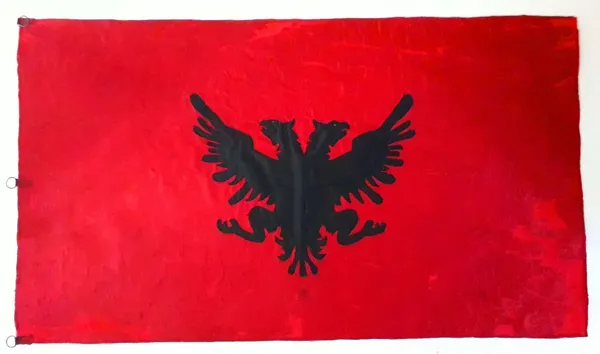
The Lushnja Congress flag restored in 2020 by Frederik Stamati
Unlike the Kastriots, the Muzakas, these silent rivals, had a "voice" of their own to become part of the narrative of posteriority. John Muzaka, who wrote a testament in exile, the oldest emblem of the family was a water stone in the form of two torches, "but later we made our emblem the eagle with two heads, crowned in the middle with a star" (in the original: " ma dopoi ch'havemo havuto l'aquila con due teste coronate con la stella in mezzo”).
In Mesanje, a city on the Ionian coast of the province of Bari, the descendants of the Muzakai apparently obtained the consent of Charles V to use their heraldry with the "double-headed eagle".
"Dreamed and loved"
And this heraldic symbol saw itself alive precisely among the people of Arbëresh: Zef Skiroi would use it in one of the cultural monthlies.
With the flag on the red background and the black double-headed eagle, the delegates of the National Assembly in Vlora, on November 28, 1912, signed the document that said: "...Albania today should become more independent, free and non-dependent".
In the epitaph delivered by Ismal Qemali, he emphasized that the gathering tasked him to do "the holy raising of our national emblem, our dreamed and loved flag". As soon as he took out a small flag, which he placed on one of the poles of the balcony, the audience erupted with cheers and ovations.
"Here, then, this is our red flag with the black double-headed eagle in the center. And now, all together, as a whole and undivided body, let's work to make it proud, to progress and to civilize it as befits our Free Motherland", he continued. all the pathos of the old Vlonjat with 68 years on his shoulders.
also Longfellow described the Skanderbeg flag to Faik Konica
"Armor of Albania"
Still before being placed on the throne of the independent principality of Albania, the riosh and phlegmatic Prussian prince, Wilhelm of Wied, had shown interest in sketching the "armor of Albania", as conveyed by the official newspaper of the Government of Vlora, "Përlindja e Albania".
"...one of the first concerns of Prince Wied was to arm the new state. These weapons or this armor will be Skanderbeg's eagle with two crests that will have the weapons of Prince Wied in the armor, which are a peacock peacock with an elaborate tail in the layer of gold", wrote the governmental body of Vlora at the beginning of the year 1914.
Mostly the same expressions would be used by the Albanian Republic of Korça, the "National Defense of Kosovo" Committee and the Congress of Lushnja. One of these must have been used in Kosovo when the Austro-Hungarian troops were deployed at the beginning of 1916.
In the area ceded to Vienna (which included Mitrovica, Vushtrri, Lower Drenica, Peja, Istogu, Gjakova, Plava, Gucia and Ulqini), the Albanians were granted the right to local self-administration, education in their mother tongue, as well as the use of the flag and national symbols.
Competing with "Bajrak"
But at the time when the Turcophile riots broke out in Central Albania, which in a few months undid the "principality" of Wied, the Islamic rebels of the districts of Durrës, Shijak, Tirana and Kavaja used as a flag a green cloth with a moon. Likewise, Esad Pasha Toptan's forces would also use a bajrak on their head, which consisted of a red stripe with a white star in its right corner.
But the design of the symbol of the red and black flag would take more or less the form it has today in 1928, the time when Albania was declared the King: this flag with a red background had in its epicenter the black double-headed eagle, above which was placed the helmet of Skenderbeu, with the same number of feathers on both open wings (9), as well as a tail with seven feathers.
From Tutini to Follorina
23 years after the reconquest of Kosovo and the Albanian territories in Macedonia and Montenegro, November 28 for the first time gained the status of a national holiday. After the destruction of Yugoslavia by Germany and Italy in 1941 and following the Vienna agreement signed between the German foreign minister, Ribbentrop, and the Italian foreign minister, Ciano, most of Kosovo, a portion of western Macedonia, as well as parts of Mali the Blacks came under the administration of Rome.
the royal decree of August 7 of the same year, this area was joined to the "Kingdom of Albania", in which case the administration with Albanian officials was established, Albanian schools were opened and the use of the national flag began in all the newly created prefectures. Thus, the two-pronged Albanian was seen waving in all the prefectures and sub-prefectures from Tutini and Rozhaja in the north to Prespa and Follorina in the south.
"Union with Nana Shqipni"
also The eagle with two crests and the two crests of the Albanian
Even in the Albanian provinces, which remained outside the borders of the "Kingdom of Albania", a revival of demands for the use of the red and black flag was noticed at that time. Such was a request of the representatives of Podgorica and its surroundings that on May 14, 1942 they addressed to the official Tirana. In the long letter, which bore the signatures of the Albanian representatives of Podgorica, such as: Haxhi Hafiz Sulejman Begaj, Omer Beg Haveri, Hysejn Brati, Jusif Lumani, Mustafa Dervani and M. Berira, it was mentioned that "the overwhelming majority of the people of the city of Podgorica invoke , through us, warmly its union with the common homeland: with mother Shqipni".
"The long time that has separated Albania from one of its Kreshnik daughters: from Podgorica, seems to have awakened, here and there, an unfounded impression: that Podgorica is, now, a Slavized city. This impression, on the contrary, does not correspond to the truth at all. Here's why: The population of Podgorica is made up of thirteen thousand inhabitants. This population is divided as follows: four thousand Muslims and Catholics and eight thousand of the Orthodox faith. The Orthodox majority of the population made many mistakes: they think that since the majority is of the Orthodox faith, they want to say that the majority of the population is Montenegrin. From mistake to mistake: this impression is not true either. Here's why: all eight thousand inhabitants, although they are Orthodox, are Albanians, indeed predominantly Albanians. The Orthodox population of Podgorica is made up of Albanians who come from different Albanian villages: from Kuçi, from Pipri, from Leshanji, from Bjelopaliqi, whose origins derive, as they themselves say and affirm, from Dukagjini. Therefore, the Albanian rights over Podgorica remain completely intact and, as such, can be reclaimed in the first place", this letter said. "In addition, Podgorica, even if unjustly left in Montenegro, would not be able to survive. The reason is simple: its entire hinterland: Gruda, Hoti, Triepshi, Dinosha, Omerbozhjaj, Koça, Ledina and Fudna, Vranje, Vllana, Matagushi and others are purely Albanian and the remaining or destined to remain Albania. The life of Podgorica, therefore, without this hinterland, which is the natural one of this city, is basically impossible, which is why even if it were to be left outside the borders of Albania, economically speaking, it would not be able to live The economy is, as is known, the axis that regulates people's lives and, from this point of view, Podgorica can only remain within the borders of Albania. On the other hand, even the hinterland cannot live without Podgorica and the trade of this center is always done in Shkodër. The conclusion that emerges from these findings is both logical and natural: Podgorica cannot live without its natural district, and its district cannot live without its center".
