


Paolo Giova (1483-1552) was a collector of works of art, an outstanding personality of the Italian Renaissance, who, thanks to his passion, is believed to have made it possible to reach the image of the national hero, George Kastrioti Skënderbeu, writes Bajram Peçi in the newspaper "Shqip".
Bishop, physician, physicist, historian and biographer, has become famous as the creator of the "Illustrious Woman" museum, with the most unique collection of works of art seen in Medieval Europe.
Coins and medals, as part of the decorative arts, from the time of Fulvio and Giovo became a subsidiary discipline of history
Giova's idea of establishing a museum with portraits of famous people, emperors and popes, philosophers, figures of letters and rulers, famous warriors, artists and generals, was perhaps the most original thought of the European civilization of the time. The passion for collecting portraits began in the Renaissance period. Shortly before him, the contemporary Andrea Fulvio, (1470-1527), had tried to lay the first stones in the foundations of a cultural building, which would later become the house of art and civilization. He was an Italian humanist, poet and antiquarian of the Renaissance, the collector who first attempted to identify the famous faces of Antiquity from the source coins and, likewise, the first antiquarian to make epigraphic records of the ancient ruins of Rome. He published the pictures illustrated by him in two volumes. One contained images of famous faces of Antiquity from numismatic evidence and the other was a guide to the antiquities of Rome. The first book of notable men based on numismatic sources was carried out in collaboration with another antiquarian, Jacopo Mazzocchi. The "famous people" of the illustrated edition were Roman and Roman-Germanic emperors. Others, beginning with Alexander the Great of Macedon, included Byzantine emperors, Carolingian princes, etc.
The innovation he brought to the art of making portraits was the idea and effort to collaborate with painters, so that for the identification of the faces of famous people of Antiquity, now forgotten, imperial coins and medals could be used. Similarities in coins and medals produced the art of portraiture. Fulvio is credited as the founder of the art of numismatics and epigraphy.
also Michelangelo: The Man, the Brand, the Mystery
Fulvio's idea was followed by Giova. The purpose was to consciously revive and bring them out of the twilight of past ages, believing that portraits of men who had shone in glory and wisdom, if placed before the eyes, would help to ennoble and invigorate the soul. Examples of pictorial art collections were encountered in bronze busts of philosophers in Roman libraries, but none of these were conceived with the express purpose of building for the public, as Giovio expressed in his project. Both of them, independently of each other, besides illustrating the image, also made for them a brief historical description.
Creating a unique museum of its kind
The Renaissance marked a qualitative upheaval in the history of portraiture. The taken turn replaced iconography based on Christian holy books with an interest in the natural world, in the "earthly" man, in the classical cultures of Rome and ancient Greece. The portraits, painted and sculpted by the artistic genius that filled the age, have not yet been surpassed.
Giovio began collecting portraits around 1512, after he had left Como, his native city, to pursue a career as a Christian prelate in Rome. From portraits of prominent men of letters, such as Virgil, Dante Alighieri and Petrarch, the collection began to include military figures, kings, popes and prominent artists of past eras. He wanted not idealizations, but portraits drawn from life whenever possible. In the absence of such opportunities, he commissioned painters to rely on the likenesses produced on existing imperial and royal coins, busts or medals. Chroniclers note that in order to collect the collection, he had to write to dozens of public figures in Europe and the Near East, to ask for their portraits. It was the beginning of coin collecting, and it was the ancient coins that immortalized most of the most remarkable portraits that the classical world had produced in its grandeur as it crossed the threshold of modern civilization. The need to awaken the memories of the past, besides the art of creating portraits, gave birth to the science of numismatics with all the weight and values of their historical, economic and cultural study.
Giova started the construction of the museum in 1537 and finished it in 1543. The portrait paintings, divided into four categories of subjects, were organized within the groups chronologically, according to the date of death or by the year of birth, if the person was still alive. Giovio accompanied the portraits with short biographies which have been published and known for short as "Elogia". Paolo Giova thus followed the experience of the antiquarian Andrea Fulvio, who in 1517 accompanied the portraits taken as views from the coins with notes. There was also an illustrated set of about 700 famous figures of the ancient world, made by Fulvio, which may have inspired Giovio. While Fulvio published the portraits in the catalog, Giova ordered them to be artistically worked with the oil on wood technique.
Belini and his portrait of a sultan
From the collection of this colossus of the Renaissance and his work in Como, there are many museums that today spread culture and promote tourism, having in their possession parts of his fund. Paolo Giovio collected and copied many well-known works from the great masters of the era, including our hero, Gjergj Kastriot Skënderbeu. It is worth mentioning, in function of the purpose for the portrait of Skenderbeu, also a portrait of Sultan Mehmed II, created as a copy from Belini's original model. It is known that the copy was made by the painter Cristofano del'Altissimo. The chronicles record that Sultan Mehmed II, unusually for Muslim rites, had sent a diplomatic missionary to Venice, with the task of finding a named painter and bringing him to Istanbul. It was the artist Gentile Belini, who was chosen to go to the High Gate in 1479 and 1480 and make the portrait. Historians and art critics mention that his collection also includes some sketches and paintings of Albanians. There is no proof of where he could have done it. He may have done it while passing through transit, which gave rise to speculations that he modeled Skanderbeg in a portrait, without having to do it in Venice! Years later, Sultan Bayezid II removed Belin's portrait from the court, and even removed it from Istanbul. Art historians still debate about the path the portrait took, to arrive in Florence or London. The Uffici portrait stands next to that of Skanderbeg and (art critics say) have great similarities in style and workmanship, indicating that they may have been done by the same hand. Jason Goodwin, the writer and historian of thriller novels, in "Portrait of Belin", about the famous work of Mehmet the Conqueror, located in the National Gallery-London, writes that the curators have labeled the painting as "Attributed" and not painted. As the fate of this portrait is not completely known, with the departure of the founder of the museum, the fate of many other portraits is also unknown, since the archive-museum of 484 portraits was affected and destroyed. He lost, to remain in the copy.
Painting copies of Skanderbeg's portraits
Portraits of Skanderbeg have their origins in the picture galleries, which were copied in Italy from the royal houses of Northern Europe in the early 16th century. After Paolo Giovio's death in 1552, the original collection was dispersed and lost. Some portraits are kept in the Pinakoteka "Civica di Palazzo Volpi", in Como. Most are preserved in the Uffizi as copies by the painter Cristofano dell'Altissimo, who spent 37 years copying the portraits from 1552 to 1589. Only three collections of "Famous Men" portrait paintings are known that contain portraits of Skanderbeg and are similar to each other. These are the collections of the bishop of Nocera, Paolo Giovi; of Duke Cosimo I of Florence and that of Archduke Ferdinand von Tirol of Ambras Castle. There are great iconographic similarities between the portraits in the aforementioned collections, because these portraits were created as copies of the original. Duke Cosimo I de' Medici asked Cristofano Altissimo to copy Paolo Giovo's collection around 1552 and 1564. Archduke Ferdinand did the same. A painter (whose name is not known) was sent by him to Florence, in order to copy the portrait fund of the capital of art. A number of copies made for Cosimo I de' Medici are now permanently housed in the Uffizi Gallery in Florence.
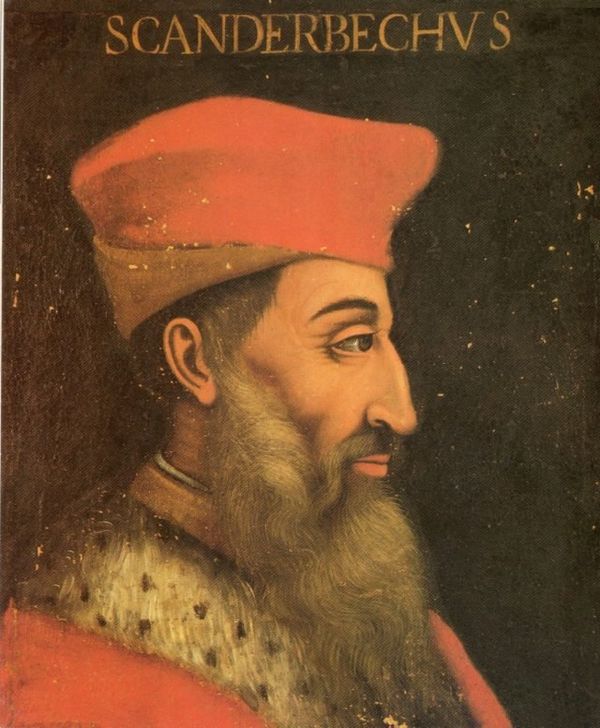
Archduke Ferdinand asked for two portraits of Skanderbeg to be copied. I took one of them, which illustrates the article, from the publication "ALBANIEN Schätze aus dem Land der Skipetaren". The group-editors of this luxurious 480-page edition of the publisher "Verlag Philip von Zabern, Mainz", launched on the German market in 1988, on the occasion of the Exhibition of Archeology and Albanian Culture in the city of Hildesheim, has chosen to illustrate the appearance of Skënderbeu precisely with this portrait and the following information: Portrait of Gjergj Kastriot, nicknamed Skënderbej/ Private property, Oil painting, 64.5 cm high and 45.5 cm wide/ Anonymous author, late 17th century/ high, in the middle, there is the note: SCANDERBECHVS.
also The figure of Skanderbeg unfolds as a unique knight and strategist in Europe
The medieval art historian, Friedrich Wilhelm Knies, accompanies the portrait with some historical descriptions. He claims that for the portrait of Skanderbeg published in the book, we owe it to the Ambraser collection, where there is also an allusion to the iconographic origin. Further, art historian and critic FW Knies opines that “…one of the specimens in the Ambraser collection is so similar to the above portrait, that both paintings must have been made at the same time and place, or were based on the same original. Although the two portraits are on opposite sides of each other (facing each other), they are almost identical in face (completely agree), especially the ear, eye and chin. Only the shape of the nose differs slightly in the two portraits, because it is obvious that the copyist of Ambraser was influenced by the ideals of Central European beauty and straightened the typical turned nose of Skanderbeg". For the same portrait view, in the book "Skënderbeu" by the author Kristo Frashëri, in the caption of the illustration it is noted that it is located in the castle of Waldburg-Germani.
But what was alluded to in the note about the iconographic origin of the portrait of Skanderbeg, which was found in Ambras? In the 19th volume of the Yearbook of the Collections of the Imperial Family, there is a note stating that a portrait was copied from a model created by Gentile Bellini in 1466, when Skanderbeg had gone to Venice. Skanderbeg was alluded to have been all over Italy, including Venice, between 1461 and 1466 and as a result Bellini probably portrayed Skanderbeg. FW Knies, from the allusive note of Ambras, expresses the opinion that, "... Since it is a painted portrait of Skanderbeg, it must have been commissioned during his visit to Venice, in 1466".
Another prominent collector, the Viennese historian, archaeologist and numismatist, Friedrich Kenner, in 1898 identified this painting (by Ambraser) as part of the princely collections, which according to him, for stylistic reasons, could only have been made in Venice and by Venetian copyists. Furthermore, the lithograph published in 1500 in Marin Barleti's "Skënderbeu" is said to have been inspired by sketches made by the artist Xhentile Belini. From the allusion of "Ambras", the opinion of FW Knies and the definition of F. Kenner, which made Venice and its painters as the iconographic source of the original painting, a debate took place: Did Gentile Belini paint a portrait of Gjergj Kastriot Skanderbeg? The portrait is noted to have been copied at the end of the 17th century, but the painter-copyist of Archduke Ferdinand, as well as the painter Cristofano Altissimos, commissioned by Duke Cosimo I de' Medici, copied portraits created in the c. 16th, maybe even the century. 15, which belonged to the Giova collection. Art historians and critics are of this opinion, who generally adhere to the view that the true image of Skanderbeg originates from the legacy of the collector Paolo Giova, copies of which are in the Uffizi Gallery, Ambras castle and other copies scattered in art galleries, state and private. A section of critical opinion has long insisted that a portrait of him, taken as the true likeness, was the work of Bellini. Others bring the counterargument that this has happened. Dozens of researchers have come around Gjegja who have contradicted each other, affirmed and denied, but the shroud of mystery can hardly be removed. Historians are of one mind and clear: Skanderbeg has never been to Venice and therefore could not have posed there for Belin. In Italy, only visits to Rome and Naples and the walks around them are known, both in military campaigns and on visits. Other possibilities of the artist's contact with the warrior of Christianity have been dismissed as conjecture, such as that of Kristo Frashëri, who assumes that Skanderbeg's four-month stay in Rome and Naples may have been used for posing by Xhentile Bellini.
Portraits of Skanderbeg on medals
The medal, which developed from the Renaissance as a form of artistic expression, was seen in that world as a symbol of achievement. A specially designed medal became a symbol of values, it was a sign of recognition to honor the individual in the highest degree. It has not been known that a medal or coin with his portrait was dedicated to Skenderbeu while he was alive, until the artist and critic of the art of painting, Mr. Ferid Hudhri announced the presence of three medals in Venice. Skanderbeg's period is the only time that the lands of our nation were seen as a factor by Europe. Awarding medals to Skenderbeu is the best indicator of this assessment.
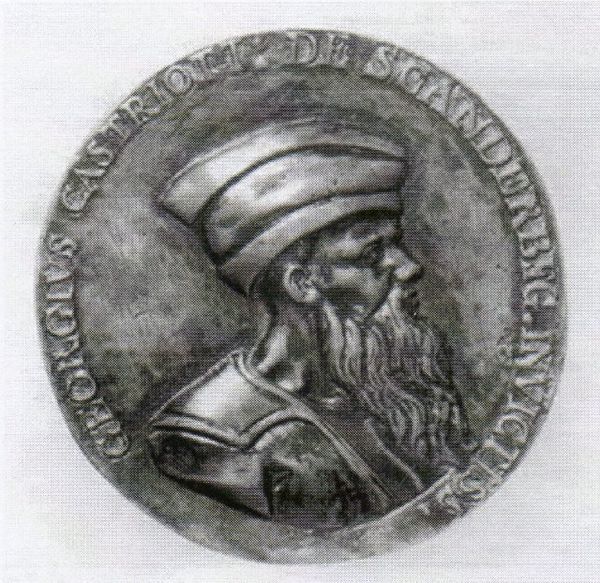
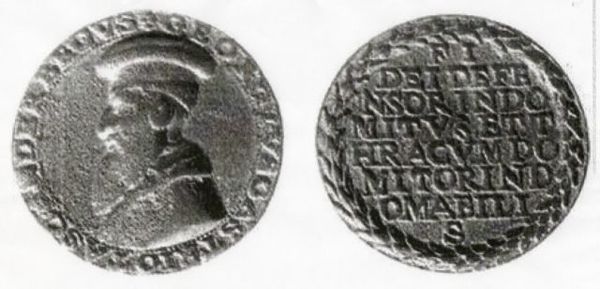
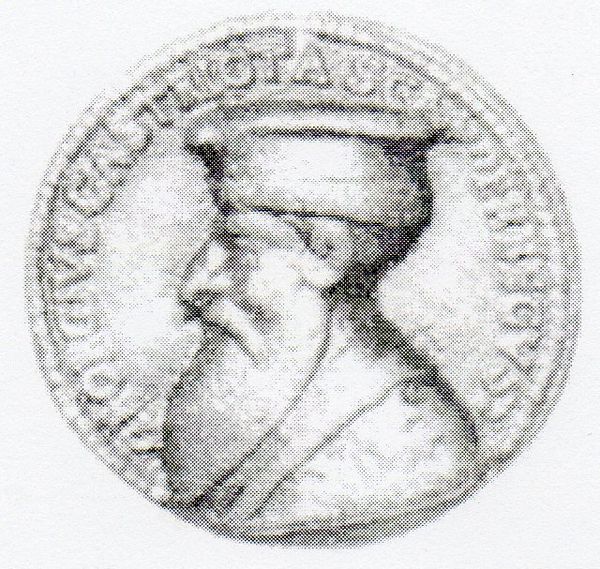
In the 1998 edition of the album "History of Venice through medals" by the author Piero Voltolina, three medals with the portrait of Skenderbeu are presented. Hudhri, through an article published years ago, informs us that the album is determined to have been made in the third quarter of the 1450th century, around 1475-XNUMX, when Gjergj Kastrioti was still alive. Further, the art critic believes that they were created according to drawings made directly from nature.
The first medal with the portrait of Skanderbeg, profile on the right, was produced in Venice, author unknown, in the years 1463-1466, it is silver metal, circular with a diameter of 98 mm. In the limiting spaces it bears the inscription, GEORGIVS CASTRIOTT:DE SCANDERBEG.INVICTISS (the invincible). The medal is part of the private collection of the author of the album, Piero Voltolina.
The second medal of the album is a silver alloy, produced in Rome around these years of the 46.3th century. It has a diameter of XNUMX mm. The author of the creation remains unknown. About this medal, Kristo Frashëri in his publication, "Skënderbeu", says that a copy is in the numismatic museum of Berlin and is made of bronze. The medallion is circular, inside the surface bears the profile portrait left, surrounded by the inscription *GEORGIVS CASTRIOTA SCANDERBEGVS*. On the reverse he bears in the peripheral edges a laurel wreath and the inscription FI DEI DEFEN-NSOR INDOMITVS ET T-HRACVM DO-MINA-TOR INDO-MABILI-S (Invincible Defender of Religion, Invincible Triumphant of the Thracians).
The third medal in the album is also a silver alloy, produced in Rome in the 37.7th century. It has a diameter of XNUMX mm. Author of creation unknown. The medallion is circular, inside the surface bears the profile portrait left, surrounded by the inscription *GEORGVS CASTRIOTA SCANDERBERGVS*.
also Skanderbeg in the narratives of centuries through portraits
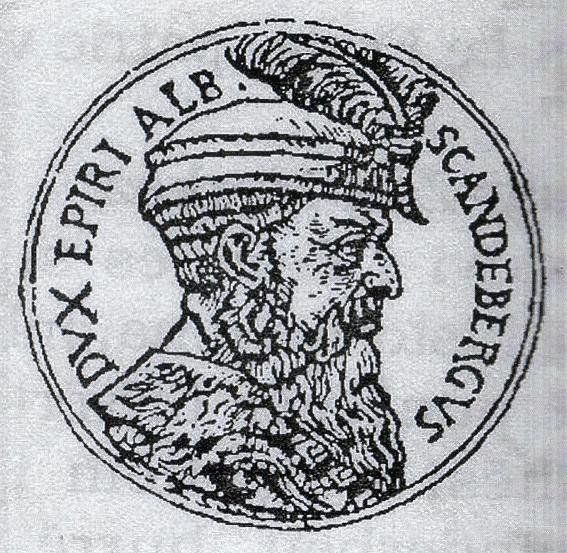
A Dutch master residing in Germany, Domenikus Custos (1550-1612), is known to have engraved within an elliptical medallion a portrait of Scanderbeg, with the peripheral inscription surrounding the portrait: GEORGIVS CASTRIOTVS SCANDERBEGVS, Epiri et Albaniae etc Princeps, Anno 1444 Similar to it, it turns out to be another medallion, not elliptical but circular, that illustrates on one of the inner pages the publication of the author Carlo Padiglione, "Skenderbeu and his descendants". Within a circular surface of 36 mm, the portrait of Skënderbeu, profile to the right and in the limiting spaces bears the inscription: DVX EPIRI ALB. SCANDEBERGVS.
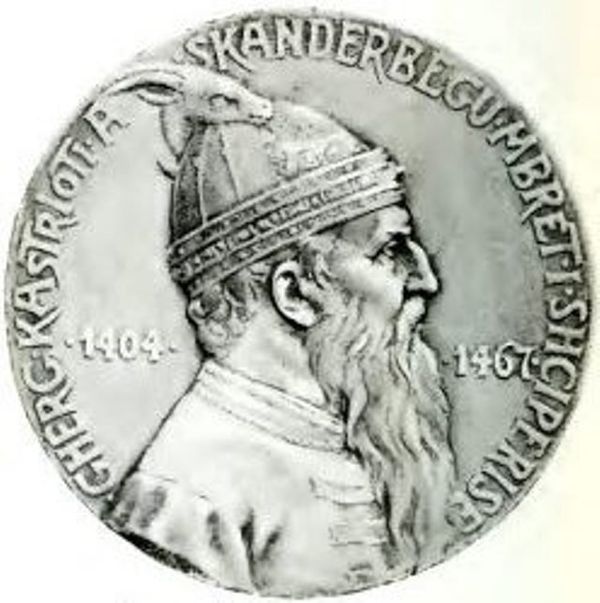
Following is a design for a medal created in 1912 by Heinrich Kautsch. Indeed, the artist-sculptor, H.Kautsch, in turn modeled for this medal an engraving made by another unknown author, but published in Milan in 1886, in the book of A. Schweiger-Lerchenfeld- Orient. This medal could not be produced, but the model was used for the production of the postage stamp of the independent Albanian state, in 1913, as well as the military medal for the militia, in three classes, in 1939. With the creation of the independent Albanian state, medals, orders and medallions with Skanderbeg's portrait were frequent and varied.

