


-
By:
Sinan Berisha

- June 26, 2025 08:00
- Share to:
Three artists – Arbër Salihu, Rea Mehana and Kreshnik Arifi – have shared with the public their winning works of the “Infrared” residency, opening new windows of reflection on the relationship of the citizen with nature, a relationship that is in the process of disappearing. The three projects place man in a tense relationship with the space that surrounds him – whether it is suffocated by smog, stripped of greenery or faced with the silence of fragile sounds that no longer find a place in cities structured on concrete and noise.
When the tension between development and ecological neglect increases day by day, artists have decided to walk with this in an inverse ratio. They have chosen not to remain silent. They give voice, form and sensitivity to the crisis that haunts the collective breath. With this mission, on Tuesday evening in the spaces of “Residence 17”, the three winning projects of this year’s “Infrared” residency were presented, a program that has promoted the combination of contemporary art with environmental sensitivity and technology.
The "Infrared" project, which has been organized since 2019, requires candidates to come up with ideas, whether artistic or research-related, related to the topic of the environment and to work with those ideas for three months to present them and create a pipeline of ecological projects.
For this year, three artists – Arbër Salihu, Rea Mehana and Kreshnik Arifi – have shared their works with the public through installations, research and discussions, opening new windows of reflection on the citizen's relationship with nature, a relationship that is in decline.
Despite the differences in mediums and approaches, the three projects presented within this residency have a common denominator: the concern for the lack of harmony between man and nature in everyday reality. All three projects place man in a tense relationship with the space that surrounds him – be it suffocated by smog, stripped of greenery or confronted with the silence of fragile sounds that no longer find a place in cities structured on concrete and noise. The artists have not offered ready-made answers, but have pushed the viewer towards sensitivity, reflection and, ultimately, awareness.
Rea Mehana has brought the project “Trees/Man/Symbiosis”, an artistic research on the impact of green spaces on urban well-being. Reflecting on citizens’ personal experiences with nature, her work aims to raise awareness of the vital importance of these spaces in an era of unstoppable concretization.
also Theater in constant search for the audience, facing art that is challenged
She said that the lack of greenery in Kosovo's cities has become increasingly apparent and that the aim of the work was to explore the perceptions and opinions of Kosovo citizens regarding the lack of these spaces. Through a survey, she took a sample of 150 citizens to come to a conclusion about how aware they are of this phenomenon.
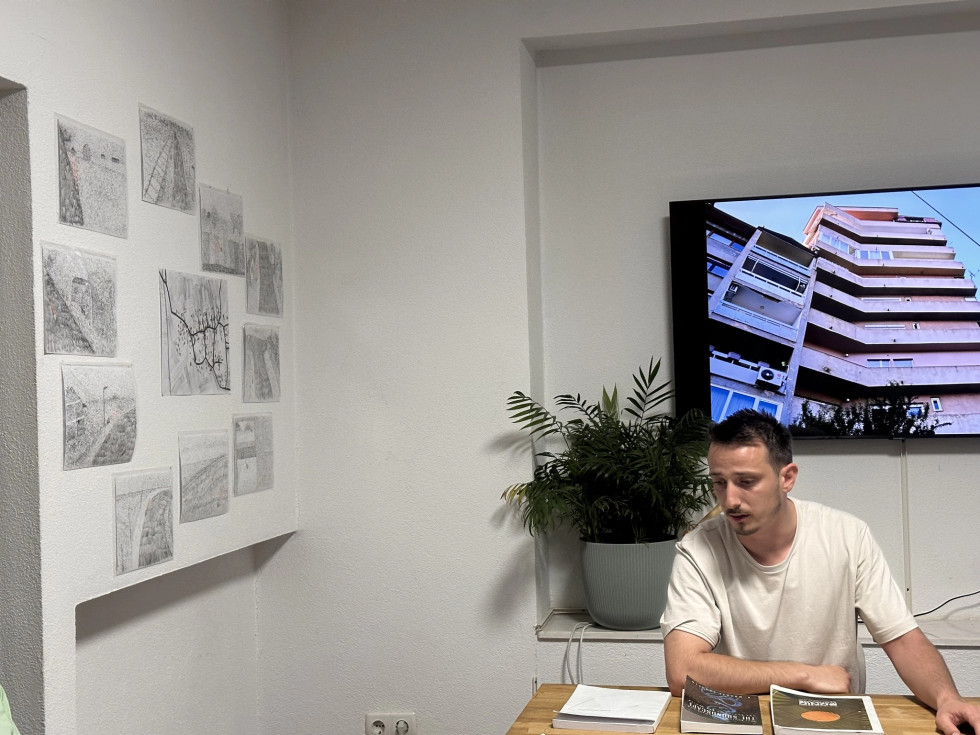
"The study will examine the factors that, according to citizens, contribute to this shortage and will provide an overview of the current situation regarding green spaces in Kosovo as well as their potential impacts on the health and livelihoods of the population," said Mehana at the beginning of the presentation.
After reviewing the survey results, she added that in conclusion, citizens are aware and willing to engage in various ways to preserve and expand green spaces, but according to her, to do all this, greater responsibility towards public policies and the implementation of laws is needed.
"To meet this challenge, it is necessary to improve public policies and the implementation of laws for forest protection, as well as to promote effective cooperation between institutions, communities and organizations. Urban planning must sustainably integrate green spaces, thus ensuring a healthier and more qualitative environment for all citizens," she added.
Kreshnik Arifi, through “Echo–Eco Fear,” has explored soundscapes as carriers of identity and ecological anxiety. He has seen the relationship with acoustic powers versus smaller places or situations as a problem in societies that have less access to louder information.
"The way I wanted to translate this research into artistic work is by making it a hypothetical journey from the rural area to the urban area. This artistic process was done through a technique that I say is a very unstructured and innocent-sounding technique," said Arifi during the presentation of his research.
Through the symbolic sound of a bicycle bell, he has created a narrative where the sound travels from the countryside to the city, reflecting the uncertainties brought about by the shift from nature to urban noise.
"In sound art, I would translate it as a tendency to create fragile sounds, which have grown in a space where they are without structure, do not know how to position themselves and are not defined by any type of communicative structure. What I have selected is the bicycle bell and the reason for the selection is how to find a material that is in the most initial stage of its development and is still unaffected by the politics of space and the hypothetical case is the launch of this fragile sound to a space that is noisier, that has an inherited structure and does not easily accept things that are quite unfounded and fragile," he added.
also Theater – the necessary space to break the silence on the environmental crisis
He has also created a sound map. He has presented part of the sketches in black to visually show the journey from the village to the city, while in orange he has presented the naive sounds that have been influenced by that journey, and it is noticeable that since passing through the village, at the beginning there is a greater freedom of sound expression and the part where he went towards the city a certain sonic hesitation emerges.
"The way I wanted to approach it artistically was due to the problematic consideration of infrastructure," he said.
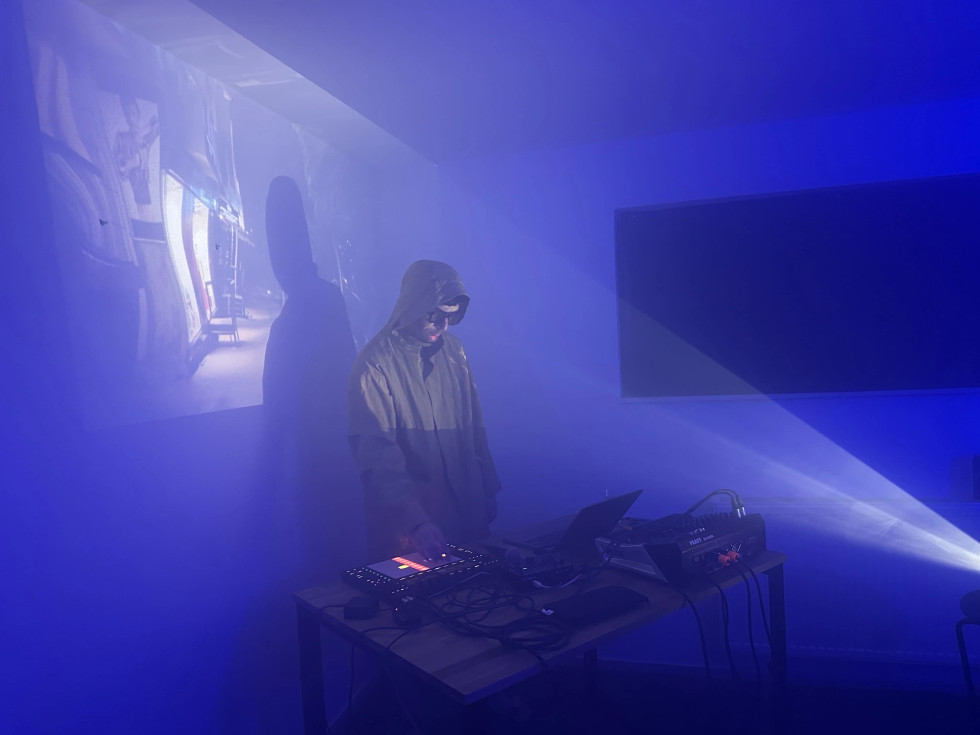
In one of the rooms of “Residence 17”, shrouded in fog and with dim lighting that revealed the spirit of a smog-choked winter, Arbër Salihu presented “Smog Waltz”, a sound installation in progress, which transformed air pollution into a multi-sensory experience. He sat focused in front of his musical equipment, wearing a jacket with a hat – a perfect silhouette representing the cold and unbearable Pristina. Next to him, a projector displayed distorted images of urban streets, while the sounds that he slowly layered enveloped the space with a poetic tension: the difficult breathing turned into rhythm, and the lack of clean air became the melody of collective memory.
"The theme of the environment is something that obviously affects us all, whether we like it or not. I miss the greenery in Pristina, I miss the clean air in Pristina, especially in winter. What I have done is an audiovisual work of art and I made an artistic interpretation of the feeling of living in Pristina, especially during the winter months when we are trapped in smog and we are not able to leave our apartments and houses, because you simply cannot even open the window, because you feel like you are suffocating from the bad air," artist Arbër Salihu, known as La Fazani, told KOMËN.
As a solo performance – the first of its kind for him – he has created a work that stems directly from personal and shared experience: living in winter Pristina.
"This was an opportunity for me to interpret this theme, but also to do a solo performance, which I'm not very used to, and to explore a new form of artistic expression through technology, which allows me to layer voices one on top of the other, and for me it was the first time I've done such a performance, and everything came together as it should for this to happen tonight, and I'm glad it did," he added.
Through the recorded sound of himself breathing, he has constructed a sound structure that represents breathing as the most sincere symbol of life and its absence.
"Every element in this performance has come as an expression that represents the feeling of living in Prishtina in the winter. Breathing is the main symbol and when you feel like you are not breathing cleanly, as you should, then you will feel like you are not living life properly. In this artistic performance, breathing has been the main element. I have recorded myself breathing and I have inserted it as part of the music, and this has been like the heartbeat of this work", said Salihu after the end of his performance.
also Giant installations by two Asian artists take over London
His work invited the audience into an absurd "waltz" with smog – an invisible but omnipresent partner for Pristina residents during the winter.
As the environment silently degrades, it is precisely art that tries to make this noise heard. And in a country where urban planning often ignores the vital needs for clean air, for greenery, and for spaces where the sound of nature is not drowned out by machinery, the artists of the “Infrared” residency provide a testimony: that pollution is not just a black statistic on paper, but is an experience that breathes – or doesn’t breathe in fact. This residency is proof that art not only reflects reality, but is sometimes the only one that calls for collective consciousness, that when the city no longer has greenery, what art plants is only sensitivity.

