


-
By:
Besarte Elshani

- July 9, 2026 20:57
- Share to:
After more than a year of renovation, the National Gallery of Kosovo has returned to its largest-ever investment. For the first time, the institution has a storage facility that meets the standards for the preservation and conservation of the state art collection. The 1.7 million euro renovation was inaugurated with the exhibition “Not All People Exist in the Same Present”
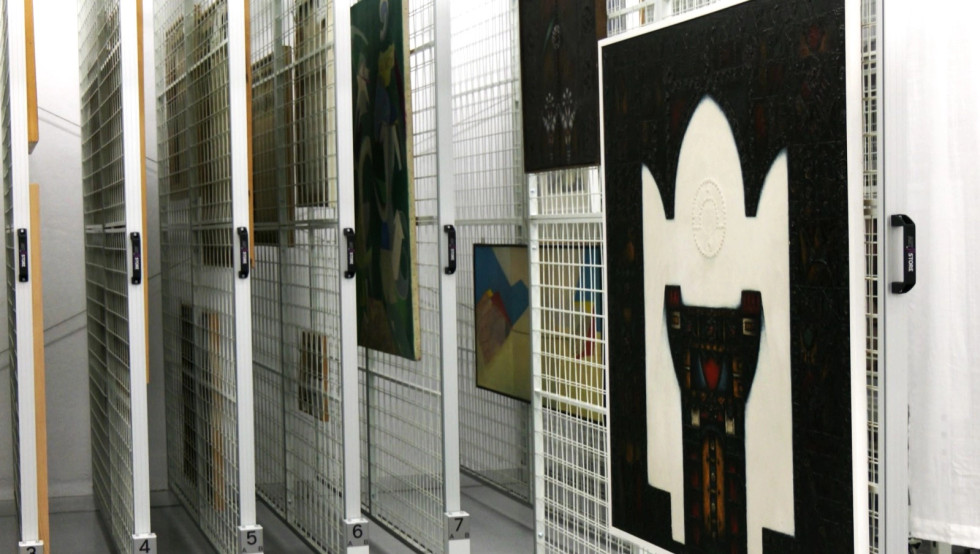
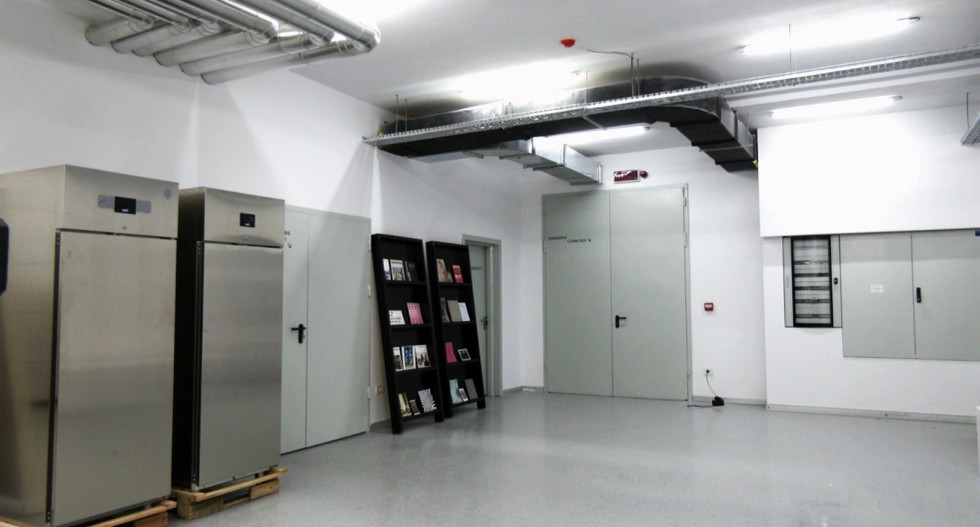
The National Gallery of Kosovo has reopened its doors to the public after more than a year of renovation, putting into operation new spaces aimed at improving the preservation of the state collection and exhibition conditions. The main part of the investment of approximately 1.7 million euros is the construction of the first institutional warehouse for the storage and conservation of works from the permanent collection of the National Gallery of Kosovo.
The reopening of the institution was marked on Thursday with a press conference, while in the evening the collective exhibition "Not all people exist in the same present", curated by Hana Halilaj, was inaugurated.
In addition to improving the existing infrastructure and exhibition conditions, the project has brought about, for the first time, a warehouse built according to standards for the storage and conservation of the state art collection. This space is considered one of the most important achievements of the renovation, as it creates the necessary conditions for the long-term preservation of the works that make up Kosovo's artistic heritage.
The press conference held on Thursday morning preceded the opening of the collective exhibition "Not All People Exist in the Same Present", curated by Hana Halilaj, who inaugurated the renovated facility on the evening of the same day.
The Gallery building was closed in the last week of May last year to undergo a complete renovation. The GKK was moved to what was known as the Gallery of the Ministry of Culture, then the “Qafa” gallery, and when the GKK took over it, it was called the Small Gallery. The project included improving the existing infrastructure, working and presentation conditions for artists, as well as the visitor experience. In addition to the reconstruction of the warehouse, the interventions included the air conditioning system, lighting, adjusting the height of the ceilings and exhibition spaces according to the needs of the institution. One million and 474 thousand euros was the value of the contract signed in April last year, but a year later additional work was also carried out. Additional funds were also taken for the reconnection to the electricity grid, thus increasing the cost. “Reconnection of the National Gallery of Kosovo building to the electrical network” and “Additional work in the works for the implementation of the detailed project (main implementer) of architecture and engineering for the renovation of the 'National Gallery of Kosovo' in Pristina” were two new procurement activities that the Ministry of Culture had developed for the National Gallery of Kosovo. The first, through an open call, was closed with 18 thousand 400 euros, selecting the company that offered the cheapest price. As for the additional works, the Ministry of Culture had negotiated with the group of companies that was implementing the main project. It was agreed that the additional works would be completed with 123 thousand 603 euros. Thus, one million 676 thousand 546 euros was the final cost of renovating the mid-30s building, originally built as a military unit of the Yugoslav Army, then as a library from 1955 to 1981 when it was adapted as an exhibition hall by architect Agush Beqiri for the Revolutionary Museum of the time, and from 1995 as an art gallery and officially in what is now the National Gallery of Kosovo since 1999.
also The National Gallery of Kosovo does not have enough 1.4 million euros for renovation, additional work increases the cost
The chairwoman of the governing council of the National Gallery of Kosovo, Renea Behluli, said that the institution has undergone a major transformation over the last four years, despite the challenges it has faced.
"In these four years, we have organized over 30 exhibitions, the collection has been enriched with over 350 new works, which has been the largest institutional process in the history of public collecting in Kosovo, the collection of over one thousand two hundred works has been fully registered and we have begun its digitalization," she said.
According to her, the Gallery had many shortcomings when she took over as head of the institution.
"In the spring of 2022, when we took over the mandate, the National Gallery lacked human resources, an educational program, and a research program. This has made it difficult for the institution to function properly. Four years later, we are a very advanced institution, with a full annual program, with doors open to artists of the new generation and those who were not previously involved, with international collaborations that have enriched the program," said Behluli.
The Deputy Director of the National Gallery, Alisa Gojani, said that the most important investment from the renovation is the construction of the warehouse for the state collection of artworks.
"The investment that has been made in the warehouse is one of the most important works that have taken place so far during all the renovations of the Gallery, which have been inside the building and have had to do with the halls, with the spaces. The Gallery building is an adapted building, initially for the Museum of the Revolution and then for the National Gallery," she said at the conference.
Air conditioning, lighting and ceiling height are among other interventions in the National Gallery of Kosovo building. According to Gojani, the renovation was necessary.
"It was a necessary and much-needed investment, perhaps much earlier, but it has happened now. But it is never too late, as the preservation and conservation of the state collection that we keep in the National Gallery has been a necessity because we have an obligation not to keep those works just for ourselves, but to pass them on to future generations," she considered.
also The treasury of Kosovo's art as a dialogue of times and revival together with the Gallery
The exhibition "Not all people exist in the same present", curated by Hana Halilaj, which inaugurates the Gallery's renovated facility, brings together the works of 43 artists from the institution's collection and aims to offer different readings on how history, politics and society influence human experiences.
Curator Hana Halilaj said that landscape as a theme symbolizes free artistic expression and beyond.
"The exhibition brings together works from 1970 to the present, presenting some of the earliest works in the collection. As a starting point, it has precisely the landscape as a theme which, in moments when free speech and movement have often been limited, has been an important moment and something that artists have constantly returned to," she said, explaining that this is also evident among Albanian artists when Kosovo was a province of the former Yugoslavia and until the post-war period.
"Researching the collection and considering what is within the more critical narrative that artists of that time considered, many of them were preoccupied with landscape and territory as geography. Above all, their whole desire to bring the message as an idea, is read as a political stance, considering the context of Kosovo as a province during the Yugoslav period, and then in the '90s with the political turmoil in the country, parallel institutions and then the post-war context," said Halilaj.
The exhibition also includes a special section in the warehouse, where the collection is stored, which invites the public to reflect on the works and artists that remain outside of any curatorial selection.
According to curator Halilaj, this is a way to show that exhibition space, despite renovation, is never enough.
“The exhibition continues with a specially curated section from the Gallery’s collection, as a way of showing that no exhibition is ever complete. Often any space, despite renovation, the exhibition space is not large enough to include all the names, all the perspectives. Each exhibition and each grouping of certain works is a good moment to understand what is left out and what can be considered for the future,” said Halilaj.
also Gallery with ten exhibitions in the year of return to the renovated facility
The Gallery building was closed in the last week of May last year to undergo a complete renovation. The project included improving the existing infrastructure, working conditions for artists, and the visitor experience.
The National Gallery of Kosovo, founded in 1979, has been operating in its current building since 1999. For a long time, officials of this institution have had requests for intervention, especially regarding the spaces where the works of the permanent collection are kept. Since last year, when the National Gallery of Kosovo changed premises due to renovation, this issue had also influenced the drafting and approval of the annual program of the highest visual arts institution in the country.

