


-
By:
EUobserver

- November 3, 2021 23:25
- Share to:
That was the mission that had brought Angelina Eichhorst, the managing director for Europe of the European Union's Diplomatic Service, to Sarajevo last week, infuriating Bosnia-Herzegovina's pro-European and pro-American citizens and lawmakers; to cooperate with the US envoy, Matthew Palmer, and push the main Bosnian party, as well as the non-nationalist opposition, to accept an agreement on the so-called judicial election reform, which would legally and institutionally deepen the ethno-territorial divide in Bosnia - Herzegovina
Bodo Weber and Valery Perry
EU policy in Bosnia and Herzegovina, more precisely in the entire Western Balkans, has had an increasingly downward trajectory since it took the reins a decade and a half ago.
Now, in cooperation with the US and Great Britain, it is seeking to cover this failure by appeasing the separatists in Bosnia, while at the same time leading a geopolitical victory, to oppose Russia for free.
This would actually count as collaboration with the country's nationalist leaders in an intense path towards the ethno-territorial disintegration of the state, which will not be peaceful.
However, we have already seen that such a diplomatic coup can be labeled as an achievement, not as an inevitable failure.
also EU and US Embassy: Political leaders in Bosnia have not done their job
This is traditional practice in diplomatic negotiations to squeeze the weaker side until an agreement emerges.
That was the mission that had brought Angelina Eichhorst, the managing director for Europe of the European Union's Diplomatic Service, to Sarajevo last week, infuriating Bosnia-Herzegovina's pro-European and pro-American citizens and lawmakers; to cooperate with the US envoy, Matthew Palmer, and push the main Bosnian party, as well as the non-nationalist opposition, to accept an agreement on the so-called judicial election reform, which would legally and institutionally deepen the ethno-territorial divide in Bosnia - Herzegovina.
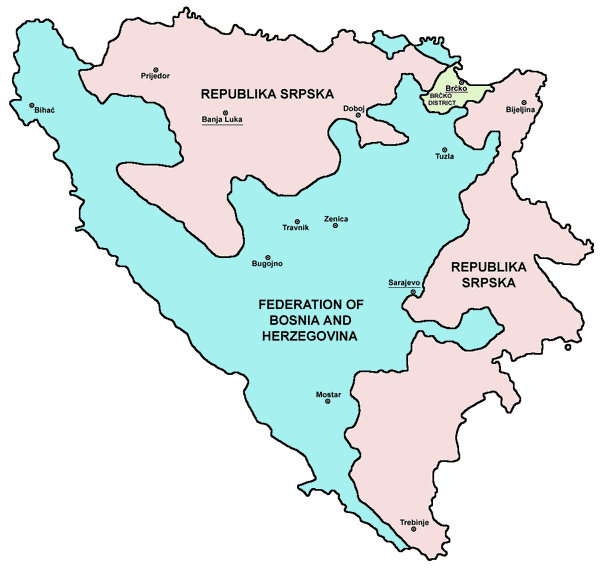
All this is happening against the country's worst crisis since the Dayton peace treaty in 1995. The leader of the Bosnian Serbs, Milorad Dodik, linked to the HDZ and with the courage given by Zagreb and Belgrade, has started the decade of his and a half-length attack on the state's postwar constitutional law, announcing high-impact steps by Republika Srpska institutions toward the dissolution of that Bosnia-Herzegovina entity.
The latest escalation evolved over the past six months, as EU and US diplomats on the ground in BiH, supported by mid-ranking officials in Washington and Brussels, launched cross-party talks on electoral reforms and the so-called "reform constitutionally limited".
These talks took the form of a de facto collusion to satisfy the unfulfilled nationalist agendas of political leaders, first and foremost that of Dragan Čović, head of HDZ, the main Bosnian Croat party, which wants to maintain the primacy of among Croat voters in Bosnia.
The then EU High Representative in BiH, Valentin Inzko, after pressure from the EU and the US to uphold the agreement they were violating, had prompted him to impose a law against genocide denial and glorification of war crimes and criminals on his last day in office; a completely understandable personal and moral decision, but one that was lame in terms of strategic structure and support.
This decision had prompted the departure of Bosnian Serbs from central institutions. It also made life difficult for his successor, the German Christian Schmidt.
The designed appointment of Schmidt by German Chancellor Angela Merkel herself, without any clear strategic policy or plan, has further facilitated the escalation. It has prompted Dodik to question Schmidt's early appointment and the existence of the wider Russian-backed High Representative Office, which has stepped up its activities against the West, according to Bosnia-Herzegovina.
Russian veto this week at the UN?
The move raised the risk of a Russian UN Security Council veto against the EU peacekeeping force in Bosnia and Herzegovina, EUFOR, whose mandate is being discussed for an annual extension this month, possibly even this week.
Milorad Dodik came to power as the leader of Republika Srpska, the Serb entity in Bosnia-Herzegovina, in 2006, around the time the European Union took over the leadership of the international community in the country.
also US threatens to reconsider role in Bosnia due to disagreements with Europe
Since then things went on a downward spiral. Dodik has tested the red lines of the West several times by threatening to organize different referendums or complete secession. The West's weak response helped undermine the integrity of the central government and stall the very democratic and rule-of-law reforms supposedly required for the country to make the necessary progress towards EU candidacy.
This time, Dodik himself appeared surprised by the lack of pushback from the EU and the US, something that, according to some reports, led him to escalate his threats beyond what he intended to go.
It would have been a direct move to stop Dodik's adventurism, simultaneously neutralizing the potential Russian veto against EUFOR. Sending EUFOR reinforcements and sending EUFOR and NATO troops to the strategic town of Brčko, the autonomous province that bisects Republika Srpska, would demonstrate the strategic will of the European Union to prevent a serious challenge to security and territorial integrity. of the country.
Unfortunately, this does not exist, as if the strategy does not exist.
Instead, the vacuum created by the lack of a Western strategic policy and political will has been filled by lower-level officials, Eichhorst and Palmer, both of whom were also decisive factors in the dangerous EU-US push towards a trade deal. ethno-territorial of lands between Kosovo and Serbia in 2017-2020.
"Calm down"
And in Bosnia they appear to be deliberately appeasing two divisive nationalist agendas through a package deal; Dodik would receive the significant gift of giving a large share of state and defense property, of which the state of Bosnia and Herzegovina is the legal owner, to the entities (or cantons), a key element of Dodik's wish list, in return to waive immediate separation steps; while Bosnia-Herzegovina's HDZ would reform its election law, securing a seat in the three-member presidency through electoral engineering.
Such an agreement would deepen Bosnia-Herzegovina's ethno-territorial division and set the stage for a gradual dismemberment, aided, abetted and legitimized by the EU and the US. Declaring victory and claiming that the country met the conditions for closing the Office of the High Representative (the "resolution" of the state property and defense issue, long blocked by RS's unconstitutional actions, is at the core of the 5+2 conditions for closing ) would at the same time be the last executive instrument of the international community to curb the downward spiral, along with EUFOR. France, the US and the UK all appear on course to telegraph a message of reduced support for the High Representative to avoid a Russian (and potentially Chinese) veto of EUFOR, scheduled for Wednesday (November 3) at the UN Security Council. Moscow and Beijing could not veto Schmidt's appointment; they can oppose EUFOR in the UNSC.
EU capitals, especially Berlin and Paris, should finally show interest in the situation and confront the interaction policy of the European External Action Service, replacing it with a more strategic policy.
High Representative Borrell must start doing her job, as she was reminded in a letter signed by MEPs of the four largest political groups in the European Parliament on October 21, and replace Eichhorst in her current role.
The Office of the High Representative under Christian Schmidt must defend Bosnia-Herzegovina and the Dayton Peace Agreement seriously and curb the impulse of dangerous decision-making by the EU and the US.
also Schmidt at the UN: Bosnia is in the deepest crisis since the Dayton Agreement
EUFOR should be expanded to Brčko and the international community should refrain from the false urgency of reforming Bosnia's electoral law and instead focus narrowly on improving the integrity of elections. The time for comprehensive constitutional change is after the 2022 elections.
(Bodo Weber and Valery Perry are senior fellows at the Democratization Policy Council, based in Berlin and Sarajevo, respectively.)

