


-
By:
Muhammad Mufaku

- September 24, 2023 23:00
- Share to:
Ibrahim Bajjumi Ganim, a member of the Cairo Academy of Sciences, as a student learned in textbooks that "Egypt's brilliance began after 1952", i.e. after the military coup led by Nasser, while before that date there was only "darkness and corruption ” during the rule of Mehmet Ali Pasha's dynasty from 1805 to 1952. However, tracing in this field, he discovered the opposite: In Egypt during the rule of the Albanian dynasty, the waqf system flourished for social purposes, while after 1952, the endowment was made at the service of the new "revolutionary" regime and against the "enemies of the people". His new book brings further evidence
Mehmet Ali Pasha Kavala, as he was known in Egypt or Mehmet Ali Pasha Misiri, as he was known to the Albanians, remains an attractive figure for Egyptian, Turkish and European historians, so much so that it can be said that not a year passes without a book being published about him or for his dynasty that ruled Egypt from 1805 to 1952.
This year we have a new book by the well-known Egyptian author, Ibrahim Bajjumi Ganim, a member of the Cairo Academy of Sciences, which touches on a new aspect: the charitable works of Mehmet Ali Pasha in Egypt and abroad.
The author Ganim is a professor of political science at the Institute for Social Sciences in Cairo, but who spent several decades with an aspect of Egyptian history during the dynasty of Mehmet Ali Pasha, after receiving his doctorate on the topic "Vakëfi and politics" in 1997. As is known, The endowment as an institution had its own role in the Muslim world and was especially felt in the Albanian lands during the Ottoman rule with the monuments built by many Albanian governors from Ioannina to Skopje. However, touching on this sensitive aspect, i.e. the politicization of the waqf or the use of the waqf for political purposes, prof. Ganim became more familiar with the history of Egypt before and after 1952.
Flourishing in Egypt during the Albanian dynasty
As he shows in the long introduction of his new book, "All the endowments of Mehmet Ali Pasha", he as a student learned in the textbooks that "Egypt's brilliance began after 1952", i.e. after the military coup led by Nasser, while before this date it was only "darkness and corruption" during the rule of Mehmet Ali Pasha's dynasty from 1805 to 1952. However, tracing in this field (Waqf and politics in Egypt before and after 1952) he discovered the opposite : In Egypt, during the rule of the Albanian dynasty, the waqf system flourished for social purposes, while after 1952, the waqf became at the service of the new "revolutionary" regime and against the "enemies of the people". It is enough here to mention what happened to the Bektashi Albanian teqe in Cairo, which had many properties within the waqf which were confiscated together with the historical teqe in 1956.
also The Albanian presence in the Arab world and culture
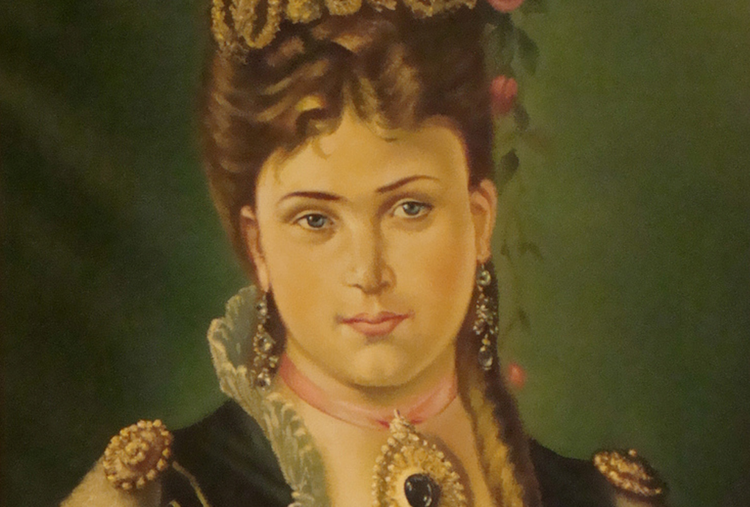
Thus, prof. Ganim says in the introduction to his book that when he started working on his dissertation, he had a preconceived idea based on textbooks that there were no endowments in Egypt during the Albanian dynasty, but in the end he came to the opposite: many endowments were founded by the dynasty of Mehmet Ali Pasha for social purposes. It is enough to mention here Princess Fatima (1853-1920), the granddaughter of Mehmet Ali Pasha, who was enthusiastic about the initiative to establish the University in Cairo in 1908 and bequeathed a large property of land in 1913 to build the headquarters of the Egyptian University in addition to a donation with cash for expenses and constructions.
This discovery of the contribution of the Albanian dynasty in the field of waqf for social purposes prompted prof. Ganim to research for several years in various archives to find many documents and endowments of members of the Albanian dynasty and to publish in 2021 the book "Endowments of Mehmet Ali's dynasty in the new and contemporary history of Egypt", which for for the first time presents with documents what a great contribution this dynasty left in the history of Egypt. Of course, the book resonated, because it presented a completely different image, compared to what the author learned as a pupil and as a student in Cairo, so he went further by publishing the new book "All Pasha's Endowments" in 2023, that is Mehmet Ali Pasha.
Overturning the theses of Egyptian historiography
The book consists of two parts, the first part containing a critical study of Egyptian historiography after 1952 towards Mehmet Ali Pasha and his dynasty, while the second part contains only documents, namely Mehmet Ali Pasha's vaqfnames that include the monuments he erected in Egypt and outside Egypt.
In the first part, the author denies the thesis spread in Egyptian historiography after 1952 that Mehmet Ali Pasha abolished the waqf system, making it the property of the state. According to the author, Mehmet Ali had his own vision for radical reforms for the rise of Egypt as a regional power, so he included the waqf system with his reforms, legalizing only those fair waqfs that were not included with manipulations. As proof of this, the author brings in this book the five waqfnames of Mehmet Ali Pasha that prove that he was not against the waqf system if it serves properly.
On the other hand, among these waqfnames, there are two that include two large waqfs outside Egypt: a large complex in his hometown in Kavalla in 1813 and two imarates that offered free food to the needy in Mecca and Medina in 1844.
also The identity of young Muslims and the contradictions of acquiring faith
The island, a gift from the sultan and the complex in Kavalla
Indeed, Mehmet Ali's rise from a soldier who came from Kavalla in 1800 to a rival of the Ottoman sultan in 1831 is linked to Hijaz. With the elevation of Mehmet Ali to the post of wali, the Saudi principality was presented as a threat to the sultan, since its Wahhabi followers did not recognize the sultan's sovereignty and occupied Mecca in 1806, challenging the sultan's title as "protector of Islamic holy places". In this state, the sultan was forced after many military failures to charge Mehmet Ali with this mission. Mehmet Ali sent his army at the head with his son Ibrahim Pasha, and then went there himself to put down the Saudi principality and the Wahhabi movement.
Under these circumstances, Mehmet Ali asked the Sultan for a large gift in 1813. He told the Ottoman Sultan, Mahmud II, that he wanted to do his homeland a service by erecting a large complex as a waqf, but he asked that donate the island of Tasho (380 square km in front of Kavalla) to cover the necessary expenses for the operation of this complex in Kavalla. The Sultan agreed, and on June 25, 1813, he issued a decree by which he made this island available to Mehmet Ali so that the income from property and other taxes would cover the expenses for the large complex that Mehmet Ali built in Kavalla.
Annexation by Greece and transformation into a tourist center
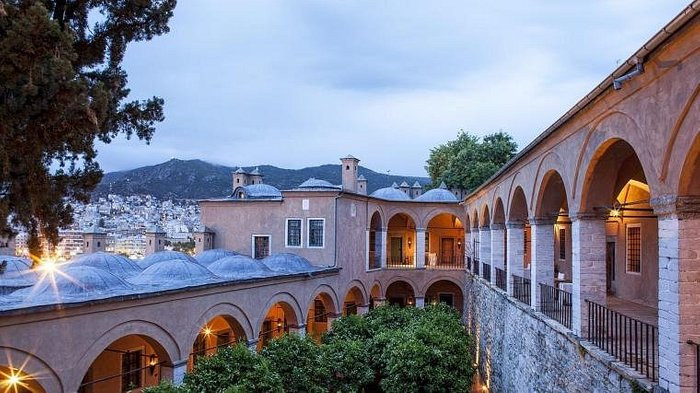
The complex was built on a hill in Kavalla that has a beautiful view of the sea, including a mosque, a large madrasah with 60 rooms to accommodate students who came from the surrounding villages, a large library and a mosque that provided free food. for the students, as well as for the staff who care for them. Also, the endowment published in this book includes the provision of clothing for the students as well as a symbolic monthly amount for the needs of the students (15 kurush per month for each student).
This large complex functioned well until the Balkan War 1912-1913 when Greece occupied and annexed the Vilayet of Ioannina, from where the Chams were temporarily expelled, and especially after the signing of the Treaty of Lausanne in 1923 for the mandatory exchange of population. Thus, a paradox was created that continued for decades: the properties in Kavalla and Tasho remained at the disposal of the Egyptian Ministry for waqf, while the facilities remained empty or wasted. This situation created occasional tensions between Egypt and Greece from 1984 to 1986, when the Egyptian Ministry of Waqf sold those properties to the Greek government at nominal prices. Mehmet Ali's complex in Kavalla itself remained at the mercy of time until a Greek entrepreneur (Ana Misisrian) rented this complex from the Ministry for dowry and turned it into a tourist complex that attracts many visitors who have sympathy for Mehmet Ali Pasha and his time.
also Islamization in the Balkans between coercion, reward and will
The book in question deserves to be translated into Albanian, like the other book published by the author in 2021 with the endowments of the Albanian dynasty that ruled Egypt from 1805 to 1952.
