


-
By:
BBC

-
Translated by: Edona Binaku

- February 23, 2025 19:00 AM
- Share to:
Although Spanish surrealist artist Salvador Dalí never visited India, an exhibition of his artwork has opened in the country for the first time.
The exhibition titled "Dali comes to India" in the capital Delhi brought an extensive collection of his works, consisting of more than 200 original sketches, engravings and watercolor paintings.
The collection is curated by Christine Argillet, the daughter of Pierre Argillet, a French collector who was also Dalí's friend and publisher.
“Dalí was fascinated by India, especially by the West's fascination with Indian mysticism in the 60s and 70s,” says Argillet.
Some of the sketches in the collection are based on photographs her father took during a trip to India in the 70s, when the social movement known as the "hippie" was at its peak, and young Americans carrying guitars and rejecting the norms of normal society visited India for spiritual exploration.
Dali's India features elephants and temples, but as with all of his works, they are not always easy to spot, as they are depicted in his characteristic surrealist style.
also Robotic elephants draw crowds and cause controversy at Indian temples
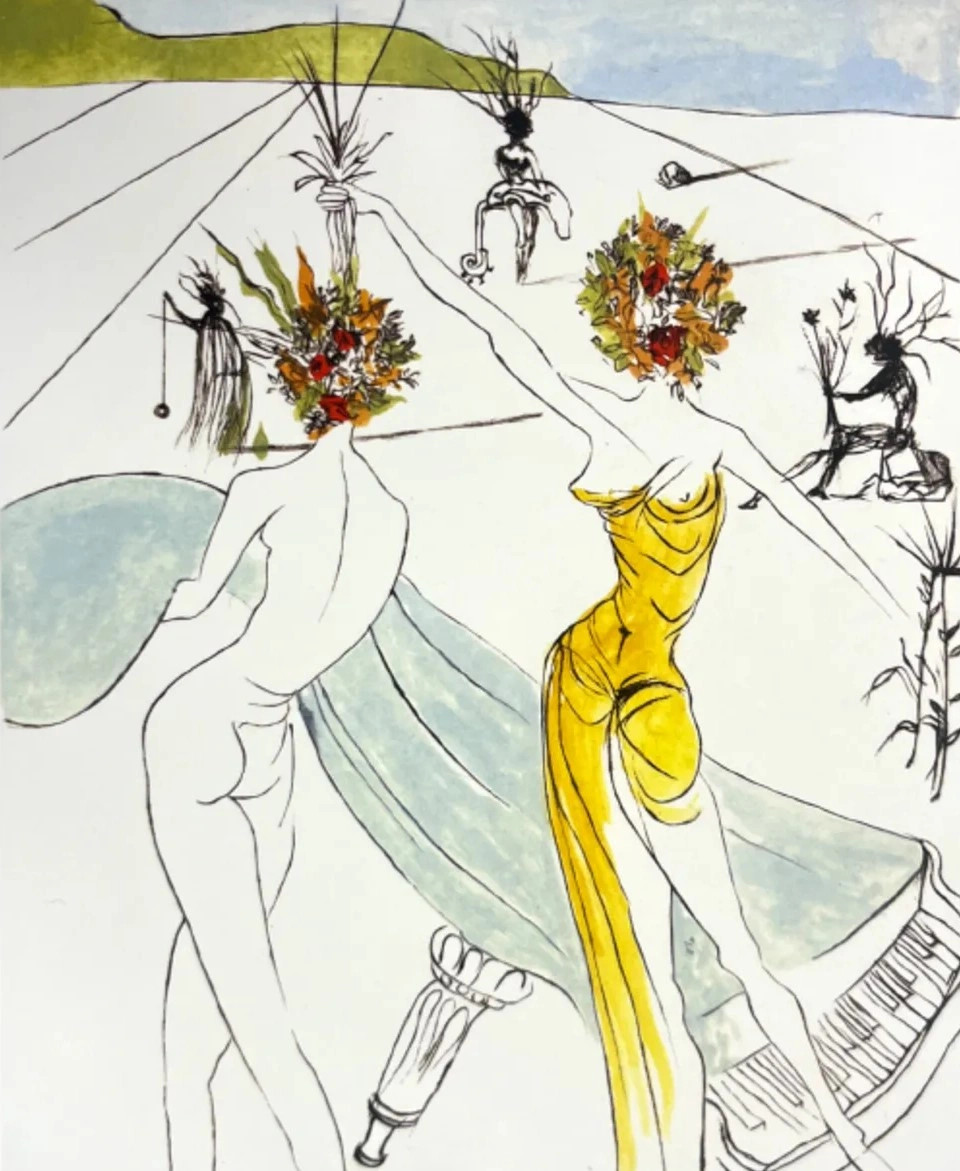
In his works, human bodies sprout flowers from their heads and the severed body parts interact with the world around them. When you look at them for more than a minute, these disjointed forms begin to create new connections and meanings in the mind.
"Appreciating Dalí's art is like peeling the skin off an onion – you can always find something new to marvel at," Argillet declared.
According to Akshitta Aggarwal of Bruno Art Group, the international art gallery presenting the exhibition, bringing Dali's works to India was a long and arduous endeavor. "This project took five years, every sketch and artwork had to be checked for authenticity."
In fact, this is not the first time that Dali's works have come to India. The Victoria Memorial Hall in the city of Calcutta houses two of the artist's colored engravings.
In 1967, Dalí created a set of bizarre cigarette cases for Air India – then the national airline of India – which were distributed to first-class passengers. In exchange for the work, Dalí did not ask for money, but a small elephant.
Uttara Parikh, the then deputy chief commercial officer of Air India, told the Times of India how she had initially gone to buy an elephant from a zoo in Mumbai but returned empty-handed. She eventually secured the baby elephant from a zoo in Bangalore (now Bengaluru), and the company flew the animal to Spain, where it was kept in a zoo.
Dalí's request may seem incredible, but those who know the artist and his legacy know that this was completely in line with his personality.
Born in Spain in 1904, Dalí grew up in a world that was embracing the avant-garde and responding to the aftermath of two world wars. Artists of his time, such as Pablo Picasso, Joan Miró, and André Breton, were finding new ways to express themselves, and their ideas and artistic styles greatly influenced Dalí at a young age.
The surrealist movement, which is widely accepted to have been founded by André Breton, resonated most with him. Surrealist art advocated a form of expression that, according to Breton, was dictated by thought, lacking any control exercised by reason.
also "Divine Dream" brings the art of Salvador Dali to Tirana
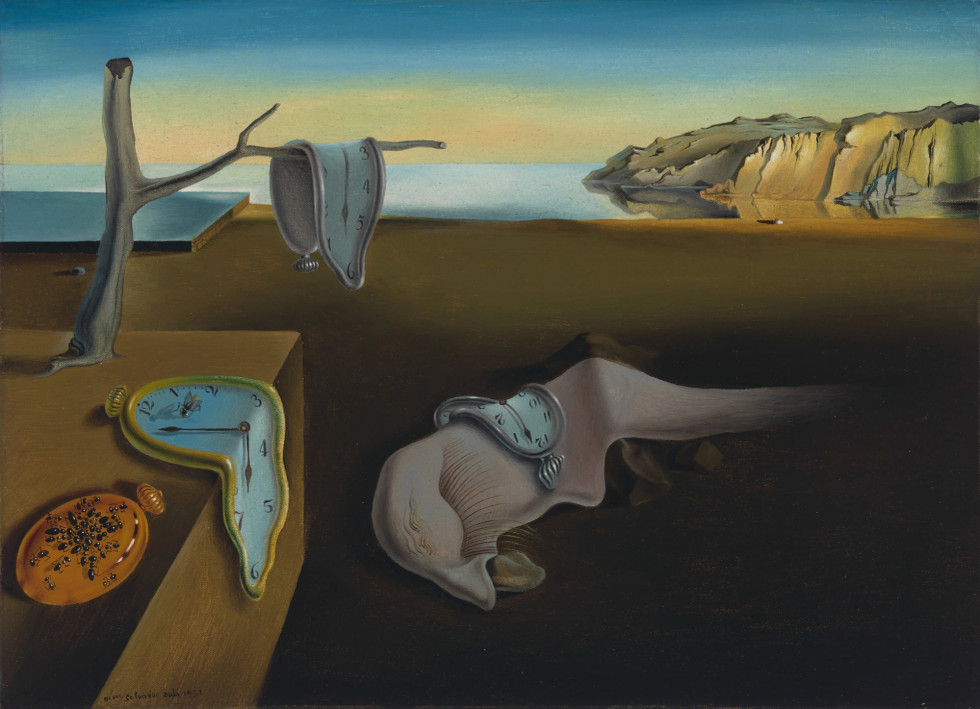
Dalí was also greatly inspired by Sigmund Freud and his theories about psychoanalysis – a method of treating mental illness by focusing on conflicts that originate in a person's psyche. Dreams take on special significance as they are believed to express a person's repressed thoughts and desires.
As a result, Dalí's art reflects many of these ideas. They have an almost dreamlike quality, and through loose juxtaposition, the images take on meanings that are unique to the viewer. There are also internal, almost shocking images, much like forbidden desires hidden in our subconscious.
"Dalí was a free thinker and he embraced all aspects of the human condition, especially those that were taboo and disturbing," Argillet stated.
The artist's outward appearance reflected his colorful outlook on life. He dressed magnificently and sported a moustache that rose so high it looked as if it might pierce his eyes. In a 1955 interview with the BBC, Dalí revealed the origins of his famous moustache.
"Dates, do you know this fruit? At the last moment of dinner, I didn't clean my fingers and then touched my mustache a little. And they stayed up all afternoon with great efficiency," the artist had declared, but later revealed that he used a hard wax to shape his mustache.
Christine Argillet, who knew Dalí closely during his childhood and adolescence, and often spent summer holidays in Spain with his father, says that Dalí was a person with a sense of humor, who liked to joke and "shock the bourgeois."
Once, he encouraged her to take some sweets from his bedroom and throw them at fishermen on a nearby beach. But this action ended up disturbing the fishermen, and as a result she was forced to flee the scene to find shelter and protect herself from the fishermen.
But she adds that Dalí was also a shy, intuitive and observant person, who had the ability to read people's minds. He painted in his studio in shorts and sandals and, according to Argillet, it was precisely the artist's shyness that made him appear exaggerated in public.
"He was misunderstood by many people. Dalí had many layers, just like his paintings. The closer you look at his paintings, the more you understand the real Dalí," says Argillet.
also Salvador Dalí and the iconic mustache as a bold statement
The exhibition "Dalí Comes to India" was open at the Habitat India Center from February 7 to 13, while at the "Masarrat" gallery it will be available to the public until March 16.

