


-
By:
Enver Robelli

- August 1, 2021 10:13
- Share to:
Adriatic Diary: Bari is the capital of the Albanians on the other side of the Adriatic
"The sea is beautiful in the eyes of God, because it waters the islands, which both adorn and protect them. It connects the most distant continents and allows sailors unhindered circulation. Through them it brings us knowledge about what was until now unknown. It determines the fate of merchants in the outside world. It easily improves the things of life, because the rich export the surplus, the poor can be supplied with the most necessary things".
Saint Basil the Great
On a summer day, this thought of Saint Basil the Great, this important figure of the Catholic Church, reminded me in Bari. It was afternoon when I arrived and the sun was scorching every corner of this Italian city, which is a bit of an Albanian and oriental, Mediterranean city, yes. We dug into history, Bari can also be called a Byzantine, Norman, German city - after all, Bari has a square named Piazza Federico Secondo di Sveva, in German Platz Friedrichs II. von Schwaben, after the Roman-German Emperor and King of Sicily.
For the British scholar, journalist, secret service officer, great Balkan expert and relentless supporter of the Albanians Harry Hodgkinson, "Bari was founded by the Illyrians from across the water - and until recently humorously called the capital of Albania". In his book "The Adriatic Sea" (published in 1956), Hodgkinson writes that for Albanians, Bari was "the closest city with an opera house and a university, there were also Albanian newspapers in Bari".
During July, thousands of Albanians from all over Europe come to Bari. Here they immediately catch the eye: they rush to catch the ferries sailing to Durrës, Vlora or Gumenica (Greece). A week off in Albania, a week in Kosovo or Macedonia. That's their plan, usually. When Kosovars do not know how to find the port in Bari, they stop to ask someone, "porto, porto", and often receive the answer in Albanian. Because Bari is also an Albanian city, their first or last station, depending on the perspective.
also The day when Captain Halimi brought the sweet ship "Vlora" to Bari
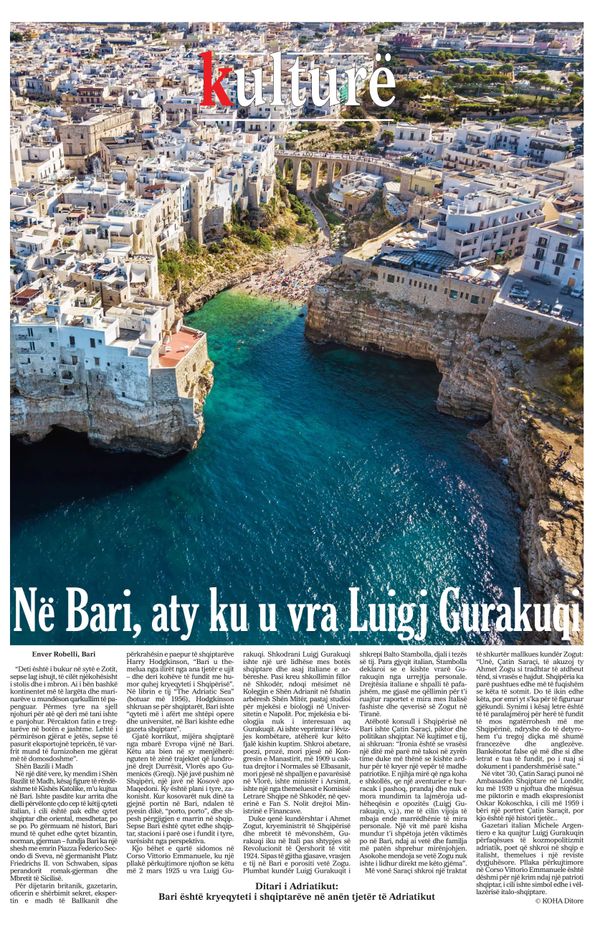
This becomes clear especially in Corso Vittorio Emmanuele, where a commemorative plaque announces that Luigj Gurakuqi was killed here on March 2, 1925. Shkodran Luigj Gurakuqi was a bridge between the Albanian world and the Italian and Albanian world. After completing his primary education in Shkodër, he attended the College of Saint Adrian in the village of Arbëresh Saint Miter, then studied medicine and biology at the University of Naples. However, medicine and biology did not interest Gurakuqi so much. He was an activist of the national movement, when these words had meaning. Wrote primers, poetry, prose, participated in the Congress of Manastir, in 1909 was appointed director of Elbasan Normal School, participated in the declaration of independence in Vlora, was Minister of Education, was one of the founders of the Albanian Literary Commission in Shkodër, in the government of Fan S. Noli led the Ministry of Finance.
Being an opponent of Ahmet Zogu, the prime minister of Albania and the later king, Gurakuqi fled to Italy after the suppression of the June Revolution of 1924. In all likelihood, Zogu himself ordered his murder in Bari. The bullets against Luigj Gurakuqi were fired by Balto Stambolla, the son of his thesis. Before the Italian court, Stambolla declared that he had killed Gurakuqi out of personal hatred. Italian justice declared him innocent, probably with the intention of maintaining good relations between Fascist Italy and Zog's government in Tirana.
The consul of Albania in Bari was Çatin Saraçi, an Albanian painter and politician. In his memoirs, he writes: "The irony is that the murderer met me in my office the other day, telling me that he had come to perform a great patriotic deed. I knew him well since school, that he was an adventurer and a peerless man, that's why I didn't take the trouble to inform the leader of the opposition (Luigj Gurakuqin, vj), with whom I continued to maintain good personal relations. A year ago, I was able to save the victim's life in Bari, so he and his family expressed their gratitude to me. At that time I thought that Zogu himself was not directly connected to these horrors".
Later Saraçi wrote a short damning treatise against Zogu: "I, Çatin Saraçi, accuse you Ahmet Zogu as a traitor to your country, as a murderer and a thief. Albania has seen invaders even more powerful than these today. These will also leave, but your name will not appear anywhere. The purpose of this letter is to warn you for the last time not to mess with Albania anymore, otherwise I will be forced to tell something more to the French and the English. I am keeping the fake bank notes and your last letters as a document of your dishonesty."
also A life between Shkodra, Cairo and Damascus in the service of the nation
In the 30s, Çatin Saraçi worked at the Albanian Embassy in London, where in 1939 he met and became friends with the great expressionist painter Oskar Kokoschka, who painted a portrait of Çatin Saraçi in 1959, but that's another story...
The Italian journalist Michele Argentiero has called Luigj Gurakuqi a representative of Adriatic cosmopolitanism, a poet who wrote in Albanian and Italian, founder of a bilingual magazine. The memorial plaque in Corso Vittorio Emmanuele is evidence of a crime against an Albanian patriot, who was also a symbol of Italian-Albanian brotherhood.

