


-
By:
Syle Ukshini

- December 17, 2023 17:30
- Share to:
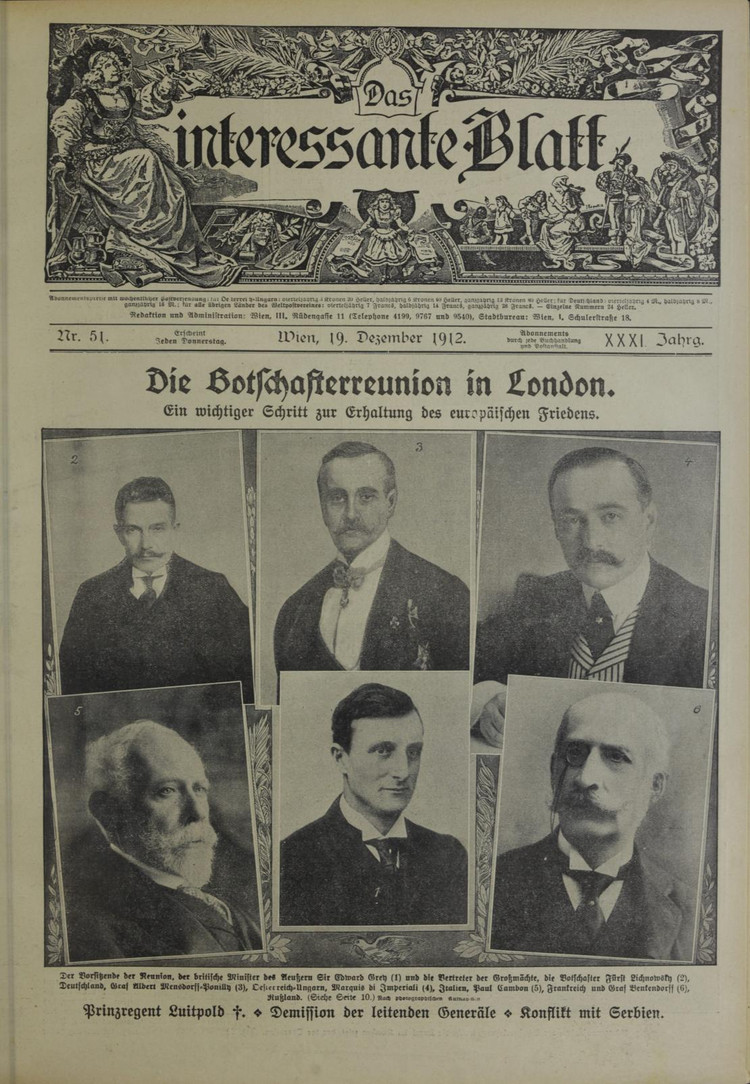
On December 17, 1912, at half past four in the afternoon, the ambassadors of the Great European Powers, who were accredited to the English court, gathered in the Office of the English Foreign Minister, Edward Grey. This was an important step for maintaining European peace. During the joint tea, the six ambassadors discussed the future of the Balkans, namely Albania. The London Conference sealed the birth of Albania as an autonomous, sovereign and hereditary principality under the guarantee of the great powers, although half of its territories remained under Serbian occupation until the breakup of Yugoslavia in the nineties
The London Conference of 1912-1913, also known as the London Peace Conference or the Conference of Ambassadors, was an international summit of the six Great Powers of that time (Austria-Hungary, France, Great Britain, Germany, Italy and Russia ) that was convened in December 1912 due to the successes of the armies of the Balkan League against the Ottoman Empire in the First Balkan War. The conference in particular aimed to arbitrate between the warring powers for the division of the conquered territories, as well as to determine the future of Albania, which had just declared independence. The Conference of Ambassadors recognized Albania as an autonomous, sovereign and hereditary principality under the guarantee of great powers.
The statement of the professor of history at the University of Potsdam, Germany, Manfred Gortemaker that "without a basic knowledge of the important events of the 1912th century, a deep understanding of our contemporary world cannot be achieved", also applies to the importance of the Conference of Ambassadors in London 13/111. Even today, when national, as well as European and international policies face great challenges in South-Eastern Europe, the Conference of Ambassadors in London has not lost anything of its historical importance, especially for the Balkan region. Some of today's problems in this region of Europe have direct links to the London Conference, although the event dates back XNUMX years.
In addition, the Conference of Ambassadors in London is one of the few events in the early 1912th century in which a major European power - Austria-Hungary, constantly supported by Germany - managed to realize the idea of creating an Albanian state at the time when the Russian-backed Balkan states had scored a major victory against another great power – the Ottoman Empire in late XNUMX.
On December 2, 1912, an armistice was signed between Bulgaria, Serbia and Montenegro with the Ottoman Empire. In the meantime, the Great Powers agreed that London would be a negotiating seat for the peace talks. At that time Greece did not want to join a cessation of hostilities and continued to wage war against Constantinople.
German initiative for a peace conference
also Albania on the eve of World War I without a government and in anarchy
In parallel with the peace negotiations between the Ottoman Empire and the Balkan states, at the suggestion of the German Secretary of State, Kiderlen-Wächter, who thus hindered the Austro-Hungarian war ambitions in November 1912, the initiative for an ambassadorial conference of the great powers was born European. In the second half of November 1912, those officers and military advisors who called for military action by Austria-Hungary against Serbia were heard for the first time. Some decision-makers in the Danube Monarchy now began military intervention in earnest. Especially in this context, the return of the heir to the throne Franz Ferdinand, who until then had represented a peaceful attitude, stands out. He now even tried to win the support of his German ally for military action, even if it would have resulted in a war against Russia and other major European powers. In this situation, the journey of the Austro-Hungarian heir to the throne in Berlin on November 22, 1912 took on even greater significance. The next day the "Reichspost" published a report on the results of the visit obtained "from a special source". The author reported that he had been assured by one of the "leading men" that the German Reich wanted to keep the peace ("Erzherzog Franz Ferdinand in Berlin", "Reichspost" 19/546 (November 24, 1912) p. 1). In fact, in this conversation, the German emperor had initially declared his loyalty to Austria-Hungary in case the "honor" of the Danube Monarchy was put in danger, even if it meant war with Russia. Following this German stand, the Austro-Hungarian Emperor, Franz Ferdinand, was cemented in his now adopted position favoring a military solution. On November 23, 1912, the newspaper "Reichspost" wrote in an editorial that the Russian mobilization could only be addressed to "Austria and its German ally" ("Rußland mobilisiert", "Reichspost" 19/544 (November 23, 1912, p. 1 -2).Another event that could lead to war between Austria-Hungary and Serbia was the case of the Serbian attack on the Austro-Hungarian consul in Kosovo, Oscar Prochaska, which further fueled the rivalry between Vienna and Belgrade.
As the member of the Reichsrat and professor of law, Joseph Redlich, who was considered an expert on the region, reported, at that time there were also rumors that the German Reich also recommended to Austria-Hungary "the greatest use of the Prochaska case against Serbia". (Tagebucheintrag Redlichs vom 29 November 1912 in: Fritz Fellner (HG), Doris A. Corradini (HG): Schicksalsjahre Österreichs. p. 515-516). Above all, the confusion surrounding the security of the German alliance was questioned in an article by German Secretary of State Kiderlen-Wächter
However, the German Empire was not seen to be entirely behind Austria-Hungary. There were now reports of Germany attempting to mediate between Austria-Hungary and Russia. There would be a compromise proposal on this issue – the Serbian port on the Albanian coast of the Adriatic. In Germany, the position of Austria-Hungary is seen as an obstacle to a peaceful solution. Moreover, Austria-Hungary had a negative attitude towards the idea of a peace conference.
Conference of the Ambassadors of the Great European Powers in London
The German initiative was welcomed by the English foreign minister, Edward Grey, who proposed to the Great Powers a conference of ambassadors through which the powers of the European Concert did not want, because of the Balkans, to start a war of European or world proportions, which it would endanger the interests of the Tripartite Alliance, but also of the Entente countries. So on December 16, 1912, the ambassadors of those countries that had signed the Treaty of Berlin of 1878 – Great Britain, France, Germany, Russia, Austria-Hungary and Italy – met for a conference in London.
On December 17, 1912, at half past four in the afternoon, the ambassadors of the Great European Powers, who were accredited to the English court, gathered in the Office of the English Foreign Minister, Grey. This was an important step for maintaining European peace.
During the joint tea, the six ambassadors discussed the future of the Balkans, namely Albania. In addition, the discussions had an almost family character, since the ambassadors of Austria-Hungary, Russia and Germany, Albert, Count von Mendorf, Alexander, Count von Beckendorff (of German origin) and Max Prince Lihnovski, were relatives. In addition, Marchese Gugliemo Imperiali for Italy and Jules Cambon for France also participated in the meeting. The British Foreign Minister presided over the Conference of Ambassadors.
For the independence of Albania and a connection of Serbia with the Adriatic
On November 21, 1912, the English minister accepted the German proposal. He proposed a three-point program for consultation between the Great Powers.
According to this, the Powers were to discuss:
1. the independence of Albania;
2. for a connection between Serbia and the Adriatic;
3. for the future of the Greek islands of the Aegean.
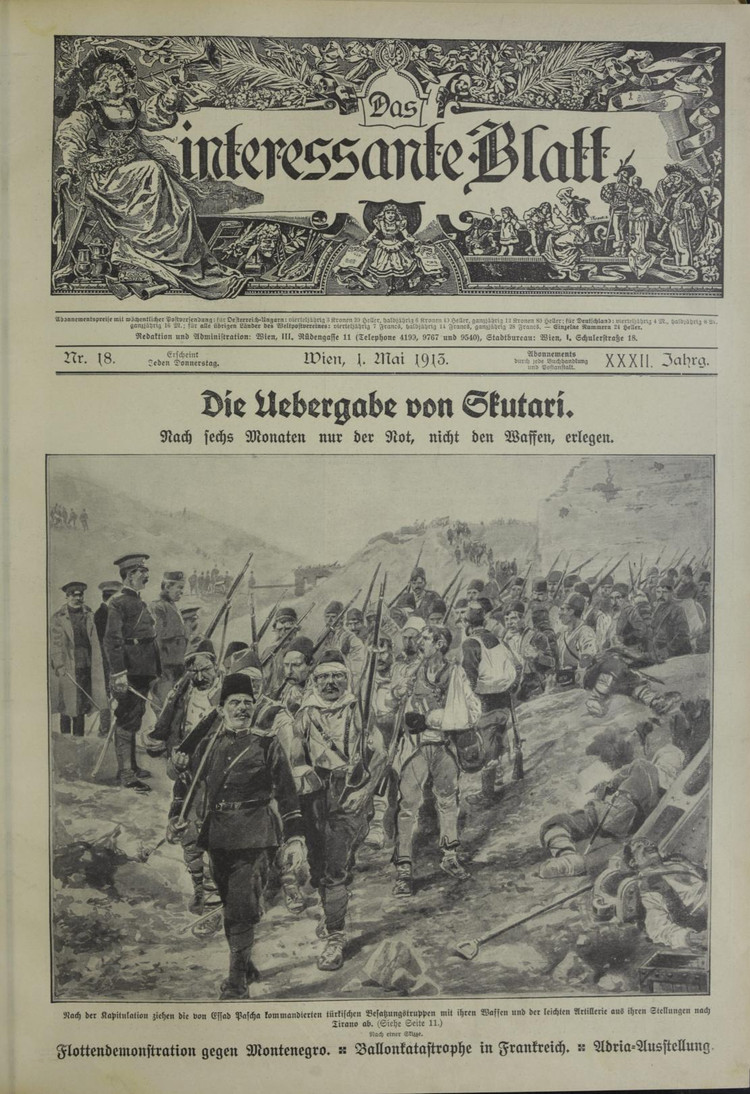
There was consensus among the participating countries to prevent the conflict in the Balkans from escalating into a serious war that would involve the major European powers. During the talks, there were also serious diplomatic tensions between the major European powers. Meanwhile, Austria-Hungary represented its well-known positions for the Balkans, where the center of attention continued to be its demand for an independent Albania and the drawing of borders according to the ethnographic principle. Another issue at the beginning of 1913 was the issue of the siege, namely the occupation of Shkodra by Montenegro, for which Austria-Hungary even took mobilization measures to undertake military action against Cetina. An eventual war between Austria-Hungary and the Balkan states would undoubtedly also involve Germany, for which its diplomat in London had warned in time that it would align England in a hostile position towards Berlin.
The importance of the Conference of Ambassadors in London is shown by the fact that the German state brought back from retirement one of its best ambassadors, Prince Karl Max Lichnowsky. Emperor Wilhelm II, despite the resistance of the Reich Chancellor and the Foreign Ministry, had appointed Lichnowsky ambassador in London and entrusted him with the task of "ensuring the neutrality of England". However, only two weeks after his arrival in London, Lichnowsky reported very clearly to Berlin on the basic principle of British foreign policy: England will always have to try to maintain the balance of power on the continent. In a war between Germany and France and Russia, England would be on the enemy's side.
It is worth noting that Lichnowsky enjoyed great respect and trust in the English authorities and in the English Foreign Minister, Grey. Also, his wife, the writer Princess Mechthilde Lichnowsky, being a smart and intellectual woman, contributed to the fact that the German embassy in London advanced to a meeting point for the British kingdom.
In this period, Germany had on duty the most professional corps of diplomats, most of them coming from the ranks of the German nobility and holding the most important diplomatic posts in Europe: In France there was Baron von Schoen, former State Secretary of the Foreign Ministry); Heinrich von Tschirschky and Bogendorff in Austria-Hungary; in Russia, Count Pourtalès; in Italy Gottlieb von Jagow (later Secretary of State in the Ministry of Foreign Affairs).
also The fear of a large Albanian state in the Balkans
The German ambassador to Great Britain, Prince Lichnowsky, possessing long professional experience and intellectual ability, played an important role in this international peace conference, and often he acted beyond the instructions of Berlin.
"Soon after my arrival in London, at the end of 1912, Sir E. Gray proposed an informal conversation to prevent the Balkan War from becoming a European war... The British statesman from the first took the position that England had no interest in Albania and had no intention of going to war over this issue", he wrote in his memoirs.
The First Balkan War, which resulted in the collapse of the Ottoman Empire, was therefore a defeat for German foreign policy, as it had long been identified with close economic and military relations with the High Porte. Since the Ottoman state in Europe could no longer be preserved, there were two options towards the settlement of its legacy: either the German state declared its complete disinterest in the drawing of borders in the Balkans and the Balkan peoples were left to settle their own, or otherwise, Berlin would support its "ally" Austria-Hungary and thus give up its mediating role.
Although Ambassador Lichnowsky from the beginning had supported the first solution, that is, German involvement in the settlement of the Balkan problems, however, as he says, the Foreign Ministry in Berlin took a firmer stand on the latter position, adding that the essence of the matter at the Conference of Ambassadors was the Albanian issue.
"Our allies wanted the creation of an independent Albanian state, as the Austrians did not want the Serbs to gain access to the Adriatic, and the Italians did not want the Greeks to reach Wallonia or even north of Corfu. Contrary to this, Russia, as is known, is supporting the wishes of Serbia and France those of Greece", underlined Lichnowsky.
Germany, instead of taking a position similar to that of the English, took the position outlined by Vienna. Count Mensdorff was the leader of the Tripartite Alliance in London, while Lichnowsky was the "second". As instructed by Berlin, his duty was to support Count Mensdor's proposals. In fact, on all issues he sided with Austria-Hungary and Italy – on Albania, on a Serbian port on the Adriatic, on the Shkodra question, and on the delimitation of Albania's borders – while Sir E. Gray almost never had supported French or Russian claims.
The issue of military intervention by Austria-Hungary became very explosive again in April 1913. For the Danubian Monarchy, the issue of the city of Shkodra had assumed the greatest importance in the negotiations between the European powers in London. For this reason, Austro-Hungarian diplomacy was intransigent in the case of Shkodra, as this issue was not only of strategic importance for the new Albanian state, but also an issue that had to do with the prestige of Vienna, the preservation of the power status European. According to the Austro-Hungarian opinion, Shkodra should become part of the newly established Albania. The German ambassador would also be behind this position, since from the beginning it was instructed that the position of the Austro-Hungarian ambassador should be followed.
The German ambassador claims that British Foreign Minister Gray mostly supported the group of ambassadors of the Tripartite Alliance. Thus, with the help of the English Foreign Minister, it was possible for King Nikita to withdraw from Shkodra. Otherwise, this issue would have erupted into a world war, since of course the Germans would not have dared to let their "ally" give up in the face of Serbian and Montenegrin claims over the Albanian city of Shkodra. This was a success of the Conference of Ambassadors in London, which avoided the option of a military confrontation.
In this context, the German ambassador testifies that without Germany's help it would be impossible to create an independent Albania, which had no survival prospects, since Serbia would have stretched to the sea and "the current world war would have avoid". This German engagement was also determined because Berlin was against the dominance of Pan-Slavism in the Balkan Peninsula, as this would lead to the loss of "economic dominance" within the Danubian monarchy.
Lichnowsky had also expressed many personal views at the Conference of Ambassadors in London and was also in favor of solutions which were not supported by Berlin. He received severe reprimands from the Chancellor, who said that Lichnowsky was "an opponent of Austria" and was instructed to refrain from such interference and direct correspondence. In fact, this situation proves that for a long time two positions had been established in the German state: that of the Chancellor's Office and the Foreign Ministry, which preferred to stay close to the Austro-Hungarian line, and Emperor Weilhem II, who stood out for his vacillating position between Tripartite Alliance and Entente.
Despite the one-sided historiographical interpretations, the German ambassador in London says that during the Conference of Ambassadors, Sir E. Gray conducted the negotiations carefully, calmly and tactfully. And whenever a complicated issue arose, he drew up some formula for agreement which was important and always accepted. Gray's personality inspired equal confidence in all participants.
In Ambassador Lichnowsky's view, Germany has again successfully emerged from one of those tests of strength that characterized German foreign policy. Russia had been forced to give way at all points, as she had never been able to achieve success for the Serbian aims. Albania was created as a new state with Austria-Hungary as a protectorate, while Serbia did not manage to secure access to the Albanian sea.
"Therefore, this conference resulted in a new humiliation for Russian self-esteem. As in 1878 and 1908, we had opposed Russian plans, although German interests were not involved," says German Ambassador Lichnowsky.
The Second Balkan War and the truncated borders of the Albanian state
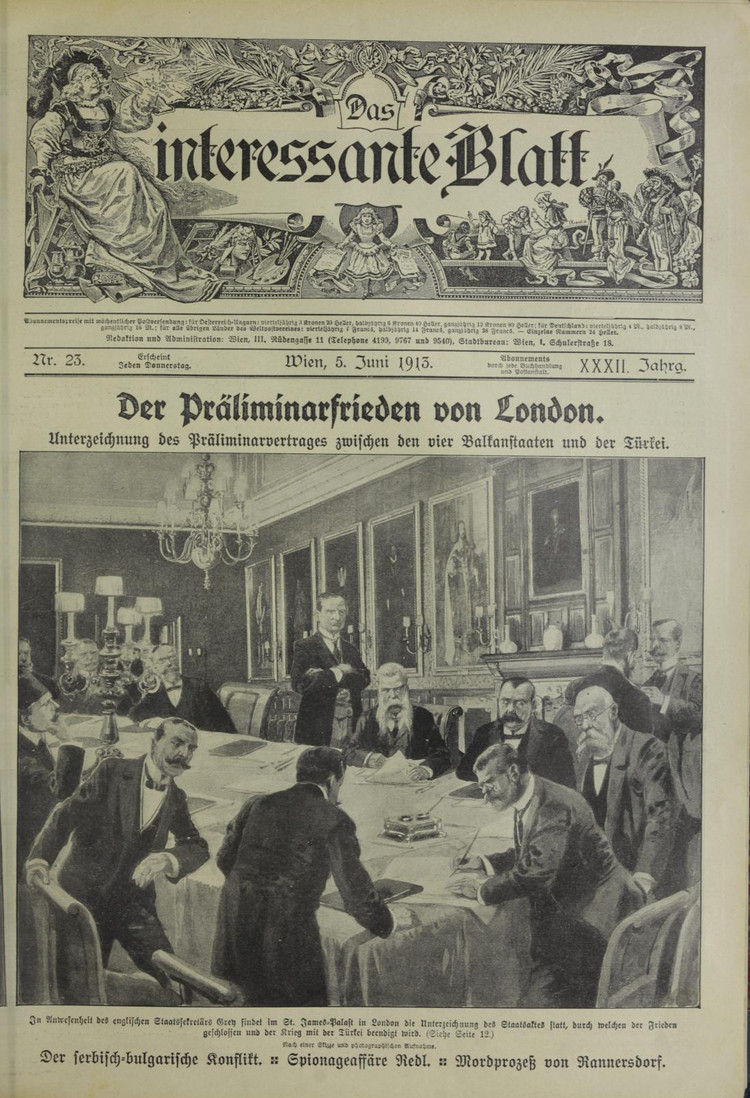
Just a few weeks after the peace agreement in London, in June 1913, the Second Balkan War broke out. This war resulted in armed conflicts between members of the Balkan League. Ultimately, the conflict resulted in open issues, namely how the conquered territories of the Ottoman Empire should be divided among the Balkan states. Despite the London Peace Treaty, the territorial division of Macedonia in particular led to conflict. Serbia was given a significant part of Macedonia as compensation for the new Albanian state, but which was claimed by Bulgaria at the same time. The dispute could not be finally resolved in London.
But, despite great expectations, the Conference of Ambassadors in London failed to take a proper step to establish lasting peace in the Balkans, just as the Congress of Vienna had succeeded, it only gave a little time, but it did not succeed avoided the European Concert from the dangerous path, which led the continent to a precipice with great consequences, in the First World War, which is considered in fact as a continuation of the Balkan wars.
However, what remains important is that this European conference sealed the birth of Albania as an autonomous, sovereign and hereditary principality under the guarantee of great powers, even though half of its territories remained under Serbian occupation until the breakup of Yugoslavia in the nineties. . It was the historical moment when Albania would join the ensemble of European states through a German prince, Wilhelm von Wied.
also Berlin 2028: From Congress to AgreementLikewise, with these truncated borders of the Albanian state, established with the persistent insistence of Russia and the support of France, the issue of Kosovo arose, which a century later managed to penetrate the agenda of the European chancelleries of the six member states of the Group of Contact, where with the support of France and other member countries it became possible to isolate Russia, which, like a century ago, was persistently following the Serbian agenda.

