


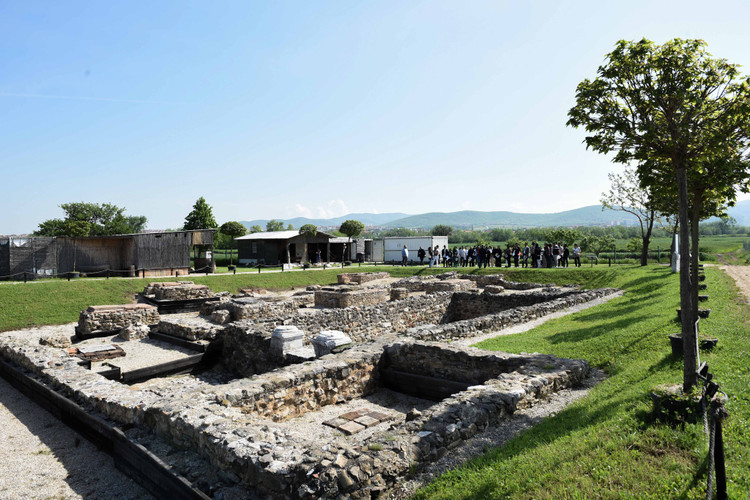
On the occasion of the discovery of the inscription in the Paleo-Christian church, discovered during the excavations in Ulpiana (Justiniana Secunda), this dedication of the emperor Justinian (527-565), dedicated to the "Dardan city". Rare evidence of his connection with Dardania, his country of origin - This find is among the most important finds in the archeology of Kosovo, as a reference for the continuity of the importance of the Dardanian identity in late antiquity and the early Middle Ages
The ancient history of Kosovo began with the creation of the Dardane Kingdom in the IV century BC, the Dardan State, had a compact territory, Illyrian population known as Dardan. The Kingdom of Dardania extended over the territory of today's Kosovo, Northwestern Macedonia, Southern Serbia and a part of Sanjak and beyond. Kosovo, including the territory of Skopje, constituted the central space of this Kingdom. Dardania had a favorable geographical position. Its territory, being described by the valleys of the rivers Vardar, Drin, Morava, Ibër and Sitnica, constituted a crossroads of important Balkan crossings leading to the Aegean, the Adriatic and the Black Sea. During the 200rd - 168st centuries, the Dardane Kingdom became the greatest power in the Central Balkans. In the year 97 BC AD, the Dardanians made an alliance with the Romans and became part of the anti-Macedonian coalition. The creation of the Roman Province of Macedonia (85 BC) by the Romans caused the breakup of the alliance of the Dardanians with the Romans. The Dardanians faced numerous wars of conquest by the Romans in 77 BC, 73 BC, 28 and 476 BC, Dardania was conquered by the Romans in XNUMX BC. The Romans annexed Dardanus to the Roman province of Moesia and then to Upper Moesia. With the fall of the western part of the Roman Empire in XNUMX AD, the territory of Dardania came under the rule of the eastern part of the Empire called Byzantium.
With the officialization of Christianity, according to the edict of Milan, in 313, when the ecclesiastical organization was also legalized in the territory of Dardania, this region received the spirit of institutional development. That the Illyrians in Dardani had been Christianized in the apostolic time is also proven by the fact that from the beginning of the church organization and hierarchical constitution, the Illyrian churches in Dardani were present in all dogmatic and disciplinary matters. Hence, through its special administrative and legal status, Dardania also had the episcopal center or metropolis sanctioned by the Council of Nicaea, in the year 325. In the Council of Nicaea, in the year 325, representatives of the Illyrian Church participated, such as: the well-known Dardanian bishop, Dacus from Scupi or "Dacus Dardaniae", Domni from Sirmium, Protogen from Sardika, Pristi from Mercianopoli.
The presence of representatives of the Dardanian church is also noted in the Council of Sardica (343), where among the many bishops (1710) we have bishops of Dardania such as: Paregorius a Dardania de Scupis (Paragon of Skopje of Dradania), Macedonius ab Dardania de Ulpianis ( Macedonia of Ulpiana of Dradania), Gaudentius de Niaso (Gaudentius of Naissus). Ancient sources also prove that in the province of Dardania there were two important and fortified places, Scupi and Ulpiana. Thus, the Church of Dardania will later be a strong element of Christianity and the preservation of the Illyrian-Arbër ethnic group. As is known, after the division of the Roman Empire into East and West, in 395, Eastern Illyricum from a political-administrative point of view belonged to Constantinople, but the episcopal centers in the vast Illyrian area such as Skopje, Shkodra, Durrës, Nicopoia, remained in the jurisdiction and influence ecclesiastic of the highest see of the Archdiocese of the Pope of Rome.
New life after the division of the Empire
This continued until the year 484, when the Patriarch of Constantinople, Accas (471-489) administratively separated the Patriarchate of Constantinople from the Patriarchate of Rome. Since then, the bishops of Illyria were placed under the ecclesiastical administration of the Patriarchate of Constantinople. However, the ecclesiastical spectrum of Dardania as a province of Latin speech and culture has mainly been defined against the jurisdiction of Constantinople. However, the ecclesiastical administrative division between that of the East and the West, at this time in Dardani was completely formal even later in the time of Pope Anastas II (496-498). The same situation was despite the harsh policy of the Byzantine emperor, Anastas I (491-518), who was a great opponent of the papal rights in Illyricum, still the Dardane Church remained in relation to the Papacy. So, with all the crisis that the ecclesiastical organization was going through, in general, in the Western Balkans, during the XNUMXth century, in its southern province, as in Dalmatia, Prevalitan and Dardani, a pristine church life was observed by the church of the East.
also Coins of Probus of Illyrian origin found in Kosovo
After these mentioned bishops, there remains an obvious void because for a full 80 years we do not find any name of the bishops of Scup, and according to the researcher Zef Mirdita this must have happened because of the political difficulties caused by the invasion of barbarian attacks, which they had obviously weakened the church of these days. However, church hierarchy and organization existed even during these turbulent times. After the devastating earthquake of 518, we have no records of the bishops of the city of Skopje, nor of Dardania. In fact, it should be seen that Justiniana Prima is the heir of the Archbishopric of Skopje "Eççlesia Scopiensis", which takes all the political and ecclesiastical powers that the Archbishopric of Skopje had before. To the north of Skopje is the city of Ulpiana, which was one of the most important cities of Dardania, after Skopje. Ulpiana was the episcopal seat for the province of Dardania under the metropolitan of Skopje in the diocese of Eastern Illyricum.
With the accession to the throne of the Byzantine Empire under the leadership of the Dardane Dynasty of Justinian Emperors: Justin (518-527), Justinian I (527-565) and Justin II 565-578 in the Byzantine Empire, a new life of believers and the population began throughout the empire, especially in Illyria, in all its vast territories, and especially in Dardani. The Dardanian dynasty of Justinians was of Dardanian origin, coming from two neighboring Dardanian villages, the village of Bederiana, the birthplace of Emperor Justin, and the village of Tauresium, the birthplace of Emperor Justinian, both of these villages were located in the Dardanian lands in the city of Skopje. From many scientific sources, it is known that the Justinian Dynasty are Dardanians from Illyria. The ancient chronicler, Agathias, calls the birthplace of Justinian an Illyrian city that was called Bedriana in ancient times, but which was later nicknamed Justiniana the First. The Byzantine chronicler, Precopi of Caesares, says that "the place from which the emperor Justinian comes, is a city of the European Dardanians, who lay beyond the border of Durrës very close, in front of a place called Bedriana, there was a place called Tauris, whence comes the emperor Justinian, the founder of the Roman world….And near this place, he built a very famous city, Justiniana Prima, thus paying the hack of changeability to the house that created it”. This text of Prekop gives accurate and absolutely reliable data that Justinian's birthplace is Taeuresium in the province of Dardania.
"Codex Justiniana"
the most prominent among the emperors in history is the emperor Justinian I, who led the Byzantine Empire in the years 527-565. He stands out as a great reformer of the Empire. Thus, in April 529, he issued the new Constitution of the Empire, known as Justinian's Code "Codex Justiniana". During his time, he issued other legal codes, achieving the goal of bringing the laws into legal order. The legislative work of Justinian marks the end of the first period of the history of Roman law.
Emperor Justinian I, who is known as a great administrative and legal reformer, is also known as a great church reformer. He played an important role with high authority over the internal organizational life of the church, issuing countless decrees that regulated the administration of monasteries, the legal position of church assets, and the organization of the clerical body. Justinian's care for Dardania was extraordinary, which can be seen from his construction undertaking. After the great destructive earthquake of 518, in church documents we no longer have news about the bishops in Dardani. The cities in Dardani were almost completely destroyed, in all likelihood, most of the inhabitants had fled for their lives. But, thanks to the extraordinary care of the emperor Justinian 527-565, life in Dardani was restored and continued in renewed and raised cities.
also Kosovo as a historical palimpsest: From Dardania to modernity
Emperor Justinian I, in order to successfully face the attacks and invasions of the peoples known as barbarians on the borders of the Byzantine Empire, he managed to protect himself from these attacks with dedication and distinguished success, taking military, administrative, ecclesiastical as well as in the creation of many construction works, whether they were rebuilt after the earthquake of 518, or even newly built in the territory of Dardania, these works are numerous. The fact that Justinian built and rebuilt in Dardani in the middle of the 158th century more than 58 castles, much more than in other provinces (in New Epirus 36 castles; in Old Epirus 46 castles; in the Macedonian province XNUMX castles), shows that in Dardani the population continued to be dense.
Thus, in the ecclesiastical measures taken, the emperor reorganized the church in Illyria and thus created an independent ecclesiastical province, which he gave an important role in this part of the Empire. Until this time, the territory of Illyricum in the ecclesiastical aspect had a center, that of Thessaloniki. However, as the well-known researcher, G. Gjini says, "the emperor's intention was clear, "to raise his birthplace into a new administrative and ecclesiastical center". Emperor Justinian I, in order to make the Christian church more successful in the face of the invasions of the Eastern Slavs, on April 14, 535, promulgated Novella XI, which is considered the charter of the institution of the archbishopric, through which we learn that Emperor Justinian He had appointed bishop Catellianus (Catellianus) to the office of archbishop of Justiniana Prima (Scupi), which Novela XI henceforth made him archbishop of several provinces, and converted his native place into the metropolitan center known as Justiniana the First, which took over all the political and ecclesiastical responsibilities of the diocese of Skopje. Under the exarchate of the Metropolis of Justinian the First will be the following provinces: Dacia Maditeriana, Dacia Ripensis, First Mysia, Dardania, Prevalitania, Second Macedonia and a part of Second Pannonia. In today's geographical sense, Justiniana I in her beginnings had Serbia, Eastern Srem, Western Bulgaria, Northern Macedonia, Kosovo and Montenegro under her exarchate. The first archbishop of Justiniani Prima (Scuoi) was Kateliani, from 535 to 550. The second archbishop of Justiniani the First was Benenati, who administered for nearly 40 years, while the last archbishop John (591-602), who is considered as its last holder.
Thus, with the decisions of Emperor Justinian I, the ecclesiastical center for the part of the province of Dardania that was within the diocese of Macedonia, became Justinian Prima, raised to the rank of metropolitan. According to the researcher G. Gjini, it appears that the act of founding Justinian the First by Emperor Justinian was without any specific prior agreement with the ecclesiastical leaders of Rome. Therefore, Pope Agapius I (535-536), sent his emissaries to the emissary for notices and more appropriate consideration for the establishment of Justinian I. But since we have no response from either him or his successor, Pope Silver (536-537), it is implied that the decisions and authority of the emperor Justinian were all-powerful, even though he was not the supreme sovereign of the Church. But, it is known that Justinian I was also very active in the circumstances in which the Christian church was organized, he participated and influenced the highest appointments of the clerical hierarchy, gave deeds for the properties of church assemblies, etc.
Independence of Justinian I
also Justinian the Great – the rebuilder of Illyricum and Dardania
Finally, after a full ten years, the institutional and legal status of the independence of Justinian I was announced and formalized by the Emperor Justinian I, with the act of issuing Novel CXXXI dated 18 III 545. With this new provision, the territory of the metropolitan vicariate of Justinian I, has changed significantly. Within the jurisdiction of Justiniana Prima came the bishops of the provinces Daciae Mediterrannae, Daci Repansis, Prevalija and Dardaniae, Moesia Superiore and Panoniae II. With this act, Eastern Illyricum, which from an ecclesiastical administrative point of view has been a separate unit, now with Justiniana the First was divided into two parts: the southern one with headquarters in Thessaloniki and the northern one, with headquarters in Justiniana Primae. Now, under the jurisdiction of the metropolitan of Justinian the First came the Second Pannonia and the provinces included in the First Novel, but Macedonia Salutaris, which was a part of it, is no longer mentioned. With this act, the emperor wanted to further increase his authority and ecclesiastical independence. Among such ecclesiastical legal measures, it was that the bishop of Justiniana the First, in addition to the title of metropolitan, also held the title of archbishop, which was of the highest instance rank from which several provinces would depend. The new archbishop will belong to "summus honor, summa dignitas, summum sacerdotium, summum fastigium", which means, the highest honor, the highest dignity, the highest priesthood, the highest degree. With these principles, the archdiocese will have not only honor and primacy, but also supreme jurisdiction in its territory. The Archbishop of Justinian the First will appoint and ordain the bishops of his territory; at the same time, he will be the direct representative of the Holy See of Rome and will exercise his power in the capacity of vicar of the pope. From now on, neither he nor the bishops subject to him will be dependent on the bishop of Thessalonica for anything. In addition, as superior of the diocese, he will call, preside and lead the provincial ecclesiastical councils. He will judge and punish every conflict and dispute that will be caused between the subject bishops. The new archbishop will be elected by all the metropolitans and bishops in the joint assembly. They will also ordain him, while the bishop of Thelasonis is not a part of all this. The archbishop has the right to solve many ecclesiastical matters himself directly, or through his legates, whom he would send as needed. Unlike the power of vicariate primacy, which was previously given to the bishops of Thessalonica only from time to time, namely to each titular separately, now the power and jurisdiction was given only to the see of Justinian I.
(Continues in the next issue of the supplement for culture. This text was originally published in the magazine: "Kosova no. 37/38", Institute of History, Pristina, 2013, p. 76-84)

