


-
Translated by: Sinan Berisha

- 5 October 2025 21:00
- Share to:
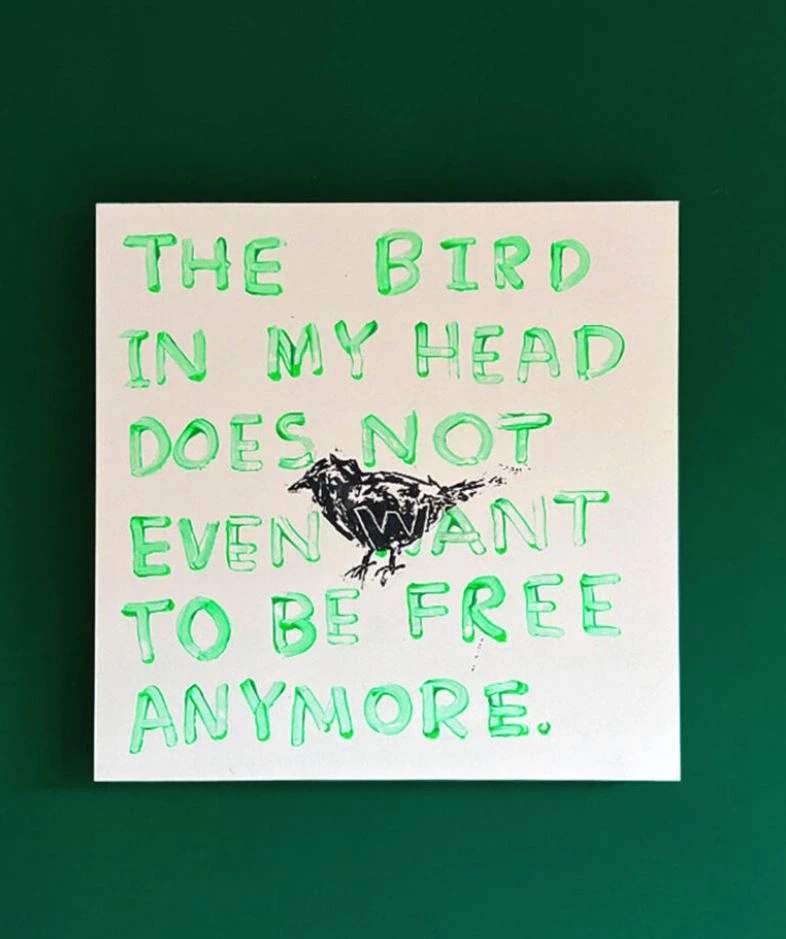
Driton Selmani is fluent not only in conversation, but also through the works he creates. While humor often permeates his work, a deep side of sensitivity is always present. Upon closer inspection of the pieces stored and hung in his studio, one realizes that his work is also connected to pain, time, birds that have forgotten to fly, dreams constrained by time, and an inevitable predestination to everything.
Erka Shalari
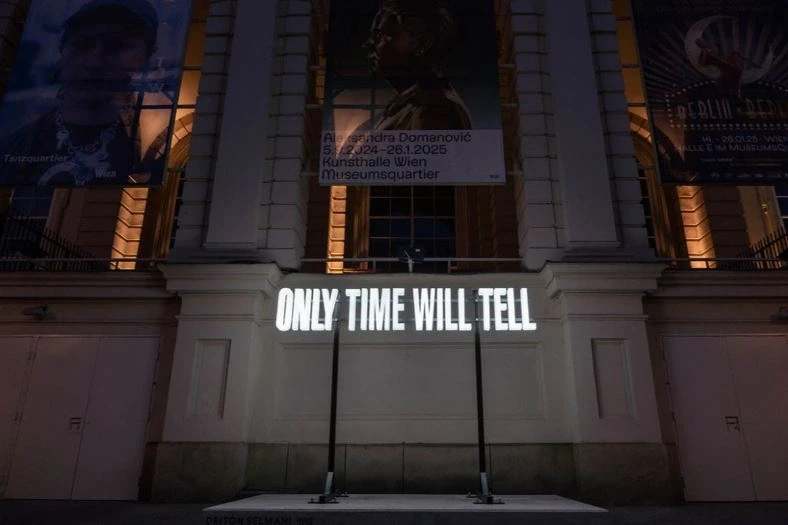
Although he has had the opportunity to live abroad, even after completing his Master of Fine Arts studies in Bournemouth, Selmani has chosen to return and work in Kosovo, a country often seen as peripheral, but which constantly feeds his practice with tensions of fragmentation, memory and resistance. This country, this “remote” place (see Selmani, 2025), and his studio continue to remain the recesses where his artistic thinking unfolds. After a solo exhibition at “Kahan Art Space” in 2023 and the public installation “Only Time Will Tell” at MuseumsQuartier Vienna, Selmani’s work is presented this year at the Vienna Contemporary Art Fair by Galerie Ernst Hilger, selected by Ernst Hilger (28 February 1950 in Vienna – 26 May 2025) before his death. His new works embrace Vienna's cultural heritage, narrating continuity through the overlapping of eras, references, and events. The artist's work is presented in Zone 1, a section curated to focus on artists under the age of 40, alongside artists such as Hélène Fauquet, Fabian Reetz, Melanie Ebenhoch, and Huda Takriti.
Erka Shalari: This year you are presenting your work with the Ernst Hilger Gallery at Viennacontemporary, where they have dedicated a space to your position as an artist. How did the gallery discover your work? At the same time, you are part of the curated section of the fair, in Zone 1, at the invitation of curator Aliaksei Barysionak. How does it feel to have your work placed both in a special gallery presentation and within this very interesting framework?
Driton Selmani: The process began with an extraordinary conversation I had with Ernst and Karolinen, just a few weeks before his passing. The gallery was first introduced to my work during “Manifesta 14” in Pristina, in 2022, and we have been in dialogue about a possible collaboration ever since. Ernst’s deep knowledge of Central and Eastern Europe made me realize that for them, “no” was never an option. I felt very honored to be considered, especially by someone who had spent his life building cultural bridges in this region. Then, Aliaksei became the final, and perhaps most important, piece of this map. We first met in 2015 at the “Chto Delat/Rosa Luxemburg” Art School in Berlin, and our paths have remained connected ever since. There is a common “stereotype” between us: we both come from “the other side”. It seems meaningful, even poetic, to me that this background now shapes our collaboration here in Vienna, a city that has historically been both a border and an epicenter, and now becomes the scene where these paths meet again.
also Driton Selmani: Time is a construct of our imagination
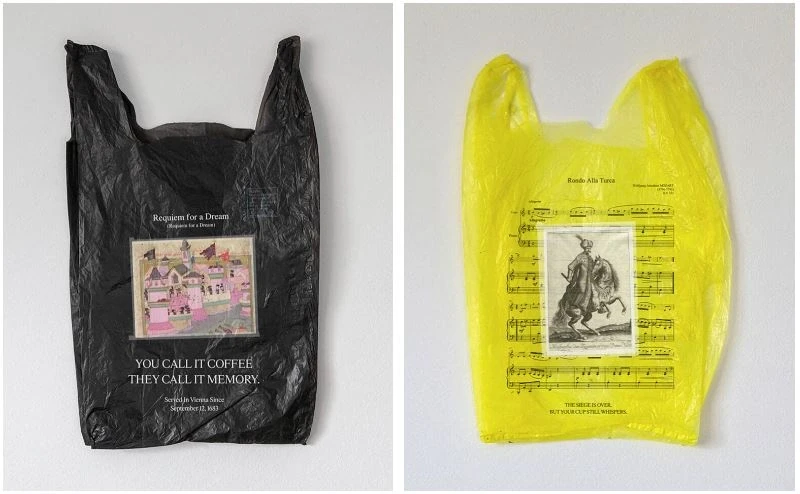
ESH: In the curatorial statement, Barysionak says that Zone 1 stands at the intersection of politics and aesthetics, and examines the conditions we experience in a moment of planetary emergency. How does your work “Requiem for a Dream. Love Letters from the Siege” relate to this idea?
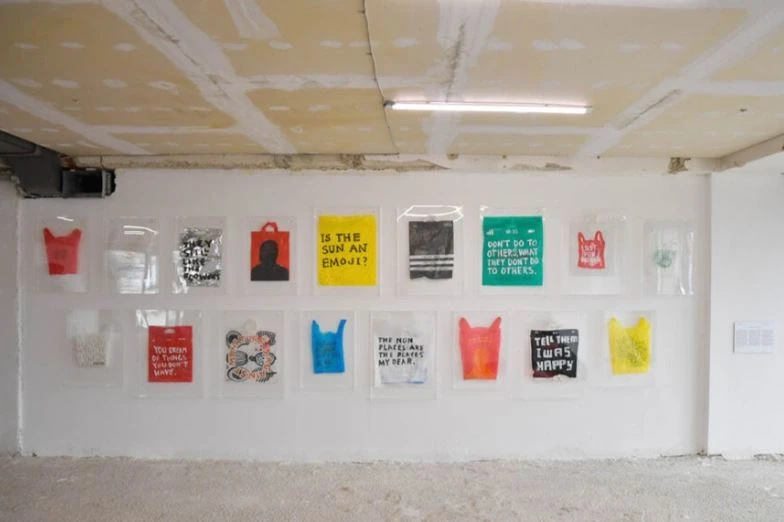
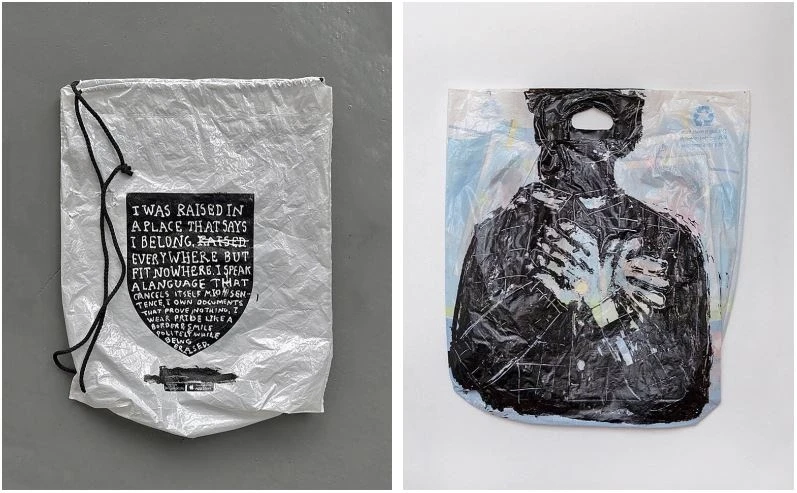
DS: The placement of my works makes me feel privileged, because I actually come from a world badly entangled with politics, where aesthetics have little or no place, except what would be the aesthetics of politics. I am returning to Aleksei Barysionak’s curatorial concept: “Plastic bags deliver unexpected truths.” I embarked on an even deeper investigation, bringing together memory, displacement, and power; an attempt to rediscover what has been deformed on all sides from the Siege of Vienna to the present day. “Requiem for a Dream” covers the surface of the plastic bag with centuries of historical remains: a miniature of the painting “The Siege,” a musical score from Mozart’s “Rondo alla Turca,” and miniature illustrations of the Ottoman knighthood period. These seemingly ornamental images are treated not as historical documents, but as emotional remains; elements of the traces of a cultural moment that still permeate the contemporary European psyche. Each bag bears phrases that hurt as much as they comfort: “You call it coffee. They call it memory,” “The siege is over. But your cup still whispers.” They speak of empire not with grand narratives, but with taste and acoustic residue. In Vienna, where coffeehouses are romanticized as the cradles of modern thought, the Ottoman origins of coffee are rarely mentioned. Here, I change the filter: what arrives in the porcelain cup is not just coffee, but a story of conquest, exile, and mimicry. What Mozart transformed into a playful ornament with his “Alla Turcan,” I restore with irony and pain.
My plastic Love Letters do not glorify the past, but complicate it, suspending time between cultural “digestion” and erasure, between memory and commerce. These works pose the question: how do we archive love in an empire that is disintegrating into the Wiener Melange? How can we keep a feeling alive, when history is already packaged, priced and served? The plastic bag, durable, ignored and global, is transformed here into a document of intimacy and heritage. Through this material, I write what official histories leave out: the small, absurd and persistent ways in which we hold each other, through sieges, through music, through coffee, through time.
ESH: The letters also seem like fragments of political memory.
DS: “Letter No. 1683” and “Letter No. 1684” are not just notes, but fragments of a love affair between power and oblivion. Wrapped in plastic, they whisper like empires that never fall, that only change their costumes. Political ghosts disguised as everyday gestures remind us that history never ends, it simply flows into our rituals.
ESH: Yll Rugova and Fanny-Alma Serée have described your work as an act of “overlay,” layering sources, eras, places, fictions, and facts, as if anchoring urgent issues of the present in deep historical currents, as in “ZigZag.” The new works seem equally alive in this layering. How has this art of overlay evolved for you?
DS: The method of superposition was actually born from my way of navigating through memory, not as a straight line, but as fragments that insist on returning. For me, history never stays where it “should”. It flows, reappears in unexpected objects, becomes banal, becomes personal. The plastic bag, the miniature ottoman, the Mozart score, all are remnants that carry emotional charge and continue to shape the present. In a way, I follow something close to Walter Benjamin’s idea of “constellations” where fragments from different times, once placed next to each other, reveal a truth that was previously invisible. Aby Warburg’s “mnemosyn” atlas is also a key reference for me; the way he juxtaposed images from distant eras, allowing cultural memory to flicker across time, is not much different from the way I work with resources, surroundings, and the leftover flavors of empire.
Meanwhile, Hal Foster has described this as the “archival impulse” in contemporary art: artists who collect and reshape remnants, not to glorify the past, but to expose what the official archives leave out. I think this is very close to what I do in “Requiem for a Dream. Love Letters from the Siege”: the Ottoman coffee cup, the Mozart score, the clichés of empire. I put them together not to tell history, but to ask the question of how history survives within our daily rituals. Thus, the search is never a dig for a single truth. It is more a pursuit of the ways in which times overlap, how an empire dissolves into coffee dust, how memory is carried in the most banal and neglected materials. Coming from a fragmented country like Kosovo, this method also reflects my reality: a place where we ourselves often struggle to grasp the complexity of things that should be simple. Self-determination, as Machiavellian as it is utopian, remains a word that promises clarity but brings endless ambiguity.
ESH: In August we talked about your work “Der Ernst, Der Zeit.” I would like to continue that conversation.
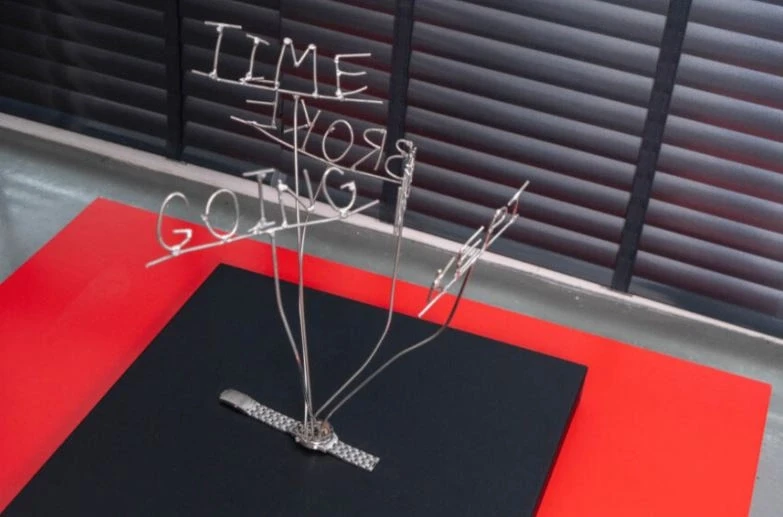
DS: Ernst and Karoline first saw my work at “Manifesta 14” in 2022 in Prishtina, however, we have never met in person. The plan was for them to visit my studio in Prishtina this summer, but time had its own plans: Ernst passed away just a few weeks before their visit. At that moment, I was on vacation in southern Albania. Out of a mixture of pride and naivety, I went swimming in the sea with a wristwatch that I loved very much. The sea that day was violent, and the watch fell off my wrist. Four days later, I found it again, broken into pieces, half corroded by salt. The irony is that it was a diving watch. This coincidence remained in my mind for a long time. As Ernst stopped time, I faced my own broken time mechanism and began to reflect on the sincerity of time itself, how it can be simultaneously playful, cruel and indifferent. I was reminded of Ahmed Imamović’s short film, “10 Minutes” (2002), which juxtaposes a brief tourist break in Rome with a life that is destroyed in Sarajevo, within the same ten minutes. From this reflection was born “Der Ernst, Der Zeit”, which is both an altar and a memorial. It is dedicated to Ernst, but also to the frivolity (Nicht Ernsthaftigkeit) of time itself, which breaks us, like the waves of the Ionian Sea, into fragments of memory and loss. A reminder that time never belongs to us, it is only borrowed; that even a clock cannot measure it, but only betrays it; and that what remains, in the end, is not the preservation of clocks, but their breaking.
ESH: Many have pointed out that you carry heavy ideas amidst the lightness of plastic. How did your interest in plastic bags begin and what does it mean to you to empower this material?
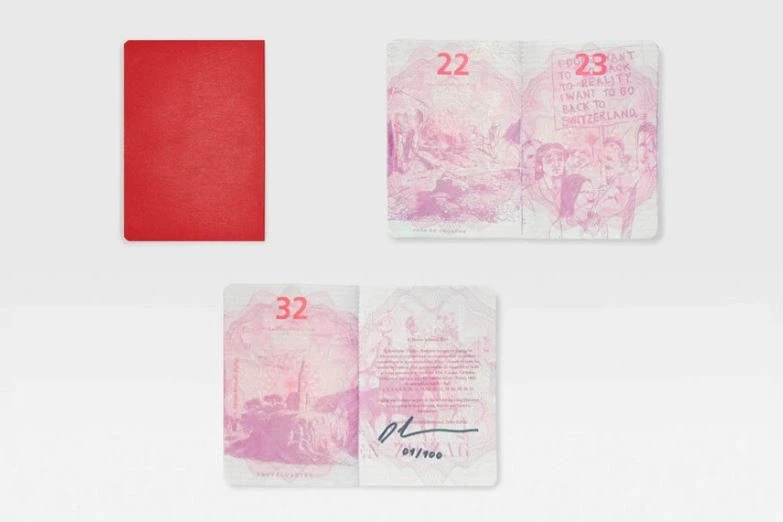
DS: Gjergj Kastrioti had declared: “I did not bring you freedom, I found it among you”. I always say the opposite: I did not bring you bags, I found them among you! The idea of buying a canvas to paint on seemed absurd to me. Instead, in 2018, I turned to the most common object found on the streets of Prishtina: the plastic bag. I fixed it, I appropriated it, I attached my thoughts to it and let them fly like a wild animal, the daughter of our cruelty to nature. I have always been attracted by the fragile border between what is considered appropriate or not in art. For me, banality is a value in itself. Working with it is both a counterattack against what cannot be avoided, and a silent legacy: a relationship with the ready, neither forbidden nor dismissed, but simply present, insistent. Plastic, in this sense, is more than material. It is a relic of our time, a fossil of the present. As Bruno Latour reminds us, planetary urgency shows that we are never outside of nature, but deeply entangled in the very crises we create. To write on a plastic bag is to acknowledge this entanglement, where intimacy and catastrophe share the same fragile surface.
also "Kosovo..." with illustrations that give another dimension to monuments
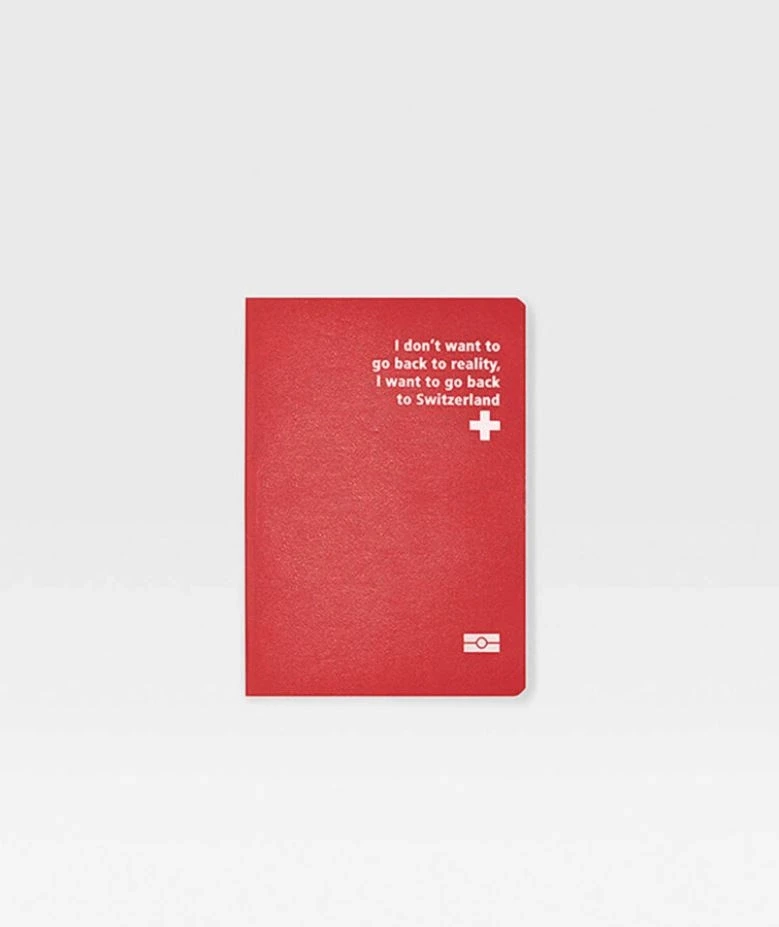
ESH: Your love letters belong to “Atlas,” a broader work, like a kind of map beyond borders and nations. How does “Atlas” hold all these works together?
DS: Just as every atlas is a collection of maps, so all my bag collections form a narrative, for me and for others. They are like maps of unofficial histories, fragile cartographies of moments that reveal meaning only when placed next to each other. Each bag becomes a page in an atlas of what is often left out: a register of the neglected, of things we have carried with us but rarely remember. The “atlas” gathers these fragments into a single field, a collection of traces, small testimonies of time, love, and loss. One day, they may seem completely meaningless, like so many other human discoveries that history has mocked, forgotten, or misinterpreted. What interests me is not their durability, but their constellation, the way they draw a terrain of memory, intimacy, and absurdity.
ESH: Public space has been a core area for your interventions since early in your career, with “For God's Sake” (2008) marking your first work in this context. What does public space represent for you as an artist, Driton?
DS: In 2008, with a strong desire to say something in a place where there was little space for expression, I turned to public space. By colliding truths and ironies, it became my paradise, especially in those places where cultural hegemonies clash, where dominant narratives are reinforced, but where counter-narratives can still arise. For me, public space is never neutral. Working there means insisting on visibility, interrupting, disturbing, or even gently displacing the everyday consensus. From “For God's Sake” (2008) to “Red Tape” (2018) and “Wanderlust” (2016), my interventions aim to charge the ordinary place with extraordinary memory, to turn a street into a stage, a wall into a question, a life jacket into an archive of absence and presence. These are small acts of resistance: fragile attempts to claim space for that which has been excluded, silenced, or dismissed as banal. Public space is not a backdrop, but a condition, a terrain where art negotiates its meaning, where intimacy becomes visible, and where the absurd suddenly appears as something necessary.
ESH: Can you explain your installation in Vienna, “Only Time Will Tell,” in more detail?
DS: “Only Time Will Tell” is not just the title of the installation; it is a kind of ironic prophecy affixed to the main courtyard of the MQ. In bright letters, it stands like an old lighthouse calling us not to wait passively, but to enter the moment and help guide what is to come. In the MQ courtyard, time becomes a mirror. Artists are not predictors, yet we are constantly asked to say what the future will bring. This paradox carries over into the work itself: it does not predict, but reflects. The MQ courtyard is grand and ceremonial, a stage where thousands of people pass by every day, yet the work feels personal, more like a stone thrown into a pond that creates ripples inside rather than outside. For me, time has always been a construct of the imagination, not a straight line, but a cycle of fragments that we hold onto until they fall apart. This idea was beautifully reflected in this public space. The work is not static; it asks you to stop, to reflect on what remains and what disappears. Placed by curator Verena Kaspar-Eisert in a place where it is impossible not to notice, the phrase hovers over your head as you walk through the MQ, not a work that passes you by, but one that walks with you long after you have left.
ESH: I often follow your interventions with drawings that you make in Instagram stories. They are at the same time concrete and ephemeral. Do you see them as sketches or do you think they can stand as predictions in themselves?
DS: They are an unstoppable ritual, somewhere between meditation, existential boredom, and the utopias that come right after an espresso. Honestly, they are a mix of everything. I don't even know. Maybe sketches, maybe warnings, maybe just drawings against forgetting. But in a way, they feel like a necessity, as if without them nothing else would make sense. Or at least my coffee wouldn't make sense. Drawing, in this sense, becomes key; it gives body to ideas that would otherwise remain invisible. And those well-kept, yet fragile, writings are apparently what keep the world moving, or at least keep me from falling out of it.
ESH: I'm curious about the rhythm in your studio. What does a typical workweek look like in your artistic practice?
DS: My studio rhythm is very professional: three days of procrastination, two days of panic, one day of productivity, and half a day of cleaning up the mess so it looks like I always knew what I was doing. A week in the studio usually looks like this: I make coffee, stare at the same object for hours, convince myself it's brilliant, then decide it's terrible, and finally pretend the whole process was intentional. Somewhere in between, something really gets done.
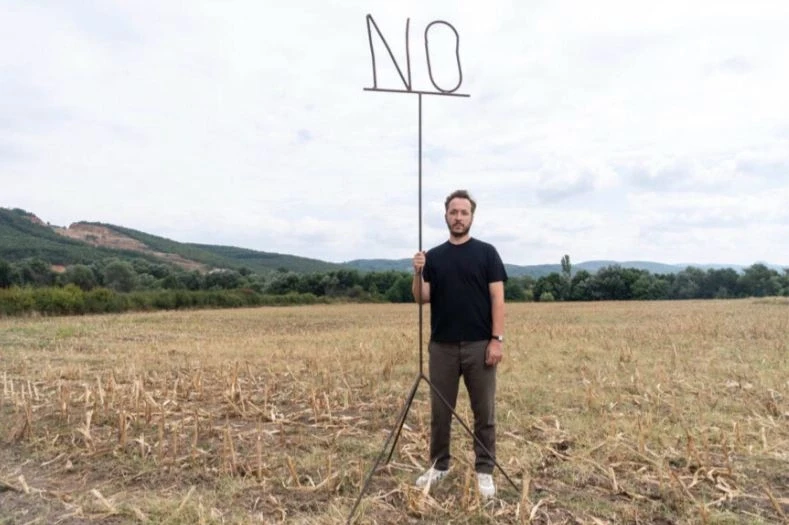
ESH: And how do studio visits make you feel?
also The geography of oblivion
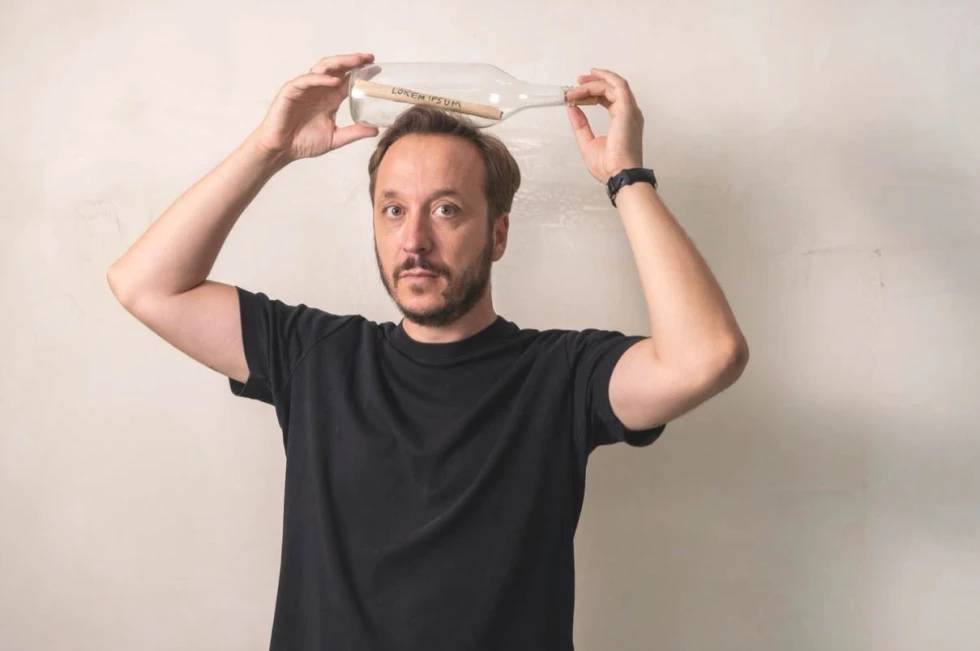
DS: Studio visits feel like waiting for ships that may or may not come. Being here, I often feel disconnected from the art world, like an island dweller watching the horizon for sails that never appear. History is full of such faraway places, people on forgotten islands waiting months or even years for a ship to bring news, salt, or a letter that may already be out of date by the time it arrives. Artists live in a Beckett-like state of waiting. The visit feels redundant even before it begins; time has passed, and yet the long process of waiting, preparing, and repeating continues. The visit becomes less about what is being shown and more about the theater of waiting: closer to “Waiting for Godot” than any practical exchange. Perhaps that is why I sometimes think of my studio as a shore, and each work as a message in a bottle, cast into uncertain waters, with no knowledge of when or where it will arrive, or who will open it. What rarely comes is what was expected, and often the only thing that comes is the expectation itself.
Taken from: “Les Nouveaux Riches”

