


-
By:
Gili Hoxhaj

- July 28, 2021 02:17
- Share to:
With his pace of work, he has decided not to give up the family tradition. Hilmi Bunjaku belongs to the third generation that continues the craft. His daily work inside the wooden shop is beyond the mundane. It is preservation of material heritage, and memories are spiritual heritage
When the silence falls, the sound of Hilmi Bunjaku's sewing machine can be heard a little, in the center of the Grand Bazaar in Gjakova. The bachelor does not take his eyes off his work. He is not impressed by the commotion created by the cafes outside, but he misses the colleagues who used to work near him. With his work pace, he has decided not to give up the family tradition. It belongs to the third generation that continues the craft. His daily work inside the wooden shop is presented in the colorful uniforms that are hung outside and in the shop windows. Dominate the white uniforms that work for health workers. Through sewing, he tries to make everyone who wears the clothes made by him feel comfortable. His craft-based work reflects nearly seven decades at the sewing machine. That's why he says there was no other way. His work in the past is related to joint work with his brothers' father, but he says that his sons who practice other professions have not inherited this craft.
"The grandfather had this craft, then they sewed twills, which are women's vests for the hasjans. All of them are handmade and then we started to work on khaki pants, which is a very difficult material to work with. Then we switched to shajak and constantly made changes according to the times", explained the 77-year-old artisan.
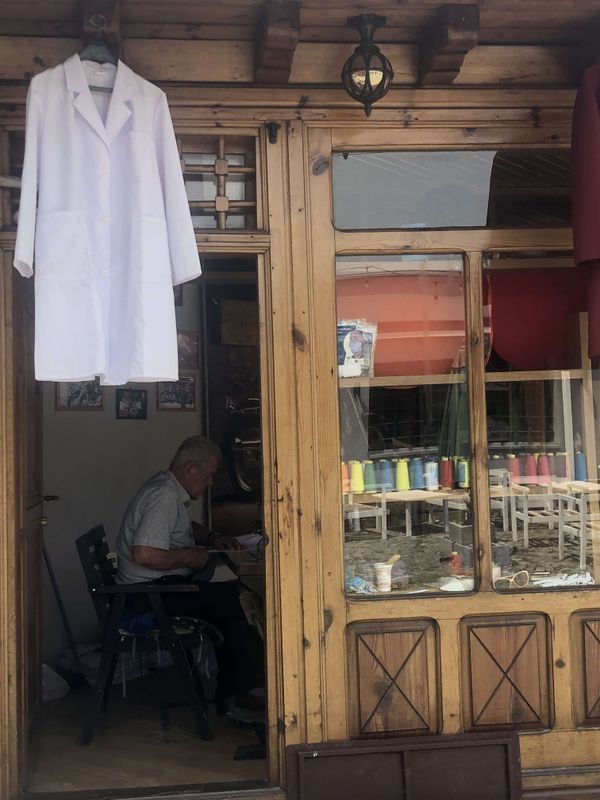
He has been in the shop where he works since 1973, but he has been involved in this craft since he was a child. The store, like the entire Grand Bazaar, burned down in 1999. It was rebuilt after the war.
"There were some people here who distributed salaries illegally, and one of them who shot here when I met him after two weeks told me: 'I shot here when the Bazaar burned down, when your dugo burned down, there is no bigger fire rich here'. Because it was all pine. This, since I have chosen the type of wood according to the architect's project", said Bunjaku.
He remembers that once in the store his family members worked with a conditional work schedule, but because of the great desire not to be separated from it, they were looking for ways not to stop work. The rule that had to be respected then was that the shops opened at 08:00 and worked until 12:00 and closed by 16:00 when the work in the shop had to continue until 19:00.
also The big bazaar in Gjakovë, center of handicrafts
"At that time, father and grandmother worked together. We didn't stop work, but let down the curtains in the shop and stood guard outside when the police came. There was only one. When we saw it from afar, we would go and knock on the wall and they would hide and when the police came, we would knock again so that they could continue their work", the craftsman from Gjakova confessed.
Bunjaku says that the Bazaar used to be dominated by artisans. For the craftsman, who now opens the shop earlier than in the past, on the way until he arrives at his shop, he is overcome by the sadness of how the former shops where various crafts were worked have now been transformed into cafes.
"Now the bazaar is not opening early. Even the crafts that used to be are no longer here. They made a big mistake, because this was the most important and the main Bazaar that connected us with Albania. Here were all the crafts. It's too bad that they all became clowns", said Hilmi Bunjaku.
He is singled out for his pedantry at work as he interacts between two sewing machines. Traditional clothing was once part of his workshop collection. Now, he mainly works in uniforms of different professions. He says that he makes up to 20 uniforms in a day.
"When it comes to ironing, the sisters wanted to take my job, because when you take them to fold the pants, they fold themselves", he emphasized.
Age has not diminished the artisan's desire for work, but it has increased his concern that there is no one to inherit his craft that left him, his father and grandfather without bread and without a home.
also Alarm for spiritual heritage: the craft of cradle making, on the verge of extinction
"I was the last of the whole family. Even if I leave it, it is a very big sin. I will not let go of the scissors from my hand until the last vein of my finger is beating, because I have no other way. With this craft, we are all at home. Anyone who does the craft willingly does not know how to get tired", he said convincingly.


