


-
By:
Sinan Berisha

- November 21, 2025 08:00
- Share to:
“Luna Park”, directed by Florenc Papasi, has also come to Pristina as Albania’s candidate for nomination at the “Academy Awards”, while Kosovo itself has not submitted any film to the international competition this year. In this nexus where film creativity moves freely across borders, Kosovo “enters” with actress Adriana Matoshi, who plays the main role of Mira. She is a single mother from Elbasan, who lives in an Albania immersed in the collective illusion of quick enrichment through pyramid schemes. It is the Albania of the collective madness of 1997
The film's narrative that returns to Albania in the '97s has also been heard in Pristina with a special echo. Not only because of the topic that touches on one of the most serious crises of the Albanian space, but also because at its center stands an actress from Kosovo and part of the Kosovar crew that gives the film a weight that goes beyond a formal co-production. "Luna Park", directed by Florenc Papasi, came to this premiere on Wednesday night as Albania's candidate for nomination at the "Academy Awards", while Kosovo itself has not submitted any film to the international competition this year.
In this connection where film creativity moves freely across borders, Kosovo “enters” with actress Adriana Matoshi, who plays the main role of Mira. The film is a candidacy submitted by the film house “On Film Production” and has been selected by the Selection Committee as Albania’s representative in the 98th edition of the “Oscar” awards. The film’s producer is Dritan Huqi and the film has also been supported by the Kosovo Film Center as a minor co-production. The minor co-production is the film house “Buka Production” of the actor, in this case the producer, Fatmir Spahiu.
The Kosovar presence in the project is visible, pronounced, even inseparable from the structure of the film itself. This has given the evening in Pristina a completely different color, a kind of silent return of Kosovo to the “Oscars” circuit, not with a film of its own, but with its voice and work.
The film's narrative, written by Florenc Papasi and Glykeria Patramani, revolves around the story of Mira (Adriana Matoshi), a single mother from Elbasan, who lives in an Albania immersed in the collective illusion of getting rich quick through pyramid schemes. Mira works hard, but poverty and insecurity have made her life a tiring journey. Her brief relationship with Berti (Nik Xhelilaj), a wealthy man who runs one of the pyramid firms, gives her the idea that she may finally have a chance to change her fate.
She believes that investing in these schemes is the only way to provide her son with a better life. She gives up everything: her savings, her valuables, and even begins to believe that she should sell her house. The thirst for a "golden opportunity" that promises to triple her income within a few months pushes her to the brink of a fatal decision. At the same time, Toni - her teenage son, played by Orion Jolldashi - tries to find his place in a fragile reality, until he feels that something big and dangerous is approaching their lives.
Set in 1997, the events the film depicts were not part of Adriana Matoshi's memory. She herself was a teenager at the time, but the film scene required an immersion in that reality, and the actress described this immersion as difficult and burdensome, but inevitable for the role.
also Albania aims for Oscar with narrative of '97 chaos, supported by Kosovo
"At that time I was 16-17 years old and I had no connection to what happened in those years in Albania. They didn't tell me, especially my parents never talked to me about dark periods, but as an actress, as a professional, normally I don't take on very heavy roles, but it was really a heavy role," she said, adding that the weight of the role was more than just interpretation. The cold locations, the harsh atmosphere of the script, the dialect that distanced her from herself, all, according to her, were barriers that had to be broken.
"The dialect has prevented me the most from being myself 100 percent, not because I haven't been, but it would have been much easier for me to express myself in my dialect. With the help of the director, with the help of the producer Fatmir Spahiu, and with the actors who were my partners in the film, we have overcome every difficulty," she added.
In the film, the collapse of pyramid schemes destroys the entire architecture of promises, pushing the country towards chaos and violence. Elbasan, like the rest of Albania, erupts in protests, looting and anarchy. Mira and Toni are forced to flee, heading towards Greece, an escape that turns into a fight for survival. The journey is dangerous, with impassable borders and frightened people seeking the same salvation.
In Greece, mother and son are separated under unbearable circumstances, Mira is arrested and Toni begins the search for his father, a shadowy figure who has never been part of his life. His only refuge becomes a closed "Luna Park", an abandoned space, which becomes a symbol of lost hope, of broken dreams and of that childhood world that is missing in the bloody reality of '97. There, Toni seeks answers, while Mira fights to reunite with him and to save what is left of their lives.
The actress also described the theme of the film, emphasizing that the story it conveys is just one of millions of similar ones.
"In Albania, almost 98 percent of people have fallen into that trap and have experienced this story, each in their own way. This is one of a million stories, but it is worth seeing, especially by the younger generations, to see what happened in that period of time, to know the history of Albanians in Albania," said Adriana Matoshi.
Sensitivity to linguistic shift, to heightened dramatic situations on stage, is also reflected in the way she sees film today.
"Now when I watch the film, I say that I could have done it this way and that way," she confessed, a typical reflection of an actor who sees his work from a distance, but who actually gives the role a human dimension.
Thematically, “Luna Park” constructs a stark contrast between dream and reality, between the fantasy of a world where everything multiplies overnight and the brutal disillusionment that destroys families and societies. The enclosed park itself becomes the film’s central metaphor: an undecided space between childhood and abandonment, between hope that never fully fades and ruin that is now irreversible.
also "Otter" - a story about loss, trauma and the struggle to regain life
The narrative sees Mira as a symbol of those women who have carried the weight of collective mistakes in the body of their family. While Toni, with his presence in the cold corridors of the park, represents the generation that has lost its childhood between two systems, a reality that was collapsing and another that had not yet been built.
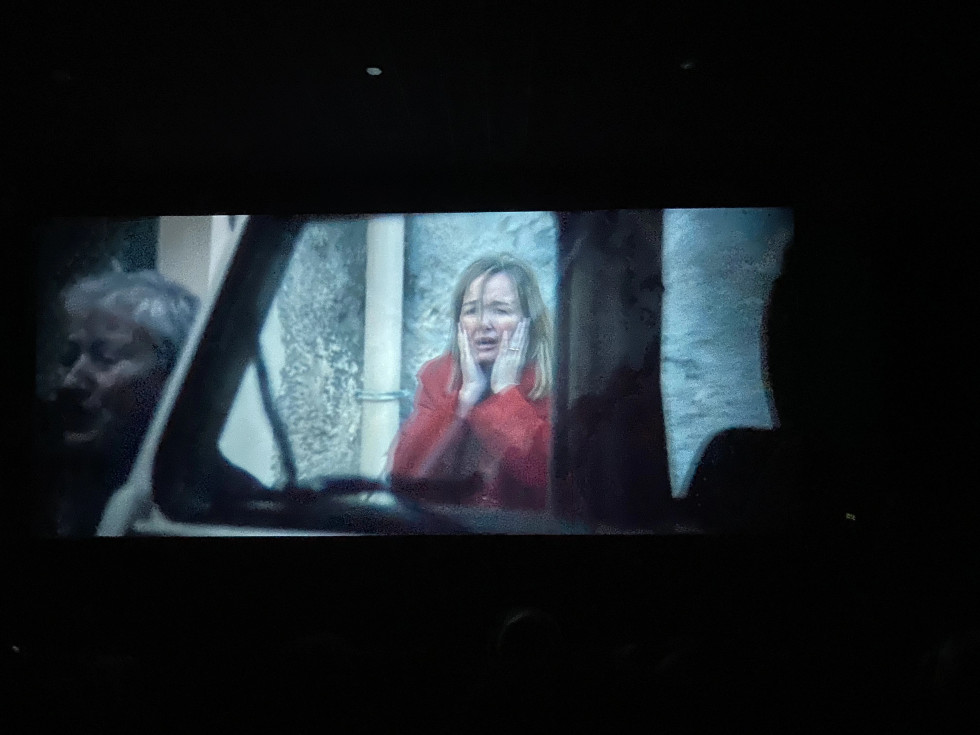
For co-producer Fatmir Spahiu, the Kosovar involvement in the film is not simply a technical entry on the list of co-producers. He links this presence to the quality that Kosovo has brought and especially to the fact that the main actress is from here.
"Kosovo has a minor role as a producer, but with the actress as the main role it gives it greater weight. Among the rare cinematographic productions that deals with an important historical event of our people, in this case of Albania, and that the actress is from Kosovo and this gives it another dimension and I am happy for this fact," he emphasized.
He said that the project began six years ago, in a long process that characterizes serious co-productions in the region. The premiere in Pristina, according to him, was a natural moment after a long creative journey.
"The film communicates very well with the masses. I am a fan of this type of film that has a little politics and history in it, especially when they promote a part of history, which makes the world understand us a little better, to understand those large crowds of refugees from Albania in the late '90s, and then the Kosovo event," he said, emphasizing the importance of narratives that help explain the great exodus of Albanians in the late '90s and the historical dynamics that have accompanied the Balkans.
One remark of his particularly characterized this evening.
"It is interesting when it is said that Albania has chosen this film to attempt to 'represent Kosovo' at the Oscars," he said with this sentence that at first glance sounds paradoxical, but which essentially reflects the current situation, Kosovo not having entered the competition at all with its own film, while its presence is central in the film with which Albania is competing.
In 2023, it was decided that Kosovo would not have a candidate, citing quality. In 2024, the CCK did not even address this topic. Initially, it was silent about the failure to open the call. Later, the director of this institution, Blerta Zeqiri, indicated that they had some problems with the e-mail address.
also "Dua" returns to Pristina with the story of the war that captures everyone
The Pristina premiere at "Cineplexx" has highlighted a void and a presence at the same time. The void of a year where Kosovo has not managed to take the step towards the "Academy Awards" with its own representation. And the presence that cannot be overlooked in "Luna Park", the main actress, the Kosovar producer, and the national institution that has supported it as a co-production.

