


-
Translated by: Shaban Maxharraj

- 1 October 2025 22:12
- Share to:
Gërvalla's legacy is multifaceted. His creative works remain forever meaningful, although a good part of his music has been undone by the system of that time. And, Gërvalla's national activity was always an inspiration. There are two sides to Gërvalla: that of the artist and that of the idealist for national issues that constitute a unique universe. This is how he was remembered on the 80th anniversary of his birth
Jusuf Gërvalla in the 70s was at the peak of his popularity. A renowned journalist, an artistic creator in poetry and prose and a well-known songwriter of entertaining music. This was his lyrical side. But his great idealism, his dedication to the freedom of Albanians under the former Yugoslavia and the general national idea in the second half of that decade would weigh him down more heavily. Thus, because of his ideas and activities, the creator of the time when Kosovo was creating its artistic identity within the former Federation would escape to Germany. The then government had left him no place in Kosovo. But it did not leave him alone in Germany either, where on January 17, 1982 he was killed by the Yugoslav service together with his brother Bardhosh Gërvalla and their friend, the activist Kadri Zeka.
Gërvalla's legacy is multifaceted. His creative works remain forever meaningful, although a good part of his music was undone by the system of that time. And, Gërvalla's national activity was always an inspiration.
A chapter of his legacy was commemorated on Wednesday at the National Library of Kosovo as part of the marking of the 80th anniversary of Gërvalla's birth.
The ceremony organized by the Ministry of Culture, the National Library of Kosovo, and the National Theater of Kosovo was not at the level of creativity and personality that was remembered.
Improvisation and haste have taken over this place and this was also reflected in the ceremony. The Ministry of Culture requested this organization from the Library on Friday. And by Wednesday something had been done. The idea for an exhibition had not progressed due to time. Exactly ten minutes late, Gërvalla's daughter, Donika Gërvalla - Schwarz, and Gërvalla's widow, Suzana Gërvalla, arrived at the Library's Great Amphitheater. The poem "Fletë testamenti" interpreted by actress Sheqerie Buçaj opened the ceremony with a not so interested public for this commemoration. Not the first in line, but the most meaningful in terms of content was the speech of the conductor and composer, Rafet Rudi.
also Xhafa: Art cannot be put at the service of nationalism
He has written a lot about his friend, Jusuf Gërvalla. In this case, he has selected some parts of his latest book, “My Book of Memories”, published this year. He has described the time when he first met Gërvalla and then their association, discussions on various art topics, philosophical discussions and ideas for another Kosovo.
"There are two traits that define Jusufi's personality, which make the entirety of a unique universe. Although they are contradictory in their essence, in Jusufi's case they are not: On the one hand, there is Jusufi the lyrical. With an affinity for expression in art (even in several arts), and on the other hand, there is Jusufi the dramatic, combative, self-sacrificing, dedicated to the general national idea," said Rudi. According to him, Gërvalla has been crossed between these two extremes his entire life, but has always managed to maintain a good balance between them.
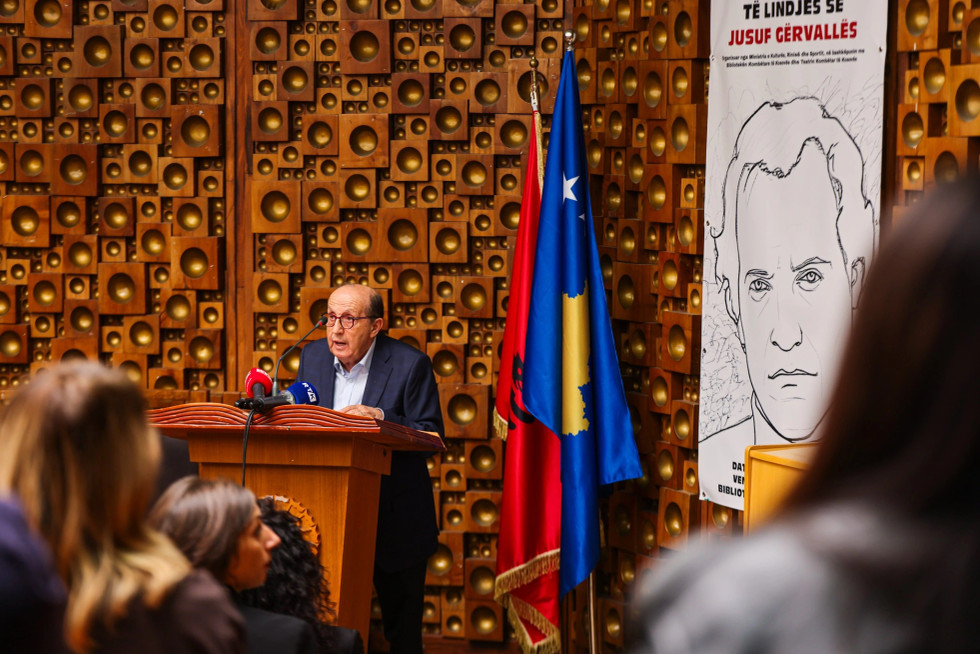
"His patriotic side, as I can imagine today, is known to the public and was indeed an important part of his character, but I am convinced that even more impressive was the other side of his personality, his affinity and talent for the arts, which presents an inexplicable contrast to his entirety," said Rudi. He recalled that in the late 70s political austerity had increased and Jusuf Gërvalla had felt this strongly. In this case, his balance, according to Rudi, had been lost, causing the militant Jusuf to prevail over the lyrical one.
"Perhaps Jusuf was held back by hope that good times would come, when he could devote himself to art, or the time when he could walk freely in the magical world of his fantasy, guided by his extraordinary talent - I can never know," said Rudi.
The poem "They Fly and Fall" recited by actor Veton Osmani and "From the Memoirs of a Wanderer", performed by actress Semira Latifi, were significant "pauses" between speeches.
also Xhevdet Xhafa's retrospective, like a never-ending run
Daulina Osmani, acting Deputy Minister of Culture, said that Gërvalla's personality remains an example of a man with many virtues.
"Yusuf was not just a writer, he remains a shining symbol of our political history with rare courage, high national awareness, and with extraordinary talent, he became an eternal part of our path to freedom," Osmani said, among other things.
Gërvalla's daughter, the acting Minister of Foreign Affairs, Donika Gërvalla – Schwarz, has said how her father grew up without a father, after he was persecuted by the regime after World War II and died years later in the basements of the city of Peja. She mentioned her grandmother Ajshe Gërvalla as an inspiring personality for her children. And, she had a prayer for everyone.
"I ask you, all those who follow us on television, that if there is one element that we can extract from the figure of Jusuf Gërvalla, then it is that we should never rest, just as he never rested: to try to find ways, ways that all together, not divided but united, we can do what is best for our country and the future of our children," she said.
Jusuf Gërvalla is among the personalities whose creativity was censored by the former Yugoslav regime. After his escape to Germany, in the late 70s, harsh measures were taken. His music was no longer broadcast on the radio. This censorship had come into effect in November 1979, the time when he left Kosovo. The government was committed to the point of destroying all of Gërvalla's recordings on Radio Prishtina at that time. All of this was done in the Radio's archives by an Albanian colleague of his on orders from management. Rafet Rudi, then conductor of the Radio's choir, recalled this time in detail. In a 2021 article, Rudi recalled that the destruction of the recordings took time since not only the recordings cataloged in Gërvalla's name were sought, but also his songs on the broadcast tapes.
"Every time I passed by that room (and this happened every day!) I felt the sadness described, not only because I had a close friend, Jusuf, but I was shocked by the fact that even in a future period of improving political circumstances, those recordings could no longer be returned to the program, as happened with all the other recordings put in the 'bunker'. The 'executioners' of art, in the case of Jusuf, had decided to eliminate this angelic voice forever!", wrote Rudi.
 Rexhep Qosja – phenomenon of Albanian culture
Gërvalla is also remembered through music. “The Nightingale’s Song” was performed by Shpat Deda. The entertaining song touches on freedom, youth, and is quite romantic. He also sang to the hills of his village.
Born on October 1, 1945, in Dubovik, Deçan, Jusuf Gërvalla, although he was killed at a young age, only 36 years old, has left to the art of Kosovo works that are part of the days of the cultural formation of the country. His figure and national views remain an inspiration for his compatriots and idealists.

