


-
By:
Enis Bytyqi

- July 5, 2024 08:00
- Share to:
Digging into the past, Barbara Prenka reshapes her quilts that elegantly hide identity marks, the craftsmanship of the past. But in essence her quilts reveal existential questions, because the artist gives them a different meaning. "The cycle of quilts was born from my desire to analyze this object, because it conveys to all of us throughout existence, from birth to death. And it is a symbol that protects us in bad times, in poverty, wars, it is a warmth that it brings", said Prenka
It was February of this year when the Gallery of the Ministry of Culture would open the exhibition of the pioneer of the textile artistic medium in Kosovo. The "Paths" of the artist Valbona Zherka had been a sensational exhibition in the capital, some of her masterpieces in tapestry and painting were brought back, for the first time after decades.
In the same composition, with painting and textile, in the same gallery, this time there are "Covers" (Quilts/Blankets) by the artist from Gjakova who works in Italy, Barbara Prenka. But unlike Zherka's creations that stretch back to the 70s, Prenka – whose name has begun to take place on the international scene – treats textiles with the freshness of today, deep reflections. She plays with digital technology, but also pays homage to tradition by respecting the traditional work of constructing a quilt. There are seven quilts which at first glance, even though they retain the identity of being a utilitarian object, also present sophisticated aesthetic techniques which, beyond hanging on the wall in an art gallery, transform them into works of art. The quilt as the starting point of this cycle comes from her, enriched with an exclusively symbolic approach and techniques that give it multiple identities, waiting to be unraveled from different perspectives.
Born in Gjakova in 1990, Barabara Prenka, raised in Italy, continues to live and work between Venice, Bolzano and Berlin. He graduated in the class of Professor Carlo di Raco at the Academy of Fine Arts in Venice. Her artistic identity is formed by her practice with painting, textile and embroidery. Her research analyzes painting that consists of different mediums, which becomes a mixture between the near and far environment. The boundary creates new perspectives of generation. Her work focuses on the search for this limit, a circle of creation-destruction-recreation as an end in itself. She has exhibited her works in five personal and several collective exhibitions in cities such as Berlin, Paris, Milan, Mexico, Vienna, Tirana, Palermo, and others.
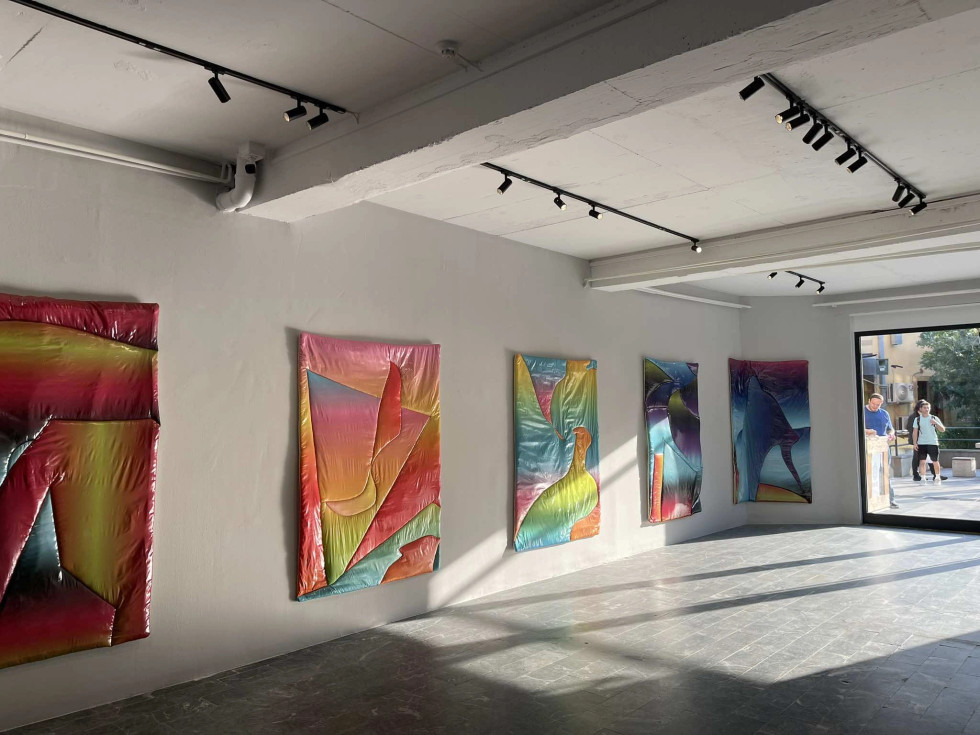
Prenka's quilts, unlike the traditional ones once made by the quilters of Gjakova Bazaar with a satin finish, shine differently. With techniques that reap the fruits of the latest technologies, her works take on a perfect shine, so much so that they seem almost artificial, and with the right perspective, they also resemble two-dimensional digital works. Up close, the signs of historical identity can be distinguished, there are workmanship, and dimensioning from the wrinkles created by the sewing of the material that is filled from the inside with cotton.
Prenka had her first exhibition in Kosovo in October of last year as part of the project of the Fund for Humanitarian Law. Entitled "New Day" through this exhibition she had brought a recreation of family photos with the technique of making traditional carpets as a tribute to the pre-war memories in Kosovo. She seems to constantly find inspiration in the traditional, she honors it by re-actualizing it in her art.
also "Quilts..." as art that deals with existential questions
"The medium I work with is traditional in the way I work, because we are dealing with sewing and material. But the work itself is a kind of painting, my work is also born from the traditional, but I have developed it in a modern way. I am interested in this vision of the abstract worker, of the one that is more hybrid and is a little distant, when you get closer there are parts of the traditional but also intimate when you discover further", she said.
Behind the brilliance of her quilts hides another motif that the artist intended to achieve when they were exhibited.
"In the first works I did not use this serum varnish that gives the reflection like plastic, but in these workshops I wanted to use this to create some reflection for us viewers, because when we walk through the exhibition we have some reflection as if we are in water or in the sky ", she added.
But she synthesizes the connection with this medium from personal and collective memories. From the unconscious connection that man has created throughout history with the quilt as a service object.
"The cycle of quilts was born from my desire to analyze this object, because it conveys us all throughout existence from birth to death. And it is a symbol that protects us in bad times, in poverty, wars, it is a warmth that it brings. It is something that protects and warms, the same way the viewer in the exhibition while walking can feel covered with memories of when he was little or something similar", said the artist Prenka.
also Valbona Zherka between archeology as a starting point and resistance with art
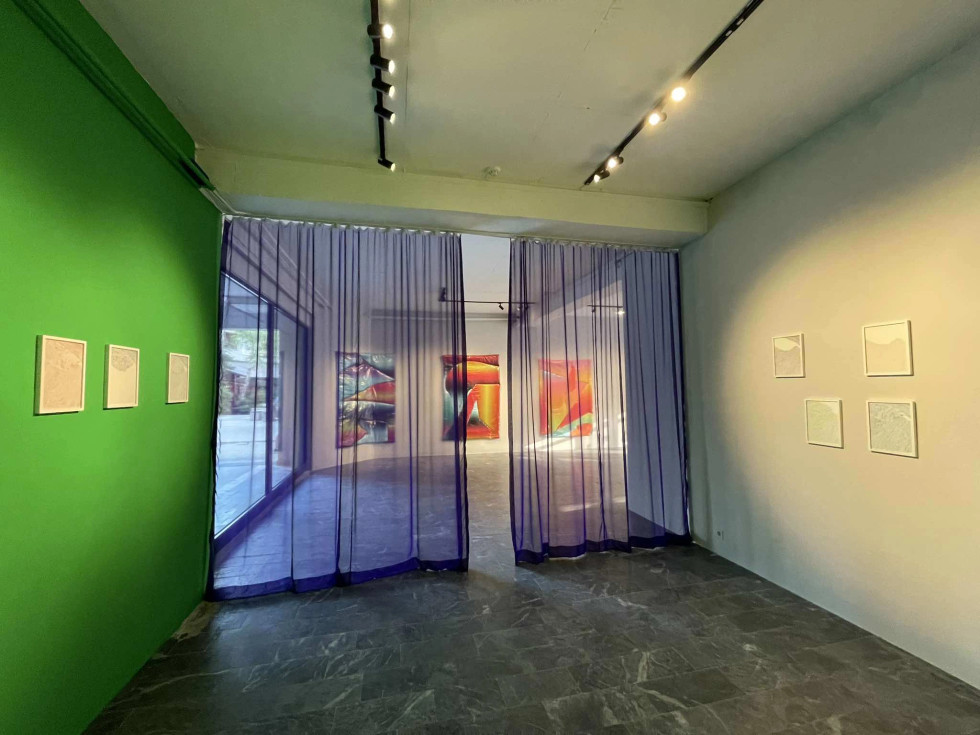
The atmosphere changes in the northern corner of the Gallery, where the walls are painted green and there hang some of the artist's paintings, and this oasis is separated from the central space by purple curtains and the ethereal sounds that play and invite reflection while observing the artist's works. this seemingly more conventional framed order.
There are eighteen sosh where each one is brought to life by the same subject but each one has a unique character. It is a close-up of a sleeping bed showing a pillow and quilt. At first glance, it looks like a peaceful nature that takes the simplicity of the everyday and the more complex meaning in other variants. In one, the pillow is missing, in the other, the quilt is missing, sometimes the background of the wall is not visible at all. Thus the artist tries to visualize an element of human nature, the struggle of the constant search for things, answers and possessions.
For the curator of the exhibition, the artist and professor Zef Paci, the collaboration with Barabara Prenka was fruitful based on the artist's own proposals. For him, the artist's work is multidimensional in the messages it conveys.
"It is an exhibition which in its simplicity brings to attention a number of problems. Issues related to identity, technology and artwork. Because there is a girl who comes from a training in painting and starts to produce these quilts that she has seen that her ancestors made. I make it by taking the same object, but in fact the technology has changed, they are no longer the old pieces, the production methods are different, the fashion, the mindset has changed. Then you understand that identity is something that undergoes changes. And then when this object that looks like a utilitarian and artisanal object turns into an industrial object, but the author uses it to awaken these questions by producing an object that is not utilitarian, but shows the importance of technology in production", said Paci in a pronouncement for TIME.
The coordinator of the Gallery of the Ministry of Culture, Dhurata Ramosaj, said that the collaboration with the artist Prenka was developed based on the principles of the Gallery itself, which is engaged with the aim of providing space for artists of different profiles.
also "Paths" in the endless art of Valbona Zherka
"During the preparation phase, we have communicated a lot with the production, with the curator and we have come to this final idea that you see today. We attach importance to the program to be comprehensive, to be different for the public", said Ramosaj about the exhibition.
And, "Quilts..." is really different.

