


-
By:
Sinan Berisha

- November 6, 2025 21:36
- Share to:
For the first time in Kosovo, the full performance of Ludwig van Beethoven's piano concertos has begun. The Kosovo Philharmonic Orchestra, under the direction of Slovak conductor Peter Valentović, on Wednesday unveiled three piano concerts from the full cycle, which is scheduled to be performed over two nights. The remaining two concerts will take place on Friday. Five Kosovar pianists have become part of this project
The cycle of piano concertos by German composer Ludwig van Beethoven, from his classical beginnings as a composer to the culminating development of his musical style, is considered a musical autobiography. Not only for its evolution, but this cycle is also important because it gave impetus to the development of piano concertos as a performance form.
For the first time in Kosovo, the full performance of this cycle has begun, filling the Red Hall of the Youth Palace with energy and focus. The Kosovo Philharmonic Orchestra, under the direction of Slovak conductor Peter Valentović, on Wednesday unveiled three concerts from the full cycle, the performance of which is planned to be spread over two nights. The remaining two concerts will take place on Friday.
Five Kosovar pianists have become part of this project, each bringing one of Beethoven's piano and orchestra concertos. On the first evening, Wednesday, concertos no. 2, no. 1 and no. 4 were performed, while on Friday they will continue with concertos no. 3 and no. 5. Their importance and "magic" does not lie only in the notes that Beethoven wrote, but in what they represent for the development of art, the human spirit and the interaction between man and the world, while the footage from the Pristina stage shows the careful preparation of the orchestra, which in this case is placed in a continuous dialogue with the pianists.
Written at different periods of the composer's life, they each have their own contexts and challenges.
“Piano Concerto No. 2 in B major”, although it bears the secondary number on the list, was composed first. Although young, at 18 years old, Beethoven was already pushing the piano to new technical limits, with long passages, strange rhythms and lively humor. This spirit was also conveyed in the packed hall of the Youth Palace.
also Beethoven in Pristina with notes of magic, courage and challenges
Conductor Peter Valentović, who has also been a pianist for a long time, awarded with many awards, is collaborating for the third time with artists from Kosovo. He was invited to perform with the piano at the “Chopin Piano Fest” last year, to accompany soprano Ulpiana Aliaj in one of the concerts of that edition. For the second time in Kosovo, he has ascended to the conductor’s podium, to lead the Philharmonic Orchestra during the staging of the opera “Carmen” in July of this year. Now for this concert cycle, he has described his experience as one filled with dedication and discipline.
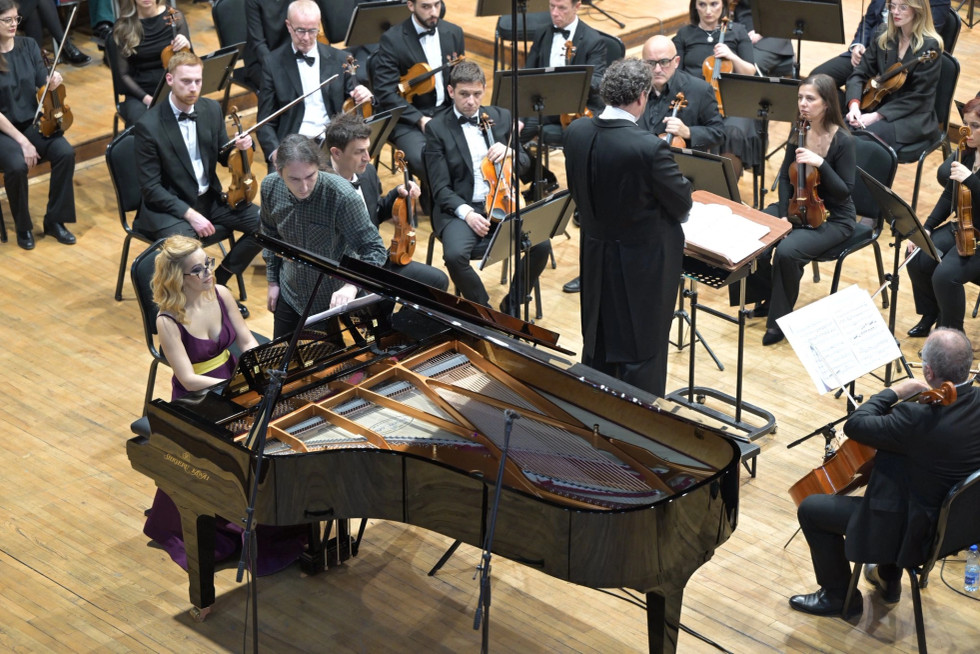
"It's my third time here, I have the pleasure of being part of this. We have had a lot of rehearsals with the pianists. We prepared three weeks ago and again this week. It was very good cooperation and great progress for the pianists and the orchestra. It was quite difficult, because we have to concentrate very much, to accompany every note, sometimes it goes slower, or faster, so we have to be focused a thousand percent," he said.
The evening opened with the “Piano Concerto No. 2 in B-flat major” performed by pianist Artemida Qarri. The work with three tempos of interpretation – “Allegro con brio”, “Adagio” and “Rondo: Molto allegro” – is more elegant, with humor, surprise and more dynamic contrasts. Now on the 255th anniversary of the composer’s birth, it comes to Pristina as the opening construct of a rare musical event in the country.
"It's always a pleasure, especially when it's a special anniversary, like this one. 'Concert Number Two' is really the first concert that composer Beethoven composed and has a different character than the others. For me it was a great pleasure, it was an honor and a privilege," said pianist Artemida Qarri, who in her musical journey has built an artistic identity that weaves the power of virtuoso interpretation with deep human sensitivity.
After it, the “Concerto No. 1 in C major” began, with a joyful tonality and classical structure, structured for interpretation in three tempos, “Allegro con brio”, “Largo” and “Rondo: Allegro scherzando”. This concerto is known for the sensitive dialogue between piano and orchestra, a conversation that in this interpretation is displayed with delicacy and clarity by the interpretation of pianist Jeta Dumnica.
"I am not a pianist who is very active on stage, because I run a music school and I have been less active. It has been quite challenging, Beethoven is very difficult, but the rehearsals have been fantastic and everything has gone well. It was a very special concert that is not often done in the world and I felt very privileged to have been invited," said the pianist, who compared it to the performance she had given four years ago of a concert from the Bach cycle. Since 2011, she has founded the "Misbah and Friends" music and art school in Pristina.
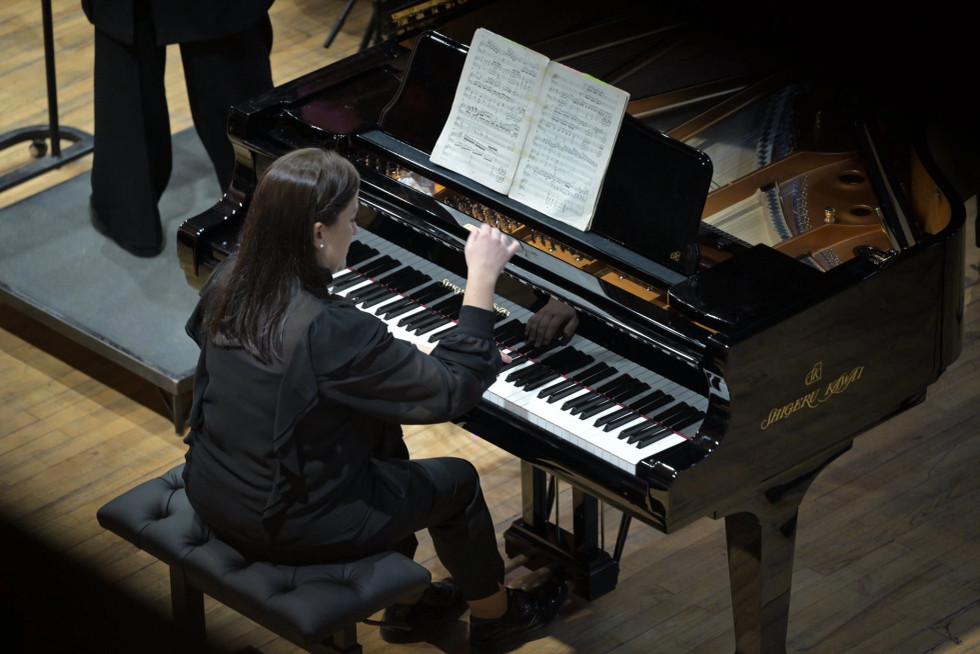
The evening concluded with “Concerto No. 4 in G major”, performed by Pranvera Hoxha. As a work, it does not begin with an orchestra, but only with the piano, bringing a more lyrical and revolutionary rhythm in the form of three interpretation tempos, “Allegro moderato”, “Andante con moto” and “Rondo Vivace”. Hoxha emphasized the historical importance of this musical initiative.
"This evening is special because for the first time in Kosovo all the piano concertos are being played, meaning that concert three, five, four have been played from time to time, but not so that they can be divided into two evenings and make a complete cycle, in honor of the 255th anniversary, of course. Since October, the celebration began to honor Beethoven's creativity and for me it has been of course a great pleasure. Since I was little, I have learned his miniatures, the smallest works, then I moved on to the sonatas and I have always had the pleasure of playing his creativity. He has a special style of composition and has always brought innovation to his works," she said. Hoxha worked as a piano professor at the "Prenk Jakova" high school of music in Pristina.
also The piano maestro deconstructs the classical universe with a unique modern approach
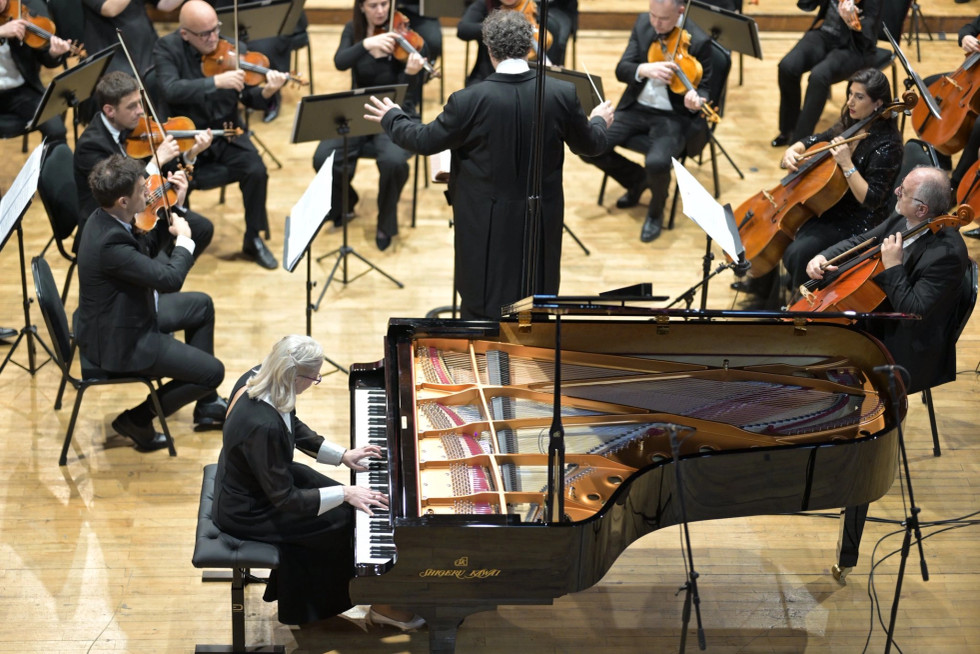
In this way, the Kosovo Philharmonic has marked another important moment in its artistic calendar, bringing not only dedicated interpretation, but also an educational experience to the general public that follows it with interest.
This cycle, which concludes on Friday with concerts no. 3 and no. 5, performed by Lirika Pula and Misbah Kaçamaku, recalls Beethoven's innovative spirit and the resilience of institutions that give classical music the place it deserves on the local stage, despite unfavorable conditions.


