


-
By:
BBC

-
Translated by: Latra Gashi

- 31 May 2024 08:00
- Share to:
Across Ukraine, young people are experiencing loss, fear and anxiety. A growing number have trouble sleeping, have anxiety or flashbacks. There has also been an increase in cases of childhood depression among the generation that is growing up under the horrors of war. And their parents are doing their best to take their minds off the chaos going on outside their home.
At the age of 12, Lera is learning to walk again. Small steps at first, but more confident with each step you take.
Last summer, a Russian missile attack broke one of his legs and severely burned the other.
About 2.000 children have been injured or killed in Ukraine since Russian President Vladimir Putin launched a full-scale occupation of the country. But war doesn't always leave visible scars, like the ones on Lera's leg.
"Almost every child has problems caused by the war," says Kateryna Bazyli, psychologist. "We are seeing a large number of children who come to us with unpleasant symptoms."
Across Ukraine, young people are experiencing loss, fear and anxiety. A growing number have trouble sleeping, have anxiety or flashbacks.
There has also been an increase in cases of childhood depression among the generation that is growing up under the horrors of war.
'I thought it was a plane'
also Birth underground, under bombardment: Giving birth to a child in Ukraine
Lera saw the rocket that hurt her a few seconds before it hit her.
It's been a hot summer vacation and the center of Chernihiv has been busy. She and her friend, Kseniya, have been trying to sell their homemade jewelry to the crowd walking by.
"I saw something flying up and down. I thought it was some kind of plane that would fly up again, but it was a rocket," says Lera, speaking quickly as if she didn't want to understand what she was saying.
After the explosion, she ran here and there in panic with her broken leg, until she realized that she was hurt.
"People say I was in a state of shock. Only when Kseniya said to me, 'Look at your leg!' I started to feel the pain. It was horrible".
At the beginning of the war in 2022, the bombing of Chernihiv in northern Ukraine has been frequent. But within weeks, Russian forces have been pushed back. And life is beginning to return to the city.
Then, on August 19, 2023, the local theater held an exhibition for drone manufacturers, and Russia attacked at that moment. Pieces of metal flew all over the road.
After nine months, Lera pulls down her pants to reveal deep scars and transplanted skin. There is a large lump where the metal implants were placed.
The wounds are healing well and she can now move slowly with her crutches. But he is still afraid of the sound of air raid sirens.
"If they show that a rocket is headed towards Chernihiv then I go crazy," she says. "It's very bad."
She insists she's getting better and hasn't changed as a person, but her sister isn't so sure.
"You are more explosive," Irina tells her. Lera nods. "I haven't been so aggressive before."
According to child psychologists, it is one of many first reactions to the stresses of war.
"Children do not understand what has happened to them, or the emotions they are feeling," explains Iryna Lisovetska, from the "Children's Voices" charity association, which is helping hundreds of young Ukrainians across the country. "They show aggression only as a form of self-defense."
For Leran, the war was doubly cruel.
A few months before she was injured, her brother was killed in the war fighting on the front line. The two have been very close to each other and Lera still struggles to accept the fact that Sasha is gone.
"I imagine he will call us at any moment. I could see his face in the passers-by on the street. I still can't believe what happened," she says quietly, covered with the Ukrainian flag that she plans to place on Sasha's grave, replacing the one that was damaged by the wind.
Without warning, Irna opens the phone and Sasha's deep voice fills the room. "I love you so much," the soldier tells his sisters, in the last audio message sent from the front.
It is the first time that Lera hears his voice since he died. Her chin quivers with emotion.
'I want to return to normality'
Daniel's biggest fear is to experience loss, like Lera.
His father is a soldier, serving near his hometown of Kharkiv, where fighting has intensified.
Recently, Russian troops have crossed the border in a surprise offensive, capturing new ground as rocket attacks on the city have increased. Among those killed in recent weeks, there is also a 12-year-old girl who was shopping with her parents.
"My father tells me that everything is fine, but I know that the situation there is not good," says Danieli. "Normally I worry about him."
The 12-year-old now lives in the west of Ukraine with his mother, quite far from Kharkiv. Russian missiles reach Ivano-Frankivsk, but there are more warnings about them. The streets are crowded and quiet. There is even a traffic jam.
But even here, Daniel cannot escape the conflict. He has placed a prayer above his bed, which he recites every night for his father's safety, even though he was not previously religious.
also Moscow attack brings war home for Russians
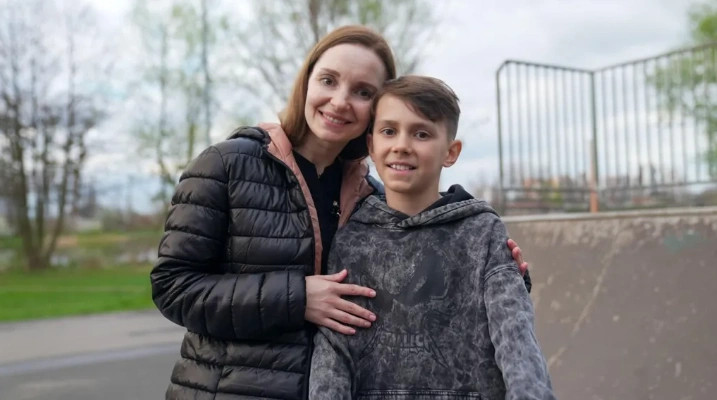
For a while, he and his mother, Kateryna, were refugees. They have returned to Ukraine because she is a child psychologist and has seen an urgent need for her skills.
She does her best to distract her son with various activities: at the park and at the guitar course. He has made music to raise funds for the Ukrainian army and attends a match club to help him deal with bullies at school.
"I've tried to find the things they liked before, to continue them here, and it's working," says Kateryna.
But the boy from the northeast is still trying to adapt.
"It bothers me a lot when there are airstrikes while I'm at school and everyone is happy that we're going to stop learning," says Danieli. "Here, the siren means going to the bunker. But in fact it means that there is fighting elsewhere in Ukraine."
Daniel counts the hours before the video call with his father. His father has been sending him packages of art supplies so he can teach him how to draw remotely.
"I want to believe that the war will end soon", says Daniel, about his greatest wish. That way he can return home to Kharkiv. "And that would be fantastic."
'It was very scary'
8-year-old Angelina is still in the city, living in the middle of the bombing zone.
She is from the suburb of Saltivka, which is also Daniel's home. When Russian troops advanced into the region two years ago, the town was in the firing line and Angelina was sheltering with her family in their basement.
"It was very scary. All I could think about was, when would it all end? There were rockets and a plane flew over us", says the girl, pulling up the sleeves of her sweatshirt.
In early March 2022, the relative giant block of flats is destroyed by a missile.
Angelina's mother, Anya, has told her to close her ears and lie still.
"I thought we would be buried under the rubble. That our building would be hit and that it would collapse", she says, recalling the event.
Then, they are gone.
But when Ukrainian forces liberated the northern region last year, the family returned to Saltivka. They are the only people living in their block of flats, surrounded by buildings blackened by smoke and broken windows. Despite the shell holes in the kitchen wall, it is still their home.
Now Kharkiv is again a place filled with anxiety. The bomb attack a few days ago, in a store, was close to Angelina's apartment.
Vladimir Putin says he has no plans to take over the city, but Ukrainians have learned to never take his word for it.
"When they start the bombing, I tell my mother that I'm going to the corridor and she comes and sits next to me", says Angelina, calm despite her experiences.
Crossing the corridor puts an extra wall between the body and any explosions. It is minimal protection.
Angelina should have started school by now, but the school has a hole created by the bombing. She doesn't remember the garden very well, because before the start of the invasion, it was Covid.
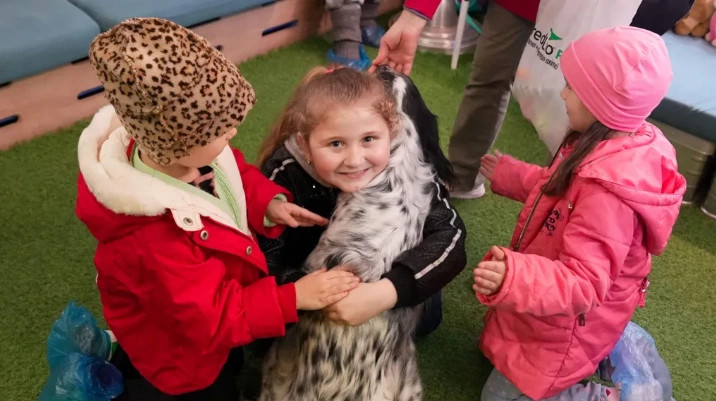
Anya tries to overcome her loneliness by taking the girl to many activities, including one with animals. This activity is held by UNICEF, down in the subway for security reasons.
Throwing the ball to the dog named Petra, Angelina's face comes back to life and she starts laughing.
But when evening falls in her house, the lights don't turn on anymore. Russia has been targeting energy supplies.
So Angelina lights a candle, carefully, and her small body casts a large shadow inside their apartment. "This happens all the time," she says of the blackout.
Like Lera and Daniel, Angelina is adapting to the war in the best possible way.
But across the country, there is growing demand for support.
"We tell the children that it's okay to feel whatever they feel," explains Kateryna Bazyli.
also Ukrainian women's accounts of sexual violence by Russian soldiers
“We tell them we can help you control these emotions so they don't destroy everything around them. Or themselves".
"When I think about whether there is enough help for everyone...", she thinks. "To be honest, we have a long queue."

