


-
By:
The Guardian

-
Translated by: Blerta Haxhiu

- 14 May 2025 07:20
- Share to:
A Russian drone attack has caused significant damage to the Chernobyl nuclear power plant, endangering the structure that covers the reactor destroyed after the 1986 disaster. The Shahed drone blew a hole in the containment building, causing a fire and other damage that could require expensive and lengthy repairs, only possible with international funding. Although the attack did not cause an immediate radiological hazard, the long-term consequences could be serious, including the risk of corrosion and the spread of radioactive dust.
A Russian Shahed drone, which costs around £75.000, is estimated to have caused tens of millions of dollars worth of damage to the Chernobyl nuclear power plant, according to initial estimates and engineering experts.
The cost of a full repair is likely to be borne by Western governments, including the UK, because initial estimates are that a full repair will cost more than the 25 million euros available in a special international emergency fund.
The attack in mid-February did not cause an immediate radiological hazard, but it significantly damaged the €1.5 billion structure built in 2017 to encase the destroyed reactor and is likely to take months, if not years, to fully repair.
The 110-meter-high steel structure at Chernobyl was hit before 2 a.m. on February 14, with sensors registering “something like a magnitude 6 to 7 earthquake,” according to Serhiy Bokov, the chief engineer on duty. “But we clearly understood that it was not an earthquake,” he said.
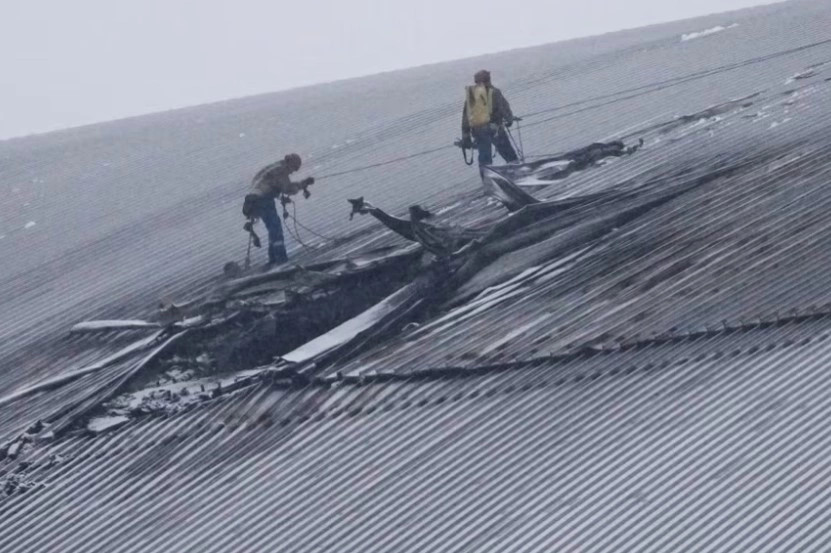
The attack – which was quickly concluded to have been caused by a drone flying low at a level where it could not be detected even by radar – tore a 15-square-meter hole in the outer roof. It also caused a large, complex fire that burned through the structure’s inner envelope, which took more than two weeks to extinguish.
also Chernobyl's bombed-out shield is no longer blocking radiation
Composed of two double arches and longer than two giant airplanes, the New Safe Confinement (NSC) was completed in 2017 to secure the hastily built and unstable Soviet-era sarcophagus that covers Chernobyl's ill-fated reactor number four, the site of the world's worst nuclear disaster in April 1986.
Funds for the structure
But the February attack has again exposed the sarcophagus to the elements, meaning radioactive dust could leak out and rainwater could enter, although the country's Ministry of Environmental Protection says the radiation background is currently within normal levels and is under constant control.
More importantly, the insulation structure is now more susceptible in the long term to rust due to greater exposure to the elements and damage.
“Failing to fix it is not an option,” said Eric Schmieman, an American engineer who worked on the design and construction of the Chernobyl shelter for 15 years. A full overhaul, he says, would “cost at least tens of millions of dollars and could easily run into the hundreds of millions” with repairs taking “months to years.”
“Previously, the shelter was supposed to have a 100-year design life, allowing time to dismantle the sarcophagus and the nuclear waste below, but that is now in doubt without repair,” Schmieman added. Unlike other large metal structures, such as the Eiffel Tower, it was never possible to repaint it to prevent corrosion.
Beneath the sarcophagus lies a highly radioactive lava-like mass, a mixture of 200 tons of uranium from Chernobyl's number four reactor and 5.000 tons of sand, lead, and boric acid dropped on the site by Soviet helicopters immediately after the disaster caused by the reactor's out-of-control operation.
A more detailed impact assessment is expected to be published in May, but the European Bank for Reconstruction and Development (EBRD), which financed the construction of the shelter and is involved in the post-bombing analysis, has announced that it is clear that the attack caused significant damage.
Other sources familiar with the assessment exercise told The Guardian that Schmieman’s estimates appeared to be accurate. Although the EBRD holds €25 million in funds to allow for emergency work, it said much more funding was required to address the long-term challenges caused by the incident.
 Ukraine accuses Russia of drones and missiles near Chernobyl nuclear power plant
A similar calculation was made by the Ministry of Environmental Protection of Ukraine. “It is likely that the elimination of the consequences of Russian aggression will require more funds than are currently available in the Chernobyl International Cooperation Account (the EBRD’s €25 million fund),” the Ministry announced in a statement.
Blame shifting
When the attack occurred in February, Moscow blamed Ukraine. Russian Foreign Ministry spokeswoman Maria Zakharova said the incident was a “premeditated provocation by the Kiev regime.” However, Ukrainian prosecutors believe, after examining the drone’s trajectory from the north, that the attack was “probably intentional” by Russian forces and a possible war crime.
Shaun Burnie, senior nuclear specialist at Greenpeace Ukraine, said he believes the attack will have consequences lasting for decades and that it happened because "Putin and the Russian state have committed a deliberate form of nuclear terror against Ukraine and Europe" that has "gone unpunished."
More likely, further funds for repairs will come from Western governments. Twenty-six countries contributed to the cost of the current shelter, including the US, UK, France, Germany and even Russia - the huge steel arch structure cost €1.5 billion out of a total fund of €2.1 billion. Others also made donations, including Turkey.
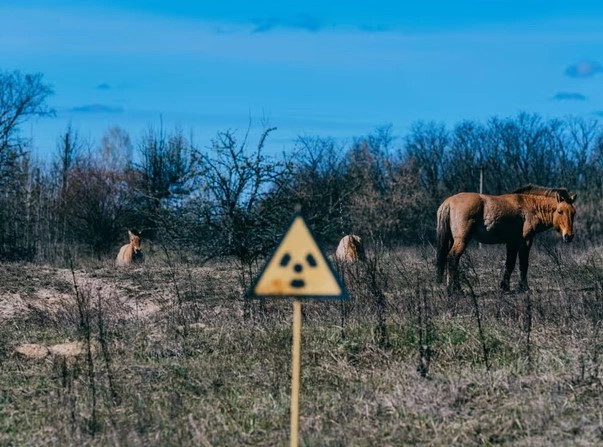
The site of the remains of a nuclear reactor that went out of control and exploded in April 1986, the Chernobyl site is seven miles from the border with Russia's ally Belarus. It was occupied by Russian soldiers trying to capture Kiev in February 2022 and has remained on the front line since Ukraine retook it in April of that year. Two people were killed in the 1986 disaster and 28 others died from radiation in the immediate aftermath, while 350.000 were evacuated from surrounding towns. Two exclusion zones remain in place, one 18 miles from the plant, where a small number of people live and work, and the second 6 miles away, including the ghost town of Pripyat, a relic from the Soviet era.
Tourists were allowed to visit until the full Russian occupation, but now the site is in a military border zone, complicating decontamination efforts. Russian soldiers dug up contaminated soil while building trenches within sight of the reactor shelter, while Ukrainian soldiers hauled in sand to build their own fortifications.
Debris recovered from the scene led Ukrainian prosecutors to conclude that the damage was caused by a Shahed 136, an Iranian-designed delta-wing drone that has become Russia’s most widely used long-range strike weapon. Now manufactured in Russia, their cost of $50,000 to $100,000 is far less than the amount of damage caused.
Ukrainian officials say the first step will be to “develop and implement” a temporary closure of the hole in the shelter, although Schmieman warns that “one thing that is not clear from a distance is that as you go up into the shelter facility, the radiation dose gets higher.”
A radical option for a complete overhaul, perhaps only feasible in peacetime, would be to rebuild the shelter back along a set of tracks it was originally built on 180 meters away, to reduce radiation exposure for workers. But that would be a “multi-year project,” Schmieman estimated.
 Russian drone strikes Chernobyl nuclear power plant
"The remote-controlled cranes hanging from the containment building were intended to dismantle the sarcophagus and the nuclear material below, and the attack hit a point near the maintenance garage," Bokov said. This too could undermine plans for the gradual dismantling of the site.
"We designed this building for many contingencies, but not for war," Schmieman said. "Although most nuclear power plants are designed to survive a plane crashing into them, we didn't do that because after the accident in 1986 there was a no-fly zone over Chernobyl. We thought nothing would fly over us," he added.

