


At least 3 people have been killed since the war began, Sudan's health authorities said. About 2.6 million people are now internally displaced, while more than 750 have crossed into neighboring countries, figures from the International Organization for Migration have shown. Save the Children has reported "alarming numbers" of raped teenage girls, who in some cases were even younger than 12 years old.
There have been 100 days of fighting in Sudan and the conflict has claimed an appalling number of lives lost, reigniting ethnic violence and fueling fears it could produce wider destabilization in the region.
On April 15, the rivalry between the army and the paramilitary Rapid Support Force (RSF) turned into war, turning Khartoum and the wider capital into a bloody battlefield. Since then, fighting has spread to the conflict-torn Darfur region, as well as parts of Kordofan and Blue Nile states.
A flurry of diplomatic initiatives to stop the war have failed to produce any concrete results as the rival sides are locked in a battle for survival — one they both feel they can win outright without having to engage in meaningful negotiations, analysts say.
What initiatives have been tried so far?
In May, the two warring sides agreed to send negotiating teams to Jeddah, Saudi Arabia, to begin talks brokered by Riyadh and Washington. At least 16 ceasefire agreements followed, but none of them have failed.
also New fighting in the Sudanese capital, Khartoum
Negotiations were suspended a month later, after the army withdrew its participation, accusing the RSF of a lack of commitment. As talks in Jeddah failed and fighting continued, the African Union (AU) unveiled its own plan. It included the initiation of a political dialogue between the country's military, civilian and social actors not only to resolve the ongoing conflict, but also to establish constitutional arrangements for a transition period and the formation of a civilian government.
Unlike the Jeddah talks, the AU summit was attended by members of a civilian power-sharing coalition with the military before General Abdel Fattah al-Burhan and General Mohamed Hamdan Dagalo, also known as "Hemedti", orchestrated a coup in 2021, ending the country's fragile transition to democracy. But despite meeting three times – the last meeting was on June 1 – and issuing wide-ranging statements, the summit has yet to yield any meaningful results.
Then came the negotiating effort of the Intergovernmental Authority on Development (IGAD).
The regional body, made up of eight countries around the Horn of Africa, set up a committee of four, including Kenya, Ethiopia, Djibouti and South Sudan, to address the Sudanese crisis. But an IGAD meeting on July 10 was boycotted by the military delegation, which accused the quartet's main sponsor, Kenya, of lacking impartiality.
Instead, the Sudanese military hosted a July 13 summit in the Egyptian capital, Cairo, chaired by President Abdel Fattah el-Sisi, with whom Sudanese general al-Burhan enjoys close ties. The meeting was attended by the leaders of the seven neighboring countries of Sudan together with the secretary general of the Arab League and the chairman of the African Union Commission (AUC).
The Egyptian president outlined an initiative to establish a lasting ceasefire, set up humanitarian corridors for humanitarian aid and build a dialogue framework that would include all Sudanese political parties.
The participants at the round table agreed to form a ministerial mechanism composed of the foreign ministers of the seven countries to resolve the ongoing conflict. The plan was praised by the army and the RSF.
Too little cooperation, too much competition
Organizing various diplomatic initiatives is not helpful for a solution, experts have warned.
"There is a major failure of diplomacy here. We see a lot of competition and very little cooperation," said Alan Boswell, coordinator of the International Crisis Group's Horn of Africa project. "Diplomacy hasn't been there and that's because it's not high enough on the agenda, especially for the US," Boswelli said, noting that Washington has not done enough in its traditional coordinating role.
Divisions between regional actors that could put pressure on the two warring parties to reach a ceasefire agreement constitute another obstacle.
The United Arab Emirates has not been directly involved in any roundtable, and its fierce rivalry with Saudi Arabia could be a barrier to involvement in any process.
"The existing tensions are probably proving too much to bring everyone to the table," Boswell explained.
also UN: Over 100 people have fled Sudan since the fighting began
Despite the number of negotiations conducted, none of the warring parties is really interested in engaging in negotiations at this stage, said Kholood Khair, an expert on Sudan and founding director of Confluence Advisory.
"Both sides think they can win, and as long as both think they can win, they will continue to push militarily not only to have more negotiating power, but to win completely," Khair said.
Although both sides have shown interest in mediation efforts, they have not done so to find a solution but to buy time, gaining international legitimacy.
"We know that they have rearmed, so they are not seriously engaging in any mediation or in a way that suggests they want to be serious," Khair added.
Lack of legitimacy
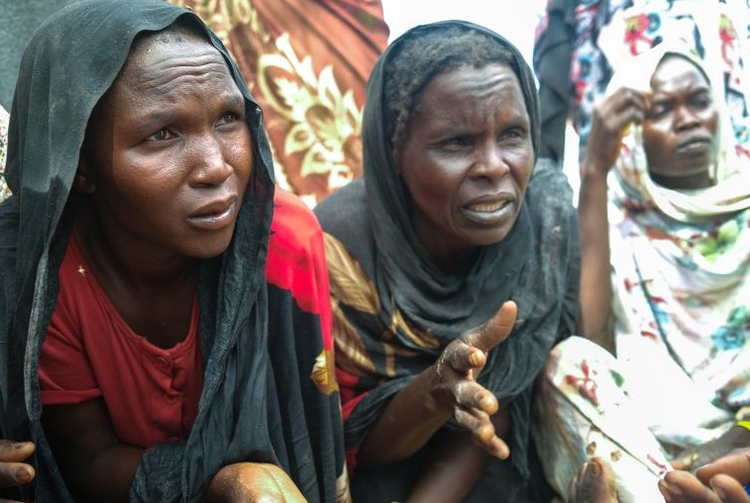
Civilians have been left in the middle of the conflict.
Since the start of the war, at least 3 people have been killed, Sudanese health authorities have said. About 2.6 million people are now internally displaced while more than 750 have crossed into neighboring countries, figures from the International Organization for Migration have shown.
"Save the Children" has reported on "alarming numbers" of raped teenage girls, who in some cases were even younger than 12 years old.
In Darfur, where the conflict has taken another dimension by pitting Arab communities against members of the non-Arab Masalit tribe, a growing body of evidence and extant documents describe increased attacks and ethnic cleansing carried out by Arab fighters, along with members of the RSF, which has denied such accusations.
Fighting in Sudan's western region has rekindled fears of a repeat of the atrocities that took place in 2003, when more than 300 people were killed.
The UN human rights office has announced that it has credible information that the RSF was behind the killing of 87 people whose bodies were found in a mass grave near El-Geneina, the capital of West Darfur.
While the RSF has a military advantage in areas where there is active fighting – particularly in Khartoum and Darfur – there is ample evidence that its troops loot homes, residential areas and commit sexual violence, causing the group to lose legitimacy.
On the other hand, the army has shown that it is unable to fight against the RSF, as it relies more and more on allies of the former regime of Omar al-Bashir.
also Sudan's military says it is extending the ceasefire, but fighting continues
"No party has the legitimacy to rule Sudan, but we can't remove them from there either," Boswell emphasized. "We should see this as a two-step process: negotiations to end the conflict, which should then move into a broader political process."
Translated by: Blerta Haxhiu

