


-
By:
Majlinda Ibrahimi

- 10 January 2023 15:46
- Share to:
On the outskirts of the capital, in one of its highest areas, known as "Film City", KFOR pilots start their routine helicopter patrols in different parts, to supervise and eventually to record situations, that may endanger safety. At the same time, the members of the NATO force in Kosovo visit the deepest regions by land to communicate with the citizens and maintain the relationship of trust conceived since 1998.
Pristina, Mitrovica, December – NATO's peacekeeping mission in Kosovo, KFOR, takes less than ten minutes to arrive in northern Kosovo from its central base in Pristina. Of course, by helicopter.
On the outskirts of the capital, in one of its highest areas, known as "Film City", KFOR pilots start their routine helicopter patrols in different parts, to supervise and eventually document situations that can lead to the destabilization of the situation in the country.
The situation in the northern municipalities during the month of December was tense as a result of political developments that resulted in the placement of barricades along the roads that connect the north of Kosovo with the rest of it.
This situation is followed with vigilance by the forces of KFOR, which since the post-war protect Kosovo within its borders.
Flight of a few minutes
also KFOR conducts helicopter exercises in Pristina to increase operational readiness
In one of the days of the middle school, the TIME team had the opportunity to accompany these patrols by becoming part of them.
From the morning until after noon, the three Swiss pilots directed the helicopters in the low air area of Kosovo. The 10 seats of the helicopter are often not completely filled with NATO members, and the Swiss unit is the only air force within KFOR that currently allows civilians in the crew to see their work up close.
On a warm day in Pristina, the three Swiss pilots joined some Italian members, and the team of the KOHA group, to travel to the northern part as well. Mitrovica, Lake Ujman and Peja were the planned destinations, which the pilots referred to as "Mitrovica, Gazivoda, and Peć".
After putting gloves on their hands and helmets on their heads, the pilots enter the cockpit of the helicopter, while one of them stays behind with the crew to open and close the door whenever he needs to film. The door stays open almost all the time, because there was no view from the height that did not seem interesting to people who always have the perspective from the ground.
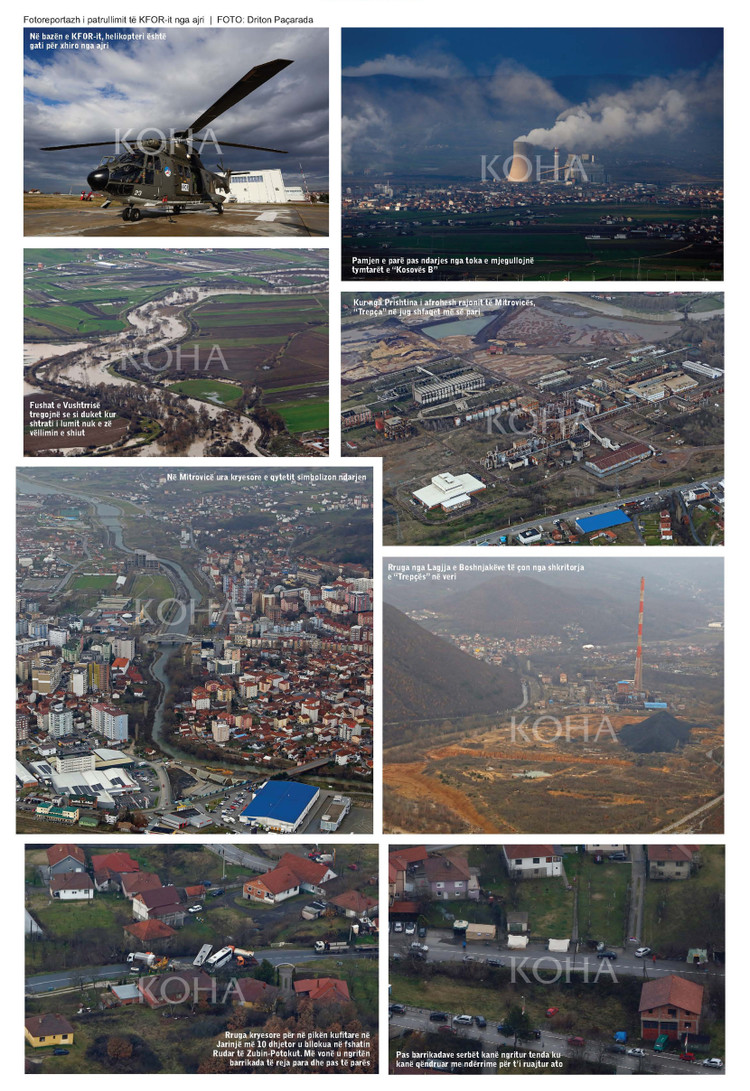
It doesn't take long when flying and passing through busy roads to change the appearance and therefore the reality on the ground. The fields flooded by the previous night's water are shown in the Municipality of Vushtrri. After that comes Mitrovica, which was once known as the industrial "heart" of Kosovo and after the war became a symbol of division with all the irony of the big bridge that connects the two sides of the city.
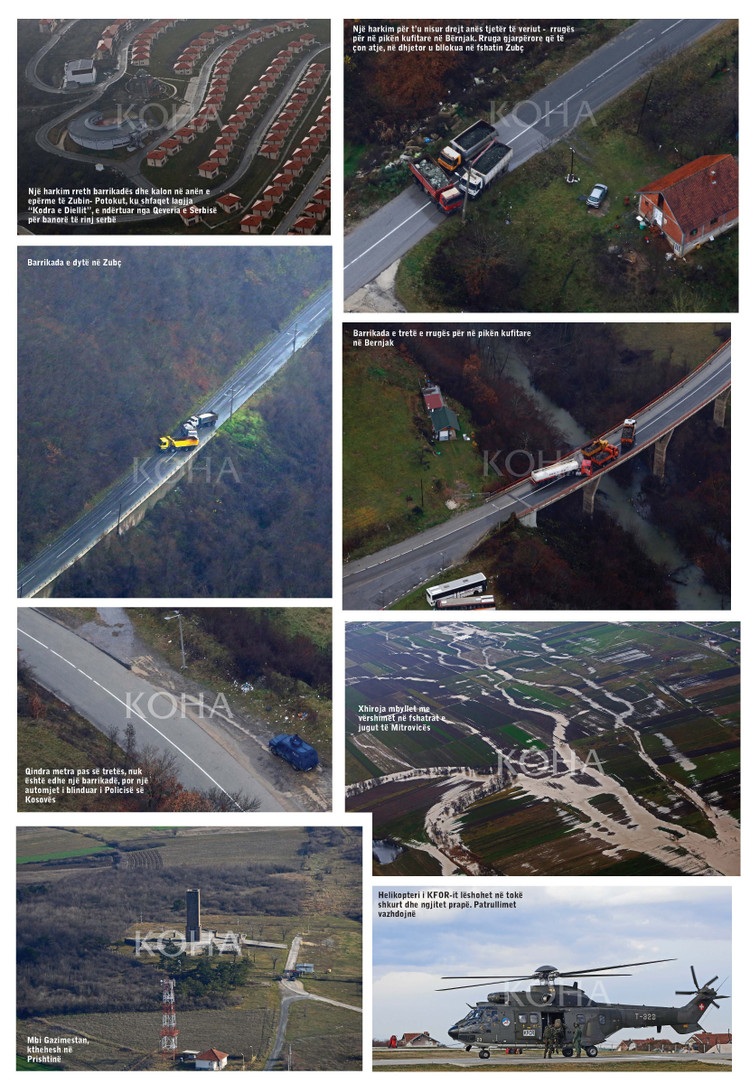
As soon as you cross the river and start the winding roads to the border points with Serbia, the barricades set up by the Serbs during the month of December also appear. The roads leading to the two border points Bërnjak and Jarinje are still blocked by large trucks guarded by organized Serbs in the tents erected nearby.
The beauty and importance of Ujman
The arches of the flight turn you towards a landscape that, in addition to the beauty it gives, also produces 30 megawatts of electricity, supplies water to several municipalities and plays a key role in the operation of heavy industry. It is Lake Ujman, 9.2 square kilometers of which are in the territory of Kosovo and 2.7 in that of Serbia. The tap of this artificial lake supplies seven municipalities south and north of the Ibër river, and in times of drought, the other two artificial lakes, Batllava and Badovci, are filled through Ujman.
It was the rain that ended the flight. The pilots regretfully announced that the trip to Peja cannot be completed due to weather conditions.
However, KFOR only sees from above.
KFOR's eyes and ears on the ground
Every day, the soldiers of this force go out by car through the deepest regions and villages and all the municipalities of Kosovo, as part of the Liaison Monitoring Teams (LMT). For pensioner Hetem Kupina, the logo they carry on their uniforms and on the cars they travel with means liberation. Every time he meets with the Liaison Monitoring Teams, he remembers the day when, after NATO's intervention, he was allowed to return from Canada to his hometown, in the village of Bardhosh in the Municipality of Pristina.
Now he is the head of the Security Council for the villages of Pristina, where he has many meetings with members of KFOR. At least once a month, he hosts them in a room of the Local Community in Bardhosh, which he heated on a December day with a small electric device.
He speaks with pride about the harmony of the residents regardless of the ethnicity that prevails in this part, and attributes the merits to KFOR.
also KFOR soldiers conduct air missions over northern Kosovo
"We have said with conviction that where there is no freedom of movement, freedom of action, freedom to live and work, there is no life, that's what we think and that's what we believe," he said.
Liaison monitoring teams, considered the "eyes and ears of the KFOR commander", collaborate with security councils to identify any potential tension or danger between communities.
The Security Council of the 17 villages of Pristina, which operates with an office in Bardhosh, since August, Lieutenant Alessandro Marino together with his colleagues regularly visit to analyze the cooperation.
Since taking office, he has never noticed tensions between Albanians and Serbs in this area. "This is an example of how it should be across the country. The special focus for us is that the population cooperates with each other and not with KFOR, this makes us happy. We are witnesses that this is happening in this area", Lieutenant Marino said.
Gratitude of the citizens
He qualifies monitoring in Kosovo as an easy job, as he believes that Albanians and Italians, especially those from Sicily, which is his origin, have similar behavior.
In January, his mission in Kosovo was completed, the feeling of appreciation and gratitude are the impressions he says he will keep as memories all his life. The citizens' interest in taking pictures impressed him.
"You will be surprised when I say that young people and even children greet us and often hug us. I think this is more because their parents and grandparents have told them about us. But their love for us is indescribable", Lieutenant Marino said.
His statement was immediately confirmed, as he left the office after the meeting with the Security Council, where two children who were standing nearby happily approached the members to greet them. The children attending the lower cycle were struggling to express their speaking skills in English. The uniform of members of the peacekeeping mission associated one of the boys with the work of local security units.
"My aunt works as a policeman in the north, my father also works in the Police here", the boy told the Italian soldiers.
KFOR members politely ask the boy if he wants to be like his father and uncle, but he does not answer them.
Their walk in the streets of the village of Bardhosh was greeted with enthusiasm even by the elderly, who did not hesitate to talk to them, despite the language barrier.
Zejnullah Krasniqi was happy to ask the soldiers if they have adapted to being away from their families. "We are grateful for the work you do, since you have left your families to take care of us. I know the feeling when you don't have family members close to you, as my sons have gone astray", said Krasniqi, who insisted that the translator tell them how grateful Albanians are for their contribution.
also KFOR conducts rapid air evacuation training in Pristina
While waiting for the bus to go to the capital, Krasniqi told them how painful it will be if one day KFOR leaves Kosovo.
"I don't believe that I will experience it, but if I reach that day, I know that I will cry", he said.

