


The responsible institutions have announced supervision of the implementation of the decision, while they have admitted that the cleaning and physical security sectors remain problematic for the implementation of this Government decision. And the Private Sector Workers' Union has said that they are skeptical about the implementation of this decision by companies that have contractual relations with state institutions.
Ilirjana Thaqi
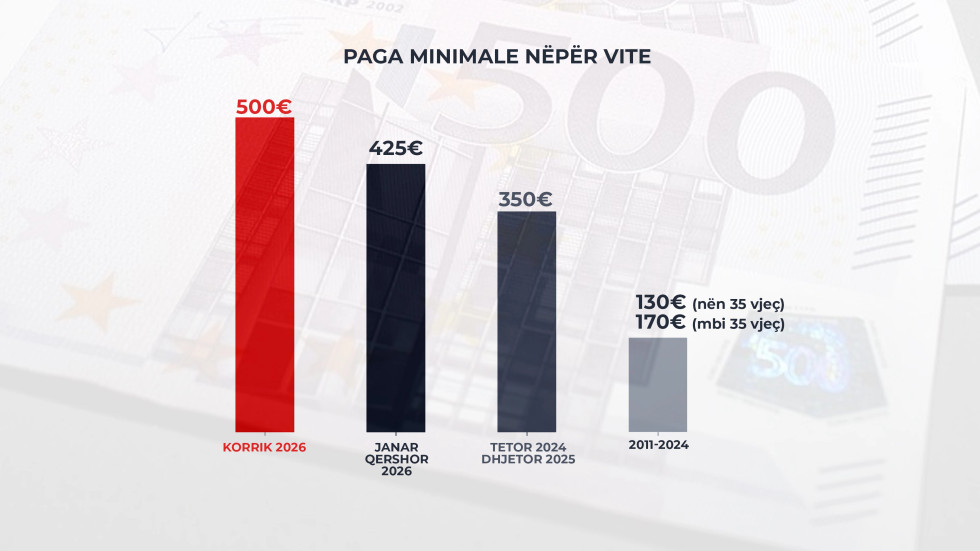
From Wednesday, the minimum wage in Kosovo will increase to 500 euros gross.
This is the second phase of the implementation of the Government's decision, after the increase to 425 euros on January 1 of this year.
The President of the Private Sector Workers' Union, Jusuf Azemi, has expressed skepticism about whether the minimum wage will be respected in companies that have contractual relationships with state institutions.
"The salary in the private sector, where there are direct owners of companies, if there is no one in between, is implemented. But the minimum wage, which is 425 euros, is not being implemented either, only in those companies that have contractual relations with state and municipal institutions. We have many companies that have not implemented the minimum wage," said Azemi.
Even the Central Labor Inspectorate has acknowledged that the sectors at risk of not implementing this decision are: cleaning and physical security, but if this happens, they have warned of measures.
"Businesses that do not respect the minimum wage decision, according to the inspection procedure, when this situation is found, a misdemeanor procedure will be initiated. The sectors that pose the highest risk in implementing the decision are the cleaning and physical security sectors, where inspections have also been carried out based on risk," the Central Labor Inspectorate's response states.
And citizens have different opinions about increasing the minimum wage.
"It's not enough for a worker. 500 euros, what expenses, what an expensive life. 500 euros with a night in the building all day, it's not enough," said citizen Sali Brahimi.
Even Atdhe Geci has called it insufficient.
"According to the price increase, salaries are low, at least by 200 euros. I believe 700 euros would be enough," he said.
According to a GAP report from 2011 to 2023, the gross minimum wage in Kosovo was unchanged for a 12-year period.
During this time, for workers under the age of 35 the minimum gross wage was 130 euros, while for those over 35 it was 170 euros.
According to the report, this age-based difference was eliminated in 2023, when the minimum wage was unified at 264 euros gross for all workers.
Since 2023, the minimum wage has been increasing continuously.
In 2024, it increased to 350 euros gross, to continue increasing on January 1, 2026, and now on July 1, 2026, to 500 euros gross.
Kurti: 150 thousand private sector workers benefited from the minimum wage increase

Photo: Archive
Photo: Driton Paçarada
Acting Prime Minister Albin Kurti has said that 150 private sector workers will benefit from the increase in the minimum wage.
Through a status on his Facebook profile, he wrote that during his government, the minimum wage increased three times.
"The minimum wage in our country remained unchanged for more than 10 years. 2011 was the last year when it was changed. Since then, it has remained 130 and 170 euros respectively (depending on whether you are under or over 35 years old). Meanwhile, during our government it was raised four times: from 130 and 170 euros to 250 euros, then to 350 and finally to 425 euros. And today the minimum wage has become 500 euros. About 150 thousand private sector workers will benefit from this increase. So, for more than a decade before our government, the minimum wage was low and unchangeable. Meanwhile, for less than half a decade with us, we have tripled the minimum wage," he wrote.